
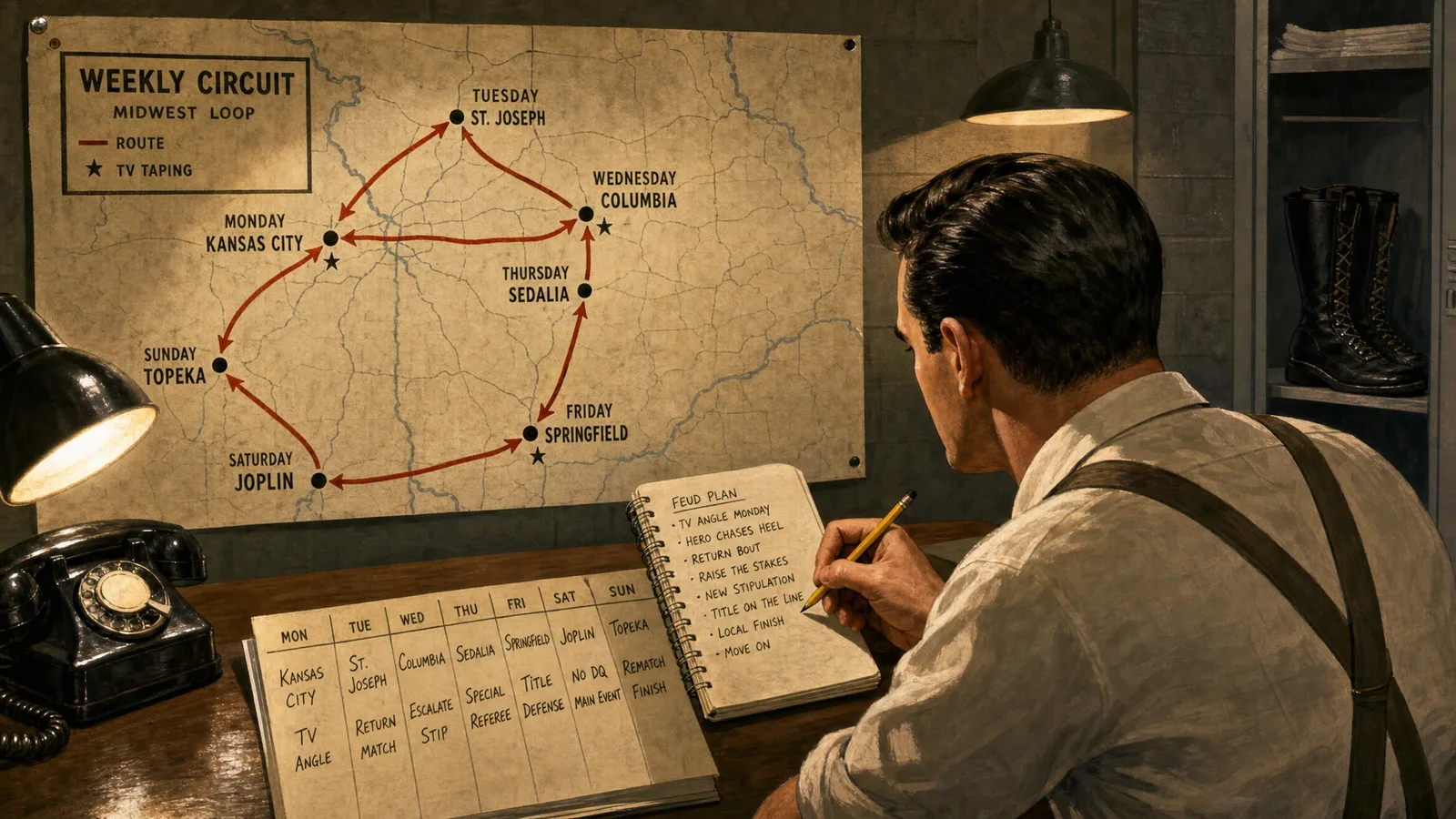
Start with a route, not a single famous card
A territory loop is easiest to understand as a pattern of repeated local stops rather than a single master card copied everywhere. The Heart of America Sports Attractions study covers Central States activity from 1971 through 1973 and draws on records for more than 1,000 house shows. That breadth matters because it lets a reader compare markets, dates and recurring venues instead of assuming that one memorable poster, television clip or reported main event represented the whole circuit. The useful question is not simply who wrestled whom, but where that pairing appeared, how often that town was used, and what happened when the promotion returned.
The Central States project records each market’s principal cities, venues and frequency of use. Those details provide a practical standard for identifying a recurring town night: look for repeated use in the surviving schedule rather than relying on a general recollection that a promotion “always” ran somewhere. The same project’s roster timelines track regular workers, usual card placement, major feuds and title reigns. Used together, route data and role timelines can show whether a performer was a continuing part of a market’s presentation or only a short-term visitor.
Administrative documents can strengthen that reading. For Kansas cards, the Central States author cites surviving Kansas Athletic Commission records that include attendance and gate information. Such records do not narrate every storyline, but they place a card in a documented local context and demonstrate that reconstruction need not rest entirely on memories. A careful viewer or researcher can separate three questions: whether a show was held, whether a town was used regularly, and whether the advertised program continued a particular local issue. Each requires evidence of a different kind.
Television could speak locally while traveling regionally
Central States television reached nine markets across most of Kansas, Missouri and Iowa, with coverage extending into part of western Illinois. The study identifies separate weekly tapings in Kansas City and St. Joseph, Missouri, but it does not assume that every television market had its own production. Some markets may have had separate tapings, while others aired a show first broadcast elsewhere. That distinction prevents an overly neat map: a broadcast footprint and a taping location were not necessarily the same thing.
The practice later called bicycling helps explain how one program could serve several places. A television tape could move from one market to another after its initial airing, while local interview material could be replaced before the tape reached the next city. The same basic program could therefore advertise a different upcoming local date. This is a concrete production mechanism, not merely a vague claim that wrestling television was “local”: circulating footage and replaceable promotion could work together in the same broadcast package.
For fans trying to read an old episode, the implication is straightforward. An interview promoting a specific town may be highly local even if other material on the program also appeared elsewhere. The Central States account says this arrangement could make an angle feel immediate and town-specific across several markets. Portland offers a comparable description: a weekly show first aired in the home city and was supplemented with localized interview segments for stops on the touring circuit. The local plug is therefore worth treating as evidence of planned geography, not as disposable filler around the match footage.
A shared feud did not require identical town outcomes
The Central States source describes promoters as able to run different angles, storylines or narratives in different markets because fans in one town often had little knowledge of what was happening in another. This means a feud should not automatically be imagined as a single sequence experienced in the same order by every audience. A pairing could be recognizable across the territory while its local chapter remained distinct. When comparing cards, the key task is to trace each market’s own chain of advertisements, results and return dates before declaring that two towns saw the same program.
That market-by-market approach also changes how a disputed or non-decisive result can be read. In the Central States account, a non-decisive main-event finish in one city could establish a rematch in that city. It did not automatically require the same ending or sequel throughout the territory. The result is best viewed as a local piece of unfinished business when the next card in the same market supplies the continuation. Without that local follow-up, it is safer to describe the finish than to assume an extended plan.
The opposite approach was available as well. The study says that in a weaker market, promoters could use a decisive ending, stop running that main event and attempt another attraction on the next visit. It explicitly notes that a feud could have different endings in different towns, including one wrestler winning a blowoff in one market while the opponent won elsewhere. That is a useful warning against treating a single result sheet as the universal final chapter of a rivalry.
Return bouts were tied to the local finish
Stipulations in the Central States account were connected to what had happened in the preceding finish in that particular market. Recorded examples include no-disqualification rules, lumberjack matches and a manager being barred from ringside. The important point is not that every rematch had to become more elaborate. It is that the prior local result could supply a specific reason for changing the terms of the next meeting. A reader should look for that connection between the finish, the advertised restriction and the return date rather than assuming that a dramatic stipulation was automatically a territory-wide escalation.
This evidence offers a practical way to distinguish repetition from continuation on surviving cards. First, identify the preceding match in the same town. Next, note whether its finish left a clearly recorded issue unresolved. Then compare the advertised return: does the new match alter the rules, remove a manager, add lumberjacks or otherwise address what occurred locally? The Central States material supports that kind of town-specific comparison. It does not establish that every repeated pairing, every stipulation or every market followed one uniform formula.
The larger lesson is one of scale. A territory-wide rivalry and a town-level rematch could overlap without being identical. Television could keep names and conflicts visible across the region, while a local result and a local interview could frame the immediate reason to attend the next stop. That interpretation follows from the documented use of cycling tapes, replaceable interview segments, market-specific narratives and locally linked stipulations. It should not be stretched into a claim that all promotions used the same system or that every audience received the same degree of local tailoring.
Portland shows why the TV archive has gaps
Portland’s history places local television at the center of successful promotion by the end of the 1950s, principally as a way to draw paying customers to live events. It also shows that production could vary: territory broadcasts might be filmed at regular events or in a studio. Portland Wrestling aired weekly on KPTV on Saturday evenings from the early 1950s, later reaching the Pacific Northwest through syndication, with tapes sometimes sent as far as Alaska. These details demonstrate a durable regional broadcast presence, while leaving open the particular production arrangement used in every place and period.
Yet television survival is not the same as television completeness. Portland’s account says cycling tapes often returned to the home city and were recorded over with a new show, a cost-saving practice that helped produce a fragmentary surviving record. It estimates that a weekly territory might erase about 20 to 30 programs in a year after reruns and weeks off. The estimate concerns lost footage rather than a universal annual count, but it gives a clear reason not to treat the available episodes as a full record of what viewers once saw.
The Portland history adds a second caution: only a small fraction of live shows staged from 1950 to 1970 were filmed. Consequently, television alone cannot provide a complete account of a circuit’s booking. A missing television segment does not by itself settle whether a local angle was absent, and a surviving program does not substitute for schedules, cards, advertisements or administrative documents. Portland’s long-running broadcast, which remained on the air until December 1991, shows the value of a weekly public anchor; the limited survival of live and taped material shows why that anchor must be read alongside other records.
Not every stop had the same scale
A circuit’s route could include very different kinds of buildings. Smoky Mountain Wrestling’s oral history, a later early-1990s comparison rather than mid-century evidence, describes many shows in small towns, school gyms, recreation centers and community clubs. It also identifies a larger Knoxville Civic Center show as a major showcase. The comparison supports a modest but useful point: an interconnected regional circuit did not require every town to have equal venue size or presentation scale. It does not establish that the Central States or Portland circuits used the same venue hierarchy.
Smoky Mountain’s origin story also emphasizes infrastructure. In Jim Cornette’s recollection, the promotion first needed buildings, production resources and television stations. The oral history says it made two pilot television shows to sell the program to stations, and Cornette recalled Knoxville, Tri-Cities and eastern Kentucky outlets as the basis of the territory. As a later example, it is most useful for illustrating how venues, production and broadcast distribution could be considered together, not for replacing earlier evidence with a generalized story about all territory promotions.
Use later escalation carefully
Smoky Mountain’s oral history describes its storytelling as clear hero-versus-villain conflict, specifically as that promotion’s approach rather than a universal territory rule. It also gives an escalation example in which an Armstrong–Cornette conflict moved through a match, a cage attack, a return involving additional Armstrongs and a lumberjack match. This is a helpful later illustration of an issue acquiring new elements over time. It should remain a comparison: the Central States evidence independently documents local rematch stipulations, but does not supply this same sequence as a general template.
For a responsible fan reading, label the level of certainty. A dated card or commission record can establish a local event; recurring venue data can identify a repeated stop; a localized television interview can connect a broadcast to an upcoming town; and a preceding finish plus a new stipulation can document a local continuation. A broader claim about an entire territory needs patterns across many such items. The Central States study’s large house-show base and its city, venue and frequency records make that kind of comparison possible, while Portland’s fragmentary television record explains why no single surviving medium should carry the entire argument.
Questions that keep the weekly loop in focus
When examining a card, ask: Is this town a documented repeat stop? What was advertised or decided on the last visit here? Does a local television segment name the coming date? Has the advertised return changed the conditions in a way that matches the prior local finish? These questions direct attention to the available evidence instead of imposing a single linear version of a feud on every market. They are especially useful where Central States material indicates that stories, decisive conclusions and rematches could differ from town to town.
The most defensible picture is therefore a layered one. In the documented Central States example, a broad television reach, separate tapings, cycling tapes and replaceable local interviews could coexist with town-specific angles and outcomes. Portland confirms both the long-term importance of weekly local television and the serious limits created by erased tapes and incomplete filming. The later Smoky Mountain recollections show related regional logic persisting in a different period, but should not be used to flatten the distinctions among promotions. The route, the market and the surviving source all matter when deciding what a feud record actually shows.
Explore more
- History
- Closed-Circuit Wrestling and Early Pay-Per-View Access
- How wrestling claimed the weekly calendar

Darryl Polo
Darryl Polo is a passionate wrestling fan covering WWE, AEW, TNA and beyond. He loves great rivalries, breakout stars and the moments that keep fans talking long after the bell. How we work.