
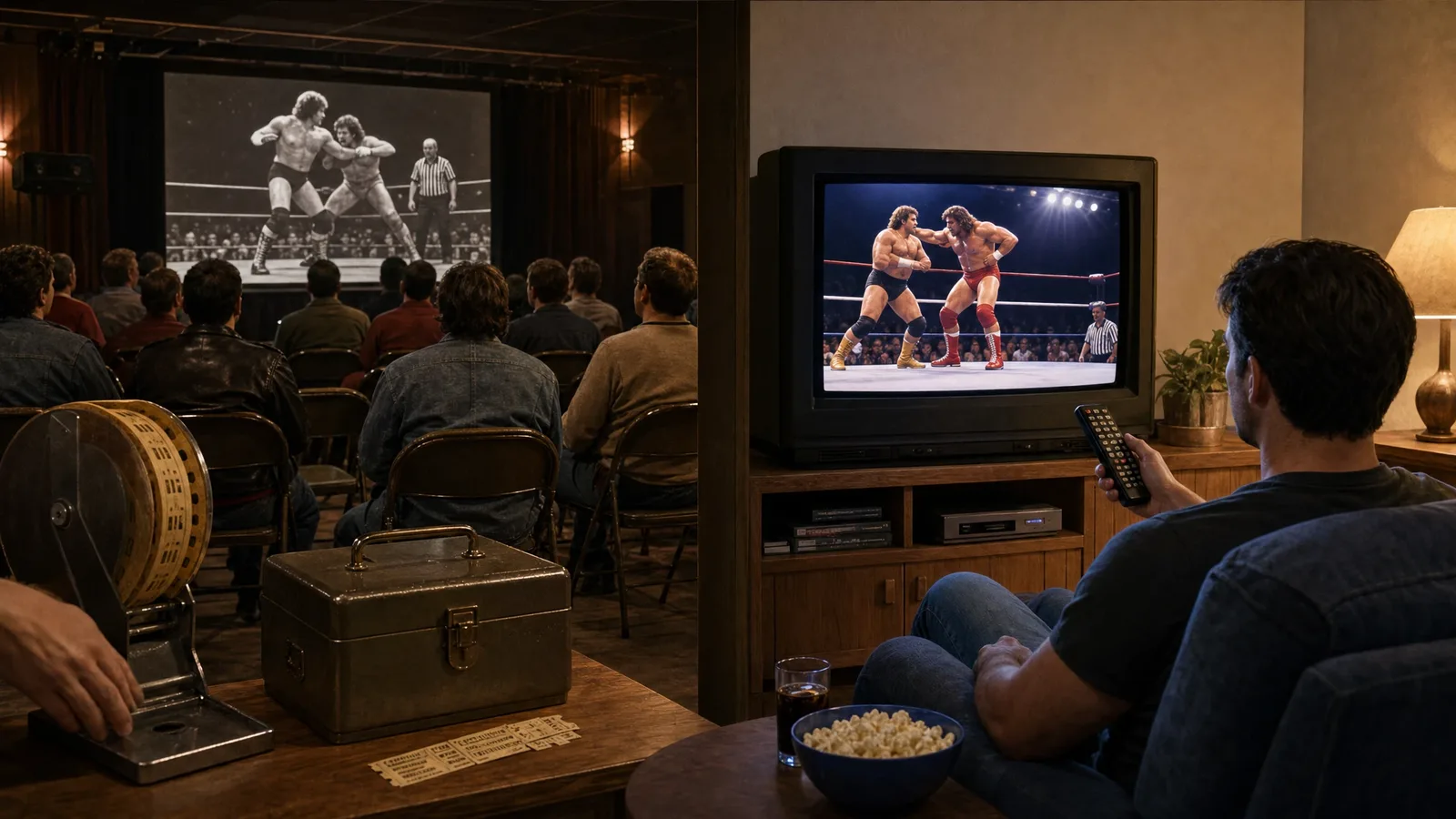
Closed circuit sold admission to a remote venue
Closed-circuit wrestling extended a major event beyond the building that hosted its principal matches, but it did not initially place that event in a viewer’s home. Fans bought admission to another theater or arena and watched a transmitted presentation there. That difference is essential when reading the period. Closed circuit created another public gathering around the same attraction: people still traveled to a venue, entered through its doors and watched alongside other ticket holders, even when the featured action occurred elsewhere. A screen was part of the night’s attraction, not simply an alternative to leaving home.
F4W dates an early pro-wrestling use of closed circuit to Los Angeles in 1971. Demand had exceeded what the Olympic Auditorium could hold, so broadcasts went to two or three large local movie theaters. The arrangement was geographically limited, and its stated purpose was to accommodate fans who could not enter the primary arena. That example is useful because it presents closed circuit as an overflow solution rather than as a national home-television service. The central transaction remained admission to a physical venue, while additional sites expanded access to one particular attraction.
A similar practical arrangement appears in F4W’s account of mid-1970s Madison Square Garden wrestling. When Garden cards sold out well in advance, the 4,000-seat Felt Forum, in the same complex, reportedly served as an overflow closed-circuit site. A viewer in that room was not seated in the building containing the ring, but was still attending an event at the larger destination. The example helps separate two questions that historical summaries can blur: where the match took place, and where the paying audience assembled to watch it.
Some remote tickets included local live wrestling
Closed circuit did not mean that every remote audience received only a screen presentation. F4W describes the 1976 Muhammad Ali–Antonio Inoki event as a North American closed-circuit presentation in which promoters paired the transmitted main attraction with live local undercard wrestling in San Francisco, Los Angeles, Houston, Atlanta, Chicago and New York. A remote ticket could therefore cover two forms of access: local wrestling seen in person and a marquee attraction seen by transmission. It is more accurate to describe this as a combined live-and-screen format than as an early equivalent of watching an event from a couch.
The 1976 presentation also cautions against treating a wide map of locations as proof of uniform success. F4W characterizes the experiment as a financial disappointment outside the Northeast. That reported outcome does not establish a rule for every market or every later event. It does show why the number of participating cities is only one part of the story. When examining a closed-circuit card, it is useful to ask what the local admission included, whether local wrestling accompanied the transmission, and whether the available account describes the response as strong, limited or uneven.
This combined format changes how a remote crowd should be understood. It was not necessarily watching a replacement for live wrestling; it could see local wrestlers in person and also watch the transmitted attraction as part of one program. Attendance at a remote site and attendance at the principal arena therefore describe different parts of the same event environment. Keeping those categories separate does not make either audience less real. It simply preserves what each ticket purchased: proximity to local action at one site, or a seat in the building where the principal matches happened.
Starrcade 1983 extended an event through public screenings
F4W reports that Starrcade 1983 was held at Greensboro Coliseum and transmitted to 17 locations in the Carolinas and Puerto Rico. The remote-location concept was explicitly tied to reducing the need for fans to drive to Greensboro for an event promoted as unusually important. This shows distribution changing the geography of attendance without ending the practice of going out. A fan could still treat the show as an outing while choosing a venue closer than the host arena. The remote site extended the event’s footprint, even though it did not reproduce every feature of being in Greensboro.
The reported Starrcade 1983 figures demonstrate why labels matter. F4W lists a 15,447 sellout at the primary venue and an additional reported closed-circuit audience of 30,000. Those are distinct measures: one describes the host building’s live gate, while the other describes audiences admitted to remote exhibitions. They can be discussed together as parts of the reported audience across locations, but remote viewers should not be relabeled as Greensboro attendees. When comparing historical events, first identify whether a figure counts people in the principal building, people in remote venues, or television purchases.
Remote exhibition still depended on people leaving home and traveling to a venue. F4W says poor weather affected Starrcade 1983’s closed-circuit business, underscoring that point. The Thanksgiving setting also belonged to an established Greensboro wrestling tradition before Starrcade, according to the account. Promoters believed families who had gathered earlier in the day would want an evening outing. That is best read as a period-specific promotional assumption attached to this local context, rather than as evidence that a holiday will always produce the same response for wrestling events.
The first WrestleMania retained the public-venue model
WWE says the first WrestleMania was shown on closed-circuit television at thousands of theaters and arenas around the United States. The scale is notable, but the form is equally important: the presentation remained centered on ticketed public locations. A network of theaters and arenas could make one event available far beyond its main building while preserving the social routine of attending a venue. In this arrangement, access expanded through more local doors, seats and gathering places rather than chiefly through an individual purchase for home viewing.
The closed-circuit model helps explain why an event’s reach cannot be reduced to the capacity of its principal arena. A theater or arena carrying the transmitted show was an additional place where admission could be sold, but it involved a different viewing position from a seat near the live ring. The first WrestleMania’s thousands of closed-circuit locations demonstrate the potential scale of that approach. For a reader, the useful question is not merely whether an event was televised, but where its audience was expected to assemble and whether the transaction was a venue ticket or a television purchase.
WrestleMania 2 documented a home pay-per-view option
WWE identifies WrestleMania 2 as the first WrestleMania available on pay-per-view television. That fact marks a clear difference from a chiefly venue-based closed-circuit presentation: a customer could purchase television access rather than buy admission to a theater or arena carrying the transmission. The source does not make that change a complete replacement for public viewing, nor does the existence of pay-per-view mean every audience had identical access. It establishes a new documented route to the event, one organized around television purchase rather than a seat at a remote exhibition venue.
WrestleMania 2 was staged from New York, Los Angeles and Chicago and used three main events. Its pay-per-view availability therefore coincided with a production that connected multiple live sites. That combination is a reminder that home access and multi-city live presentation are separate aspects of an event. One describes how some viewers could receive the program; the other describes where the show was being staged. Keeping those questions apart avoids a false choice between television and the arena. A single major event could include several live crowds while also being offered through pay-per-view television.
For fans studying this transition, WrestleMania 2 offers a focused comparison with the first WrestleMania. WWE describes the first event’s closed-circuit presentation at thousands of theaters and arenas, then identifies the second as the first WrestleMania available on pay-per-view television. Those statements document a change in available access paths without requiring a claim that one format immediately erased the other. The key contrast is transactional and geographic: remote closed circuit asked fans to buy entry to another public site, while pay-per-view made television purchase an available form of access.
Starrcade’s 1980s path was not a single switch
F4W says the 1985 and 1986 Starrcade editions used Greensboro and Atlanta as dual live sites, with matches alternating between the cities for closed-circuit audiences. This arrangement was more complicated than a single arena sending its main event to passive overflow rooms. Two live locations formed part of the event, while transmitted segments linked the audiences. It shows that closed circuit could be used to connect live sites as well as to extend one host building’s reach. The available examples support a varied picture of event design, not one fixed closed-circuit template.
For Starrcade 1987, F4W reports that Jim Crockett Promotions shifted the event to Chicago for its first pay-per-view presentation after prior closed-circuit editions. That sequence documents one promotion’s move from earlier closed-circuit arrangements to a pay-per-view presentation. It should not be generalized into a timetable for wrestling as a whole: the record here concerns this event and this promotion. Even so, set beside the dual-city editions, it provides a concrete way to see that distribution formats could change across successive versions of a major annual card.
The 1987 pay-per-view environment had constraints of its own. F4W says most cable systems then had only one pay-per-view channel, which made simultaneous competing events difficult to carry. After Survivor Series was scheduled for the same Thanksgiving night, Starrcade moved to the afternoon. This changed both channel competition and the time when customers were asked to watch or attend. The example keeps distribution history grounded in practical conditions: availability at home involved channel capacity, while a major-event plan could also be shaped by the schedule attached to that availability.
Buys and admissions are different historical measurements
F4W lists 350,000 pay-per-view buys for Survivor Series 1987, 16,500 for Starrcade 1987 and 41,000 Starrcade closed-circuit attendees. These figures should not be merged as though they count the same thing. A pay-per-view buy records a television purchase; closed-circuit attendance records admission to a public venue. Neither figure automatically states how many people sat in the principal arena. The comparison is valuable because it preserves those different units, showing why a historical claim about an event’s audience needs to specify whether it refers to purchases, remote admissions or host-venue attendance.
A practical reading method follows from those distinctions. First, locate the principal live site. Next, identify whether additional audiences were in theaters, arenas or homes. Then keep the measurement attached to its form of access: host-venue attendance, remote closed-circuit attendance or pay-per-view buys. Finally, look for qualifications such as weather, channel limits or scheduling conflicts. These questions do not supply a complete account of an event’s finances or reception, but they prevent a basic error: treating unlike numbers as proof that every viewer had the same experience or that every sale represented the same kind of access.
Home availability could be managed alongside the stadium gate
A pay-per-view option did not make the live gate irrelevant. In a first-person WWE retrospective, Michigan was excluded from WrestleMania III pay-per-view access because the company feared a partially empty Silverdome would make the event appear unsuccessful. The account presents this as a decision to prioritize filling the host stadium over making the event purchasable at home in that state. It is a specific example of territorial availability being managed in relation to a live presentation. Home television access and stadium attendance could be connected parts of one event plan.
The WrestleMania III restriction needs to remain narrowly framed. The same WWE account says the company did not black out an area again, so this should not be presented as a standing distribution rule. The stadium also required viewing technology for people already inside it: four giant color screens were suspended above the ring for spectators in a reported 93,173-person building. At that scale, even a live audience relied in part on mediated viewing to follow the action. Screens thus mattered both at remote sites and within the host venue, though they served different settings.
WWE reports WrestleMania III ticket sales reaching 50,000 by March 2, 74,000 by March 11 and 90,000 by the March 24 production meeting, before sales were stopped because of oversell concerns. Alongside the Michigan restriction, those reported details show live attendance and home availability being considered within the planning of one stadium event. They do not establish a universal formula for other promotions or cards. They support the narrower conclusion that early pay-per-view added a home-purchase route while major events could still be organized around the scale, presentation and ticketing of the live venue.
Explore more

Darryl Polo
Darryl Polo is a passionate wrestling fan covering WWE, AEW, TNA and beyond. He loves great rivalries, breakout stars and the moments that keep fans talking long after the bell. How we work.