
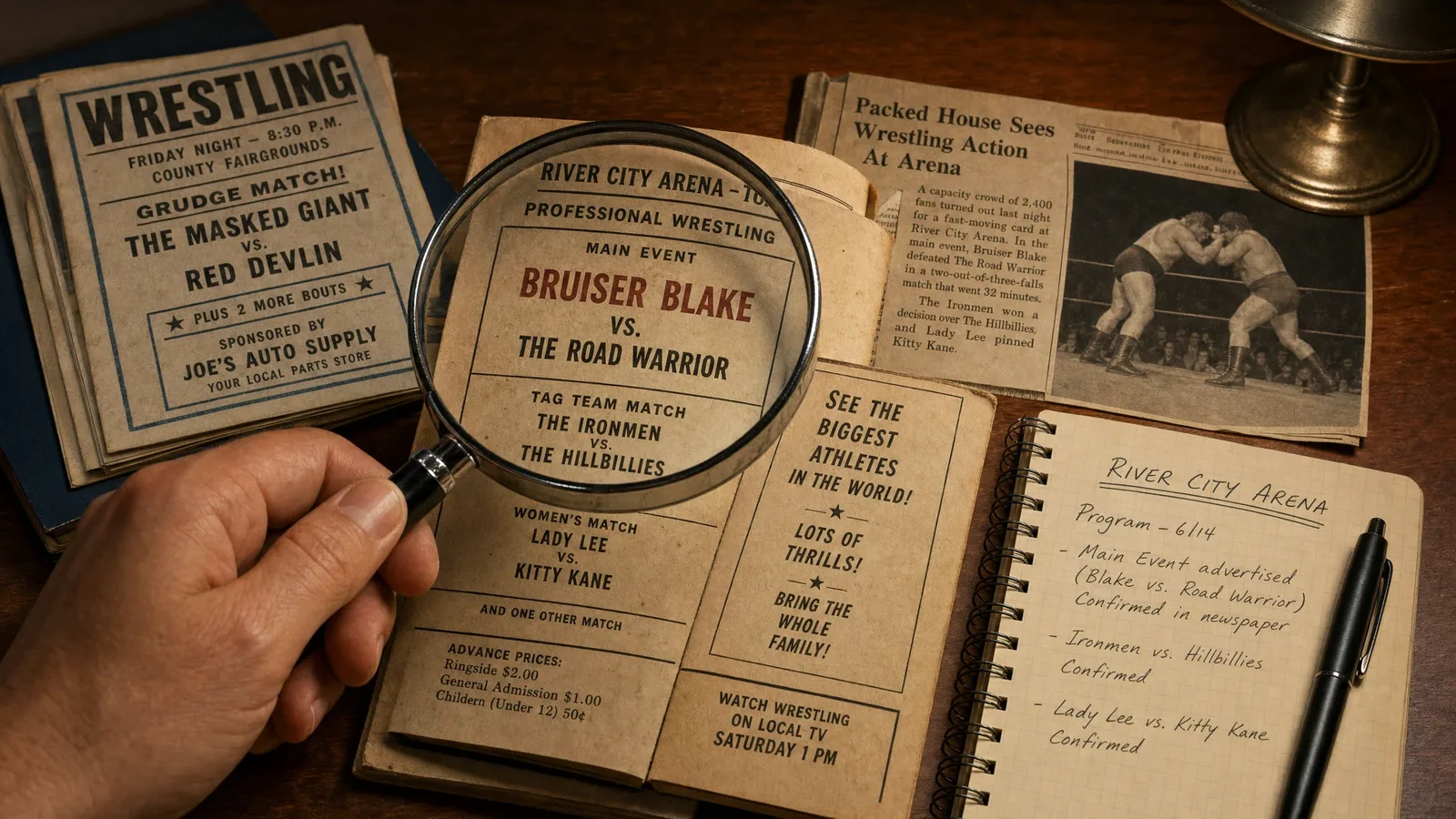
Start by identifying what the item records
An old wrestling program or handbill is strongest as evidence of a planned presentation. It can show which names were being promoted, how matches were framed, where the event was intended to happen and which local organizations appeared alongside the promotion. That is already a substantial historical record. It is not, by itself, a complete account of the bell-to-bell show. A useful first question is therefore simple: does this item describe an upcoming event, or does it report an event after it took place? Keeping that distinction visible prevents an appealing piece of printed ephemera from being asked to prove more than it can.
This distinction matters because a card can change between printing and showtime. Slam Wrestling’s examination of a Sandusky, Ohio card offers a clear case: Dale Wayne substituted for George Stanlee. The surviving account also leaves George Stanlee’s identity uncertain. Those details make a printed billing valuable without making it final. It preserves a name that was scheduled or advertised, while the result record supplies a different level of evidence about who actually appeared. For a reader, the practical habit is to label each claim rather than treating all names on a page as completed appearances.
A compact local artifact can still support careful research. Slam Wrestling identifies the Sandusky event as a September 13, 1950 show at the VFW Sports Arena, presented under the Terminal Athletic Club, described as the Toledo wrestling office. Its preserved three-match result list shows that a modest card can be investigated in detail when venue, promotion and result documentation can be read together. The lesson is not that every surviving program will yield a full reconstruction. It is that small-format material often gives researchers precise starting points for locating a fuller record.
Use a confirmation ladder for every name and match
A simple confirmation ladder makes old cards easier to read. Scheduled or advertised means the promotion publicly promised a participant or match. Substituted means a later record identifies a change. Listed in a post-show result means the person or match is reported as having occurred. These are not interchangeable descriptions, and preserving the wording avoids turning an advertisement into an unqualified result. When making notes, record the exact status beside each name. If two sources disagree, describe the difference rather than silently choosing the version that seems most familiar.
The Sandusky main event demonstrates why the result itself deserves separate attention. The reported outcome was a double disqualification involving Volga Boatman and the Bloody Demon, not a conventional victory for either wrestler. A program may prominently sell a main event while providing no outcome at all; a result source can add that missing piece. Conversely, an advertised match does not establish a finish simply because it was printed. Readers who separate card, occurrence and outcome can build a more accurate event timeline with fewer assumptions.
Memphis material provides another useful sequence. A March 13, 1978 clipping advertised Ron Slinker’s karate demonstration, while later newspaper-based entries tracked subsequent matches and reported attendances. Taken together, these records illustrate a sound method: use the advertisement to document what was promised, then seek dated result coverage for what was reported afterward. This is stronger than using either item alone for every question. It also gives each artifact its proper role instead of treating promotion and reportage as identical forms of evidence.
Read the language that sells the match
Promotional language is evidence, but it is evidence about presentation. A contemporary Sandusky Register preview reportedly said promoters moved the front row farther back because the advertised main-event wrestlers were being marketed as especially dangerous. That detail does not require a reader to decide whether the danger was literal. It shows the vocabulary through which the attraction was sold: menace, crowd safety, physical scale and villainous character framing. Notice which qualities are emphasized in headlines, captions and body copy, and ask what kind of encounter the language invites the audience to expect.
The wording and visual choices around a card can also reveal a promotion’s self-image. A 1972 Mid-South Coliseum program used King of Sports beneath its wrestling banner and pictured the Masked Interns as scheduled opponents for Jerry Jarrett and Jackie Fargo. A 1977 program, Action Ringside!, featured Jerry Lawler’s handwriting and artwork. These details document sales language, graphic design and the personalities foregrounded in those particular programs. They should not be stretched into claims about audience response, but they give fans concrete material for comparing how a promotion chose to present itself across items.
Treat venues and sponsors as part of the record
The match listings are only one layer of a program. In Slam Wrestling’s account of the Sandusky example, the VFW Sports Arena is described as a boxing and wrestling site, with the article identifying it as VFW Post 2529. The article further says promoters associated with Jack Pfefer commonly used relationships with Veterans of Foreign Wars posts or American Legion organizations to stage events. A venue line, lodge logo or sponsor credit can therefore point beyond the ring toward the local civic setting in which a card was placed. Record the organization exactly as printed before drawing any broader connection.
Sponsorship can make an otherwise spare piece of paper especially informative. Images of Mid-South Coliseum programs include a 1972 fifteen-cent program naming American Legion Post No. 1 and the Beale Street Elks as sponsors. Alongside the Sandusky evidence, that kind of credit can help reconstruct a promotion’s local business network rather than merely its advertised bouts. It is best used as a lead: compare sponsor names across programs, clippings and venue material, and distinguish an organization named on one item from a demonstrated ongoing relationship.
Local context also helps a reader avoid treating a building name as background decoration. The Sandusky card is tied to a particular arena and a particular wrestling office, while the Memphis research compilation is organized around thousands of Mid-South Coliseum matches. In both cases, a venue gives scattered material a useful organizing point. Grouping clippings and programs by location can reveal what survives around a site, but it does not automatically fill gaps in a specific show. A venue is a strong index for research, not a substitute for a dated card or result.
Search names as historical variables
Names on old cards require flexible searching. The Sandusky account identifies the Bloody Demon as Jack O’Brien and the Volga Boatman as Frank Ramey, while also noting variants of both character names. A single printed name may be a ring identity, an alternate spelling or a billing label rather than the only term under which material survives. Build a search list that includes the printed form, known character variants and any identity connection supplied by a reliable account. Then keep the forms distinct in your notes instead of assuming every variation refers to a different person.
The same caution applies to championships. The Sandusky article qualifies a claim connected to a Pfefer-associated world title because multiple splinters complicated recognition. That qualification is a valuable reminder that a title name on a program should be transcribed first and interpreted carefully afterward. Avoid flattening an older lineage into a single uncomplicated label merely because the wording resembles a better-known championship claim. Where the surviving account flags contested recognition, the most accurate description preserves that uncertainty rather than resolving it through guesswork.
Cross-check clippings without overlooking their limits
Newspaper work can add dates, results and context, but it has its own limits. John Clapp describes a Memphis compilation covering thousands of Mid-South Coliseum matches from 1970 through 1985, arranged week by week from the Memphis Press-Scimitar. The work relied on microfilm at the University of Memphis library, and Clapp noted that poor source-image quality was sometimes unavoidable. A clipping may be clear enough to establish a date or advertised card while remaining difficult to read for every number, name or line of copy. Mark uncertain readings as uncertain.
Numbers deserve particular restraint. The Memphis account treats win-loss records, title histories and attendance figures as useful historical material, but says their credibility depends on the reliability of the reporting source. It notes that some attendance figures were attributed to promoter Jerry Jarrett, meaning they may indicate trends without functioning as exact counts. The compilation compares a March 1983 card reported at 3,834 attendees with an August 1977 show reported at 11,103. Those figures can contextualize reported fluctuations; they should retain their source attribution and not become unsupported precision.
Use footage as corroboration, not a requirement
Surviving video is valuable because it can corroborate participants, venue presentation and the occurrence of a match. It is not the only route to confirmation. WWE’s 2013 archive report describes digitizing owned match material and organizing retrieval around identifiers including years, dates, venues and names. Those same categories make an effective search checklist for fans: begin with the event date and building, then try the billed names and their variants. A program supplies several useful identifiers even when it cannot independently prove every advertised match happened.
Footage is also shaped by preservation. WWE’s archive report says older tape formats can physically deteriorate and may require full-reel digitization when played. It says the library included WWE footage from about 1971 and material from other organizations reaching into the 1950s and 1960s, while acknowledging that some historically notable matches remain lost. Missing footage does not settle whether an advertised or reported match occurred. It may reflect preservation or archival gaps rather than provide a historical verdict on the event.
Build a transparent reading of the artifact
A careful fan description can be both useful and concise. Identify the item’s type, date if printed, venue, promotion or sponsoring organization, advertised matches, names and sales language. Then create separate fields for later result coverage, substitutions, attendance reports and surviving footage. For each field, state what kind of source supports it. This approach leaves room for uncertainty: a name may be unresolved, a title claim may be complicated, a clipping may be partly illegible and footage may not survive. What remains is not a diminished history, but a transparent account of what each artifact can genuinely tell us.
Explore more

Darryl Polo
Darryl Polo is a passionate wrestling fan covering WWE, AEW, TNA and beyond. He loves great rivalries, breakout stars and the moments that keep fans talking long after the bell. How we work.