
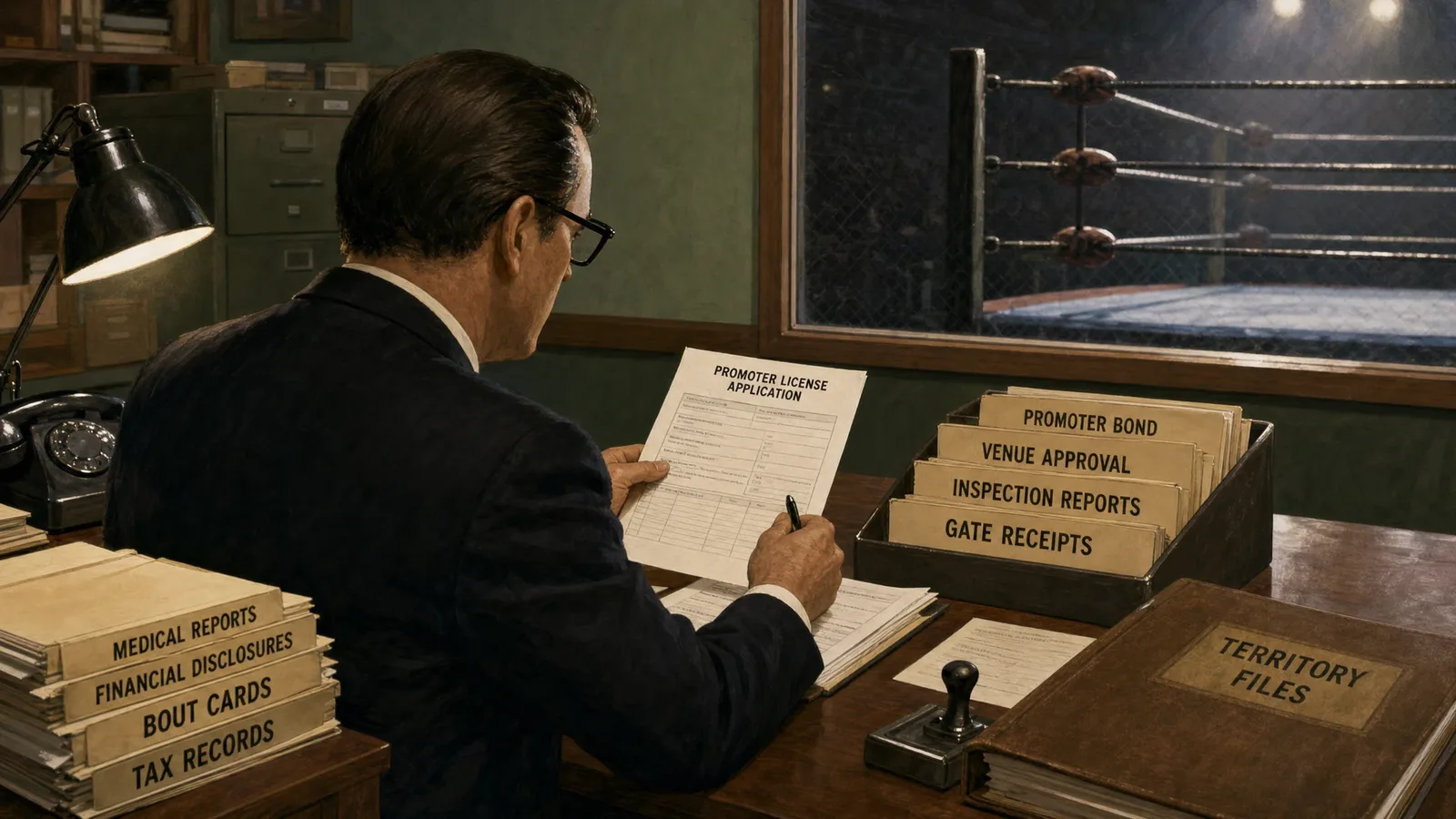
The useful question is who controlled access
A wrestling commission’s role was not necessarily confined to the action inside a ring. The Pennsylvania and Los Angeles accounts considered here point to a more practical question for fans reading local wrestling history: who had authority over the conditions for putting on a show? That can include the officials working at ringside, the license needed to promote in a city, and access to a particular venue. Those matters do not tell readers what every commission did in every jurisdiction. They do show that regulation could enter a promoter’s decisions before an advertised match began.
The evidence is especially valuable because it separates several ideas often blended together. A commission might be associated with match regulation, but a promoter’s immediate issue could instead be an added event expense or the ability to conduct business at a building. Likewise, a promoter license could be more than paperwork if it affected which companies could present shows in a market. Looking at each issue separately keeps broad claims about a single national system from outrunning the local accounts.
For a viewer or researcher, the most revealing records may therefore concern operations rather than a completed card: a license, the named venue, the people assigned to work an event, or the administrative tasks described by someone involved in promotion. Karl Lauer described learning both booking and record-keeping from Gory Guerrero. A separate account of a Mid-Atlantic front-office executive includes booking towns and venues and handling television advertising among the work required to keep a territory business running.
Pennsylvania: required officials as an event cost
In Pennsylvania, the athletic commission required wrestling shows to use its own referees and timekeepers. That is a concrete example of authority reaching beyond judging a bout. The requirement determined part of the event workforce, not merely the rules that performers followed. For a promoter assembling a show, the commission’s involvement could therefore be visible in the personnel at ringside as well as in whatever formal approval applied to the event.
According to recollections in the Pennsylvania account, the commission-mandated referees and timekeepers were a direct operating expense for the promoter. This is a narrow but important business point. A show’s costs were not limited to wrestlers, a venue, or advertising when outside-required staff had to be used. The available account does not establish a standard fee structure across wrestling, but it does document a local arrangement in which commission personnel affected the promoter’s budget.
That distinction also helps readers avoid treating regulation as a synonym for restrictions on wrestling style. Commission-appointed officials could affect who worked the event and what the promoter spent before questions of storyline or in-ring presentation even arose. In this example, the regulatory consequence was organizational and financial at the show level. It is a useful lens for examining local wrestling history: ask not only what was permitted in a match, but also which costs and workers were imposed around it.
A local promoter’s response to overhead
The Pennsylvania recollections link Newt Tattrie to a cost-conscious kind of local promotion. Tattrie primarily used students he had trained on his own shows and avoided expensive major names. That does not prove that commission expenses alone produced those choices, and the account should not be read as a rule for all promoters. It does provide a grounded example of the options available to a local operator working amid overhead pressures: building a card from trained local talent rather than relying on costlier names.
Former wrestlers remembered Tattrie’s approach to pay in somewhat different but compatible terms. One said he selected low-priced talent; another said he was fair in pay but would not absorb the losses from an unsuccessful show. These are individual recollections, not a general payroll code for the territory era. Still, together with the account of mandated commission officials as an expense, they give fans a way to read a small show’s economics without assuming that every lineup was assembled solely for creative reasons.
Tattrie was also remembered as having fought the Pennsylvania athletic commission in court and as being important to ending that commission system. That testimony comes from a local wrestler-promoter, so it should be treated as a local recollection rather than a full history of deregulation in every state. An anecdote about Tattrie paying the commission with a wheelbarrow of coins similarly conveys hostility toward fees and bureaucracy, but it is not evidence that such payments were normal practice.
Licensing could matter differently in Los Angeles
The Los Angeles material presents a different kind of leverage: a promoter license as a condition of market access. The Karl Lauer profile describes a Los Angeles wrestling promoter’s license as difficult to obtain. A participant quoted in that profile recalled that athletic commissions licensed wrestling at the time and said California had only two key promoter-license holders, one in Northern California and Lauer in Los Angeles. The numerical claim remains a recollection, but it identifies why a license could carry unusual practical value.
According to the same account, visiting national promotions such as WCW or WWF made arrangements with Lauer when they wished to promote in Los Angeles. On the evidence available, this is the clearest illustration of a local license holder being commercially useful to outside companies seeking entry into a major city. It should not be generalized into a claim that every outside promotion had to work through a local figure everywhere. It shows instead how licensing could become part of the business architecture of one market.
Lauer’s partnership with Guerrero also underlines that promotion combined wrestling knowledge with wider business capacities. Lauer brought a manufacturing background and business-world connections, while Guerrero brought wrestling knowledge. Their partnership illustrates a local promotion built through capital, relationships, and operational expertise. Licensing belongs in that same operational picture: it was one element alongside the people, knowledge, facilities, and connections needed to stage recurring events.
Venues were part of the operating map
Lauer and Guerrero’s Six Amigos promotion ran weekly shows in several Southern California cities, including San Pedro, Santa Ana, Oxnard, and Oceanside. After Guerrero stepped back, Lauer formed California Pro Wrestling and worked across several kinds of local venues and markets. The basic lesson is not that every territory followed this exact route. It is that a promoter could operate through a network of cities and buildings rather than through a single fixed home.
That network included both prominent and smaller settings. Lauer’s promotion ran at the Olympic Auditorium, held semi-monthly Las Vegas shows at the Showboat, and staged spot shows in high-school gymnasiums and college auditoriums. The range matters when considering local wrestling as a business. Recurring marquee buildings and community rentals could sit within the same promotional map, making venue access a practical concern rather than background scenery on an old poster.
The profile gives a specific example of what a licensing consequence could look like in that setting. Lauer lost the license to promote at the Olympic Auditorium, continued at other locations, and shifted heavily toward lucha libre. The account ties the license loss to both access to that venue and a change in promotional strategy. It does not establish a universal formula for how promoters reacted to lost access. It does show why a license can be read as a business asset connected to a particular market and building.
Administrative labor sat beside matchmaking
Fans often encounter territory history through wrestlers, title matches, and famous buildings. The Lauer and Mid-Atlantic accounts point toward another layer: administrative work. Learning promotion from Guerrero included booking and record-keeping, while the Mid-Atlantic executive’s duties included booking towns and venues and handling television advertising. These examples make it reasonable to read promotion as a continuing effort to coordinate records, locations, publicity, and cards rather than as the isolated act of announcing matches.
This is also where local regulation and venue access become easier to place in context. A requirement affecting the event workforce, or a license affecting access to a venue or city, would meet a promoter already handling bookings and advertising. The records do not quantify the burden of every rule or reveal every promoter’s balance sheet. They do support a more careful view of the business: commissions could matter through the operating conditions surrounding wrestling, not only through visible restrictions imposed on performers.
Georgia shows regulation could be contested and rewritten
A 2008 Georgia bill provides a later example of wrestling interests contesting proposed regulatory terms. The bill passed the state Senate by a 49–6 vote but did not pass the House in that session and never became law. Its substitute version was described as less burdensome to wrestling than the original proposal. This is not evidence of an enacted Georgia system. It is evidence of a legislative debate in which the proposed framework changed before failing to become law.
The substitute removed requirements for an ambulance at every show, a ringside doctor, and a five-percent gate tax. It would also have barred the Georgia Athletic and Entertainment Commission from regulating the entertainment aspects of wrestling matches. Those details show that a proposed regulatory scheme could distinguish between safety or financial requirements and the entertainment side of a wrestling presentation. Because the measure did not become law, these points should be read as proposed terms, not as rules that governed Georgia wrestling.
Other proposed Georgia terms focused on individual wrestlers. An annual wrestler license would have cost $20, and the application would have required proof of a basic medical examination. The proposal would have permitted bleeding only when a wrestler supplied documentation of negative tests for communicable diseases. These provisions are useful for separating a proposed licensing and medical framework from the Pennsylvania and Los Angeles examples, which center on event officials and promoter-market access instead.
The report says the substitute incorporated many recommendations from a Georgia Wrestling Promoters Advisory Committee. That is a documented example of promoters seeking a formal voice in revising regulatory terms. It should not be turned into a claim that promoters everywhere possessed the same influence or that commissions always yielded to industry preferences. Its value is narrower: regulation was not necessarily a one-way process, and the terms of a proposed system could be subjects of organized negotiation.
Questions to bring to local wrestling history
When reading about a historic promotion, start with specific questions. Did a commission appoint any personnel for the show? Was a promoter’s license described as difficult to obtain, tied to a city, or connected to a particular venue? Did the promoter run one building repeatedly, move among community sites, or continue elsewhere after losing access to a location? These questions follow directly from the Pennsylvania and Los Angeles examples without pretending that either one supplies a nationwide template.
It is equally important to label the strength of the evidence. The Pennsylvania material includes recollections about Tattrie’s legal fight, fees, talent costs, and a colorful payment anecdote. The California material includes a participant’s recollection about the number of key license holders. Georgia supplies a report about a bill that never became law. Taken together, these sources support an informed, local picture of how regulation could shape business options. They do not establish uniform enforcement, identical licenses, or a single story of wrestling deregulation across all states.
Explore more
- History
- How a Touring NWA Champion Worked Across Territory Markets
- Recurring Local Buildings in Territory Wrestling Markets
- Reading Wrestling Posters as Local Advertising Evidence

Darryl Polo
Darryl Polo is a passionate wrestling fan covering WWE, AEW, TNA and beyond. He loves great rivalries, breakout stars and the moments that keep fans talking long after the bell. How we work.