
An announced card is not a completed show
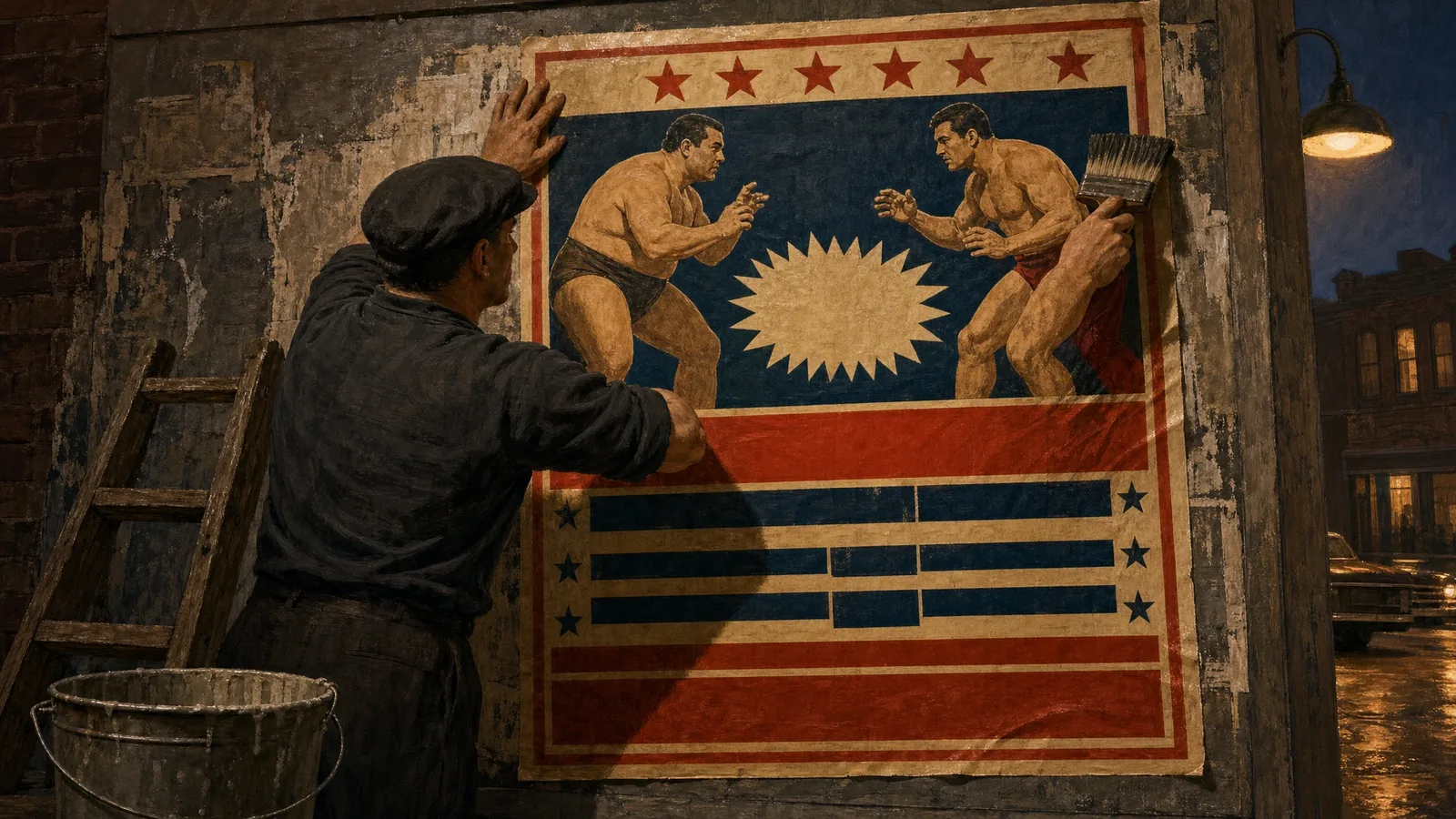
A wrestling poster is strongest as evidence that a particular presentation was planned and advertised in a named place. Conrad Gargus recalled that Dave McKigney’s Ontario operation planned matches for each town before Gargus helped lay out the corresponding poster. The town name and printed card copy can therefore document an intended local presentation at the time the item was made. They do not, standing alone, establish that every bout happened as announced, that no substitutions occurred, or that the poster contains the entire experience of the event.
The interval between printing and the event is a basic reason for that caution. Gargus said McKigney posters normally went up at least 10 days in advance and sometimes two weeks ahead. A poster is consequently a record of advance plans, not a result sheet. Its confident design and fixed wording can make the lineup look final, but a reader should still ask whether another contemporary source establishes what happened at bell time. This distinction protects the useful information on the poster without asking it to prove more than an advance advertisement can prove.
The Sandusky study shows why both kinds of record matter. Its reported results for a September 13, 1950 card list Dale Wayne as a substitute for George Stanlee. That difference does not make advance advertising worthless. Instead, it separates two historical questions: who was promoted before the show, and who actually appeared. When a poster and a result report differ, the discrepancy itself can be informative. It may preserve a change in the lineup rather than require a researcher to discard one document in favor of the other.
What local advertising can and cannot show
In Gargus’s recollection, some small Ontario towns had little or no newspaper, television or radio coverage, so posters were the principal way residents learned that wrestling was coming. Within that particular setting, posters were an active part of local promotion rather than merely souvenirs retained after the fact. Yet even a well-preserved example cannot measure how many people saw it, how many attended because of it, or what the audience thought of the event. It documents an effort to notify local residents, not attendance, reception, or financial results.
Posters also should not be treated as a complete record of a promotion’s advertising. Gargus placed them within a system that included advertisements in small newspapers. That documented overlap is reason enough to compare formats rather than elevate a surviving poster into the sole account of how a card was presented. The poster may preserve its visual hierarchy, large names, and town-specific copy especially well. A newspaper advance item can supply different local information: the Sandusky Register, for example, reported that front-row seating was moved back for an advertised main event. Each item has a distinct evidentiary role.
A printed town name also needs a limited reading. McKigney’s group sometimes worked five or six nights a week, with posters serving a touring schedule rather than a single permanent home venue. In that context, the place name is meaningful evidence of a stop on a circuit. It is not proof that the promotion was based there. A sequence of surviving posters may help a researcher trace advertised locations, but the safest conclusion from any individual piece is simply that it promoted a local date in the town named on its surface.
Separate reusable stock from local copy
McKigney posters illustrate how standard promotion design and town-specific information can occupy the same sheet. The operation repeatedly used a reverse wrestling-head motif, colored borders or fields, wrestler photographs, and large type. It pre-printed blank stock in red, blue, or green, then overprinted local match copy in black. Reading those layers separately is useful. The recurring design can identify a continuing visual brand, while the black overprint can identify the local announcement. Neither the shared template nor the later copy automatically confirms every claim made for the advertised card.
Gargus estimated that roughly 20,000 to 30,000 blank posters could be printed before local details were added. This is a documented example of producing a large common run economically rather than commissioning entirely unique art for every date. It also explains why copies with the same imagery and colored stock may carry different towns or match information. A careful catalog description should preserve both levels: the features shared by the blank stock and the particulars added for a local stop. Similar appearance alone does not show that two posters advertised the same event.
Color is another feature worth recording without overreading. Gargus said fluorescent orange and fluorescent red required screen printing and cost more, making color relevant to both visual presentation and expense. He also said the promotion returned to a town after about three weeks with a different poster color so the advertising would look new. A color variant can therefore be a meaningful physical difference, but it is not automatic evidence of a different promoter or a wholly changed event format. Town, match copy, and other printed details remain necessary points of comparison.
Physical traces are part of the source
The object’s material form can preserve evidence that a transcription cannot. McKigney posters were printed on heavy card stock. Gargus said their stiffness allowed a business to fold one like a tripod for window display when it did not want to tape the item in place. In this setting, a fold may be connected to how the advertising was displayed rather than only to later damage. Recording paper or card stock, folds, dimensions, and related features helps retain information about the poster’s practical use as well as its printed card.
Other surface marks can be considered in the same restrained way. Gargus recalled that McKigney posters were attached with masking tape in some places and stapled to wooden utility poles in others. Tape residue, staple holes, weathering, and similar marks may consequently be consistent with public display. They do not independently establish an exact location or a complete ownership history. The useful practice is to describe what is physically visible and compare it with documented distribution methods, rather than either turning every mark into a precise story or ignoring the artifact’s evidence of use.
Provenance is a separate issue from the truth of the printed billing. Gargus believed that many surviving McKigney examples remained with wrestlers’ families, referees’ families, or other inheritors. Knowing who kept an item and how it passed hands can matter when assessing whether it is original, later reproduced, or separated from its local context. A responsible account should distinguish a documented chain of custody from an assumption based only on age or appearance. Provenance may clarify the nature of an artifact, but it does not make every advertised claim a confirmed event fact.
Images promote recognition, not necessarily literal cards
A wrestler photograph does not necessarily depict that wrestler at the advertised show or even originate with the promotion’s own work. Gargus said McKigney imagery came from travelling fan photographers, professional prints chosen by the promotion, and photographs he took himself. The image may have been selected from available material for its visual value. A sound description separates the image from the event claim: identify the pictured person if possible, then read the nearby copy to determine whether that person is actually billed for the local card and how the poster presents them.
McKigney’s posters emphasized striking headshots and recognizable names, including the Sheik and Angelo Mosca, in bold type. Gargus’s account supports reading image and name recognition as promotional tools rather than neutral proof of card order or actual match importance. Large type can show what the promotion chose to spotlight on paper. It cannot independently establish a main event, a wrestler’s final position on a program, or that the image reflects the exact role performed that night. The hierarchy printed on the poster should be transcribed, then left distinct from confirmed results.
WWE’s retrospective supplies examples of the same limitation in a different promotional setting. It says Great American Bash 2000 artwork suggested Hogan, Sid Vicious, and Vampiro were opposed, while Hogan wrestled Kidman, Vampiro wrestled Sting, and Sid did not appear. WWE also notes that a WrestleMania 22 poster used an older John Cena–Booker T image even though Booker T had a different opponent at the event. Such examples show why recognizable imagery should not be treated as a literal diagram of the matches eventually presented.
Read fine print and open-ended billing closely
The smallest wording can be as significant as the largest headline. Gargus said that when women’s wrestling faced a regulatory restriction in Ontario, McKigney posters used small type calling the attraction a judo demonstration. In this documented case, fine print records regulatory positioning beside the more prominent sales language. Some posters also used the phrase “Plus Other Big Bouts,” signaling that the listed matches were not necessarily the complete lineup. Transcribing such wording preserves limits and qualifications that disappear when an artifact is reduced to only its biggest names or largest type.
McKigney posters advertised women wrestlers, midget wrestling, wrestling bears, steel-cage matches, and four-man cyclone tag bouts. The phrase “midget wrestling” is retained here as the historical advertising category reported for these posters, not as current descriptive language. These listings document what the promotion chose to put before local viewers in its advertising; they do not by themselves prove that every listed attraction took place. WWE’s discussion of World War 3 1996 similarly notes that the artwork alone did not explain its three-ring, 60-person battle royal. Copy, stipulations, and venue information deserve transcription alongside imagery.
Check venue, promoter, names, and title claims separately
A venue line can point toward valuable local research, but venue and promoter are not automatically the same entity. The Sandusky study identifies a September 13, 1950 card as run under the Terminal Athletic Club, identified as the Toledo wrestling office, and places the event at the VFW Sports Arena, now VFW Post 2529. It also explains that promoters associated with Jack Pfefer commonly used VFW or American Legion connections to stage bouts. A veterans’ organization listed in local advertising may therefore be a venue partner or community connection rather than the wrestling promoter itself.
Corroborating sources can supply information a poster does not attempt to include. The Sandusky Register’s advance coverage reported that promoters moved the front row back because the advertised main-event wrestlers were billed as particularly unruly. That item corroborates local promotion while preserving an audience-management detail absent from a standard card listing. A practical comparison can therefore assign distinct questions to distinct sources: the poster records its visual pitch and announced names, advance coverage can offer local framing or logistics, and reported results can test whether announced arrangements changed before the show.
Finally, printed names and championship language require independent checking. The Sandusky study distinguishes billed character names from the people behind them and identifies several ring identities as aliases. It also flags uncertainty around a championship history because multiple splinter versions may make a claimed lineage inaccurate. A poster can reliably preserve the identity and title language used in its advertising. It cannot, without corroboration, establish a performer’s legal identity, a unique career record, or an uncontested championship lineage. Record the claim as printed, then seek further evidence before treating it as settled history.
Explore more

Darryl Polo
Darryl Polo is a passionate wrestling fan covering WWE, AEW, TNA and beyond. He loves great rivalries, breakout stars and the moments that keep fans talking long after the bell. How we work.