
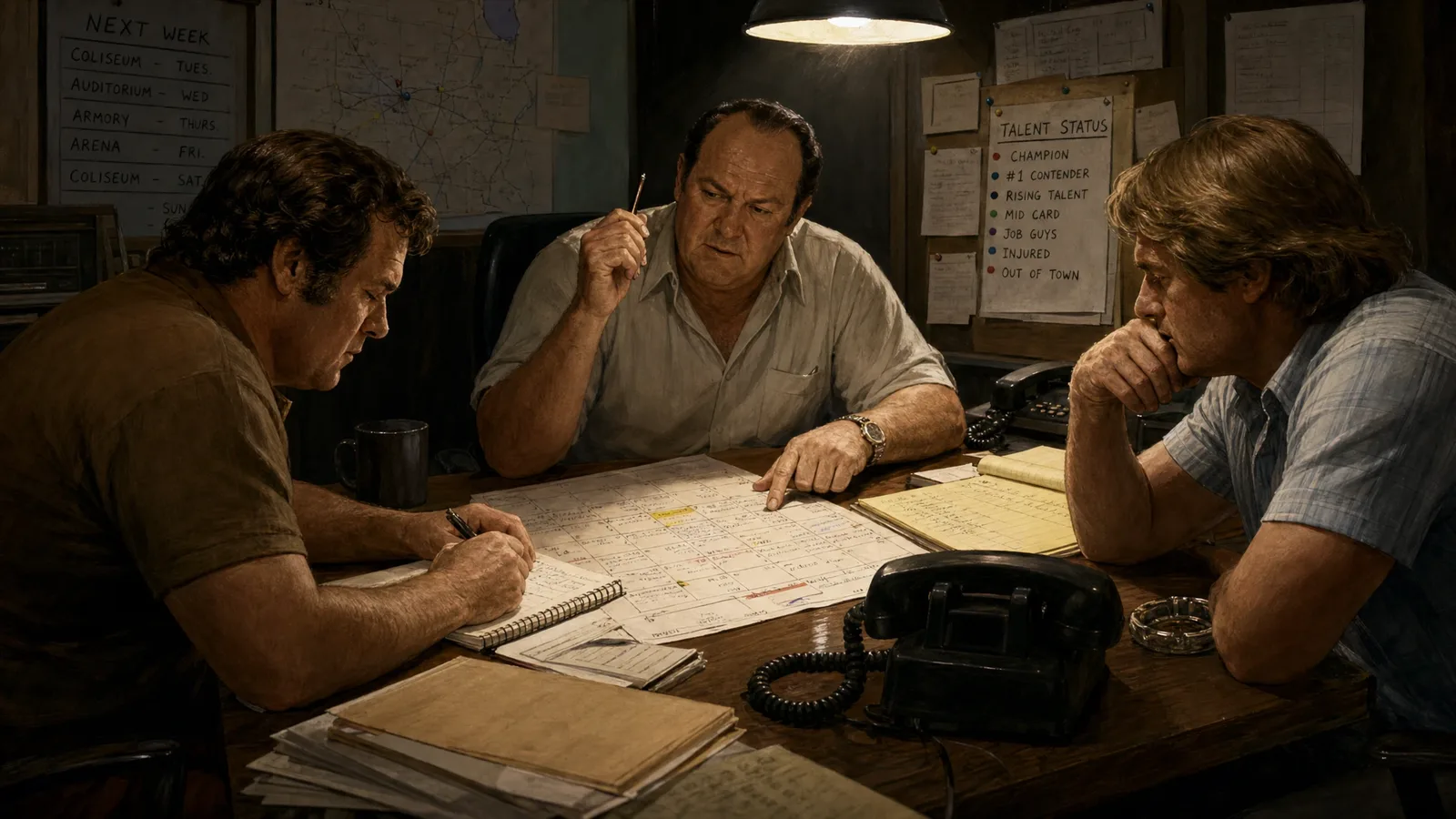
A booker’s title did not answer every question
A booker was not simply a person who devised match ideas. The George Scott profile describes a job in which decisions could affect a wrestler’s placement, payoffs and gimmicks. That range helps explain why the role could produce dissatisfaction in a locker room: it touched both what audiences saw and important parts of a performer’s working situation. When studying an older promotion, the productive opening question is not whether one person wrote everything. It is which decisions a named booker was actually described as holding in that particular company.
The three accounts here do not provide one territory-era blueprint. Jim Crockett Promotions supplies an example involving an owner and a named lead booker. Scott’s later WWF recollections describe a senior booker with a broad company role. The Mississippi material instead concentrates on local promotion, show logistics and financial handling. Taken together, they show that several functions could coexist around wrestling events. They do not document a universal approval system for pushes, title changes or feud length across North America.
Jim Crockett Promotions named an owner and a lead booker
Jim Crockett Jr. identified George Scott as Jim Crockett Promotions’ lead booker while describing himself as head of the family company. Crockett also said he and Scott shared a broad good-versus-evil philosophy for the promotion’s presentation. This separates ownership from the named lead-booker role without requiring a claim that the owner was absent from broad direction. The arrangement shows an owner and booker sharing an overall approach while holding distinguishable positions within the same Mid-Atlantic promotion.
That arrangement belongs to a particular company and a long-running period, rather than a timeless model. Crockett took over the family business after his father’s death in 1973, and the company remained active until its 1988 sale to Ted Turner. Crockett described JCP as a Mid-Atlantic promotion and, during national expansion, the largest NWA member. Those facts make caution especially important: a named division of work at JCP should not be treated as proof that every office, or every stage of JCP itself, used the same chain of command.
Scott described a broad senior-booker workload
Scott’s later account of his WWF duties is specific. He said he selected winners and losers, recruited talent, negotiated salaries and planned magazine content. Those responsibilities put match outcomes alongside personnel and promotional work. A booker with that stated portfolio could influence who won, who was recruited, the terms under discussion with talent, and how wrestlers appeared in company material. The account is more useful for understanding that stated mix of responsibilities than for reducing booking to the selection of a main-event finish alone.
His description of how his role expanded adds another layer. Scott said he moved from handling a few towns out of Miami to handling the whole company. That progression shows that authority could operate at different geographic scales. A person associated with booking might be responsible for a town, a group of towns or an entire company, depending on the assignment described. For a reader examining a particular card or program, identifying that scale is a necessary step before crediting one office or executive with a specific decision.
Scott also placed a boundary around his own authority, saying Hulk Hogan was an exception. The narrow lesson is that a senior booker could describe himself as directing most finishes and talent use without controlling every top act in the same way. The account does not establish the terms of that exception or show that all major wrestlers had similar leverage. It does make a booker credit incomplete evidence for any claim of absolute authority over an entire roster.
Ownership and television tone could involve separate authority
George Steele remembered Scott as a respected front man while Vince McMahon remained the boss. This gives a documented example of an operational leader working under ultimate ownership authority. Scott’s own account of choosing results and handling talent matters means that the operational role was not presented as merely ceremonial. Instead, the two recollections point to a more precise question for fans: what had been delegated to the booker, and who retained the capacity to make the final call?
Steele also recalled disagreement over television tone. He described Scott as coming from a more traditional wrestling background while other choices became more cartoonish. That memory does not supply a complete organizational chart for WWF television. It does show why the word booker may not settle questions about every kind of content. Match programs, magazine material and television tone could involve overlapping responsibilities and different levels of seniority.
Crockett’s recollection of his NWA presidency adds an inter-promotional limit to one office’s preferences. He said promoters disputed losing decisions, indicating that match outcomes could involve more than a single promoter’s viewpoint. The evidence does not show that every result was negotiated among multiple parties. It does show that, in an NWA setting, promoters could have conflicting interests in the outcome of matches. An account of one promotion’s booking is therefore not always the whole context for a result involving wider relationships.
Mississippi promotion places the office in local operations
The Mississippi account shifts the focus from a major television promotion to a smaller-scale local business. It describes wrestling there as fundamentally local and commonly run by people with roots in the area. That setting matters because shows were presented in particular communities through recurring local work. The account does not frame promotion as an abstract creative department detached from the places where cards were held. It places the people running wrestling inside an ongoing enterprise with practical obligations around each event.
Those obligations included substantial physical and clerical work. Rings had to be moved, erected and dismantled. Posters had to be placed. Tickets had to be printed, sold and collected. These details establish that putting on a local wrestling show required far more than deciding who would appear. They do not identify the individual who made each match decision, but they do show the array of work that surrounded a card before the event could take place.
The Mississippi account also says wrestlers had to be paid and that percentages from each night’s gate were sent back to the booking office. On this evidence, the booking office functioned as a financial clearing point for those gate percentages as well as a point within the promotion’s recurring operations. The source does not identify the office as the sole place where creative choices were made, and it does not assign every financial decision to a booker. Its value is in documenting the office’s connection to nightly accounting and wrestler payments.
Family roles and affiliations could change the local setting
The Culkin family offers a specific example of overlap between wrestling, promotion and family ownership. Gil Culkin entered the Mississippi wrestling business in 1974 after his father George, a wrestler, also promoted shows in the state. This one example cautions against assuming that wrestler, promoter and owner were always separate categories. It should remain an example rather than a general rule: the record establishes a family-linked overlap in this Mississippi operation, not a standard pattern for every territory.
In 1977, the Culkins split from Oklahoma-based promoter Leroy McGuirk and the NWA, then operated as an outlaw promotion for two years. They rejoined the NWA in 1979 through a merger with promoter Bill Watts. That sequence directly shows a local promotion changing its affiliation rather than simply following a single national office. It does not reveal the internal decision-maker for every card during either period. It does establish that the business framework around local promotion could change over time.
The 1979 merger brought national stars to Mississippi, but the larger promotion reduced regular shows in smaller towns it considered unviable. The documented result was geographic: some local fans had fewer nearby cards and needed to travel farther. This should not be used to explain the planning of a particular match or program. It does show that a merger could change where recurring wrestling shows were held, which is a useful distinction when comparing a territory’s formal reach with the towns that actually received regular events.
Planning ahead did not make programs fixed
Scott said WWF programs were booked six weeks in advance. That is evidence that at least one major office planned programs in blocks rather than deciding every element only on the day of a show. It offers a grounded way to consider recurring pairings and sequences on programs from that setting: some may have been part of advance planning. The six-week practice cannot be projected automatically onto every territory, promoter or period. It is evidence about one office’s stated method.
Scott also said that wrestler absences made programs difficult to plan. This establishes that operational disruption could complicate a planned program even where advance booking existed. It does not identify the reason for a particular absence, substitution or change in direction, and it does not document the fate of any specific feud. The careful conclusion is limited: a program that looks altered on the surviving record need not, by itself, reveal why the change occurred.
Card position does not prove personal motive
A wrestler’s place on a card should not automatically be read as proof of a private conflict with a booker. In the Scott profile, Bill Apter said wrestlers often took a lack of a push personally even though it was not necessarily personal. That observation does not deny that disagreements could exist. It separates an observable fact, such as placement on a program, from a claim about private motivation. A stronger historical reading looks for a named recollection that connects a decision to a particular person or circumstance.
Crockett’s account identifies national competition, talent acquisition, pay-per-view distribution, television scheduling, cash flow and production among the matters confronting JCP. It also says the company’s 1988 sale followed financial strain despite established television and advertising operations. These facts provide business context for the promotion, but they do not explain any particular result, title direction or rivalry length. Readers should keep that distinction in view: the interview documents a company working amid commercial and production concerns, not a stated rationale for each on-screen decision.
Questions that fit the surviving evidence
The most reliable questions are specific ones. Who is named as booker, promoter, owner or front man? Does an account describe responsibility for a few towns or a whole company? Does it identify an exception for a major star, a disagreement about television tone, an NWA-related dispute, an absence, a local logistical task or an affiliation change? These questions produce a layered reading of authority. They also avoid treating three documented accounts as proof that every territory had one office, one timetable or one person with final control.
Explore more

Darryl Polo
Darryl Polo is a passionate wrestling fan covering WWE, AEW, TNA and beyond. He loves great rivalries, breakout stars and the moments that keep fans talking long after the bell. How we work.