
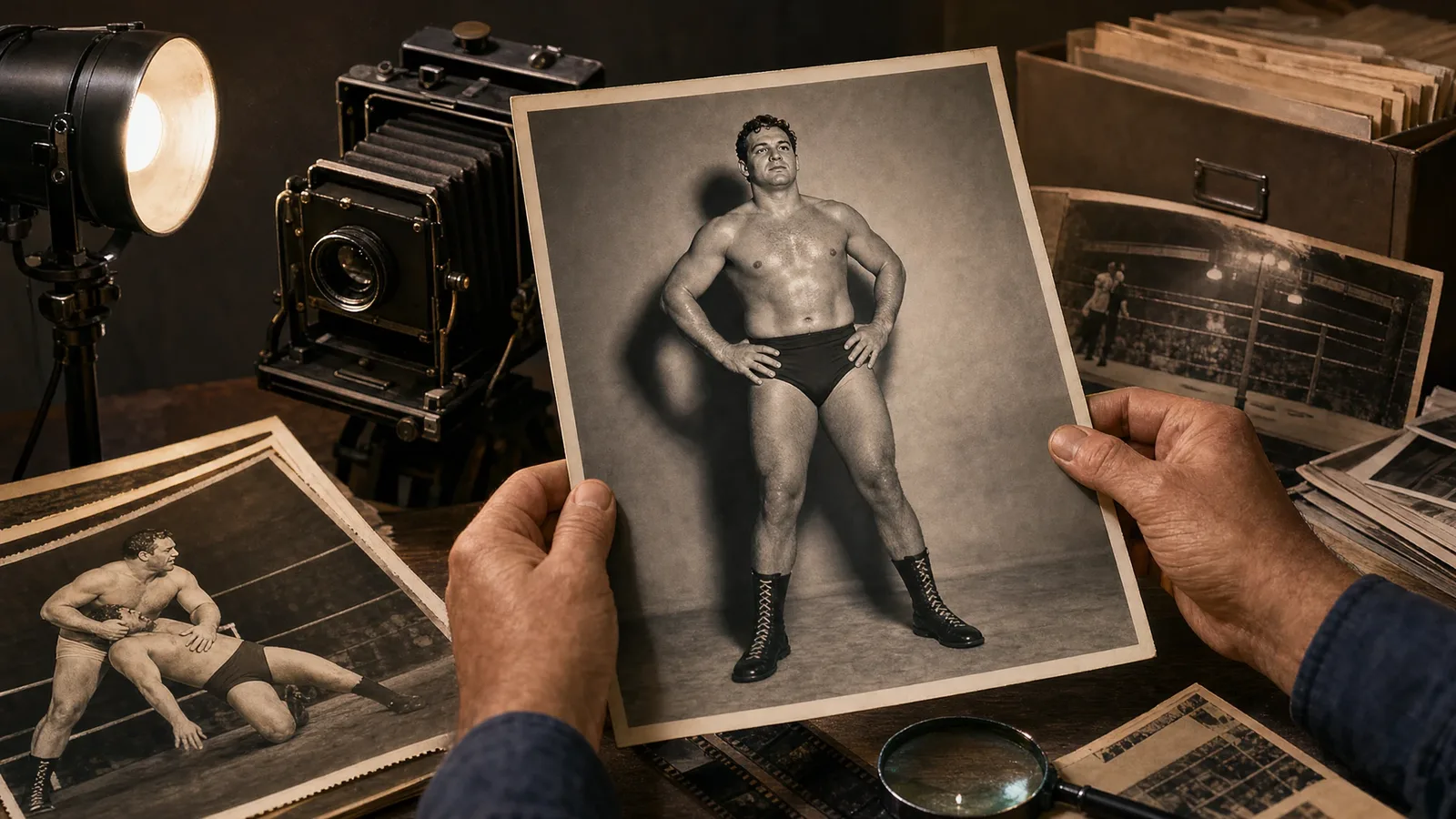
A photograph is both an image and an object with a history
Historic wrestling photographs are often encountered as striking standalone images: a wrestler frozen in motion, a posed group backstage, or a face captured away from the ring. Their value is real, but the picture alone is only one layer of evidence. A useful reading begins by asking who made it, where the photographer stood, whether the scene was staged, and how the image later reached an audience. Those questions shift attention from an image’s familiar subject to the conditions that produced and preserved it. They can also prevent a memorable frame from being asked to prove more than it visibly records.
George Napolitano’s work shows why photography belonged to wrestling’s wider media system rather than merely documenting it from the sidelines. He first contributed in-ring photographs to Wrestling Revue and later created Wrestling Scene, Wrestling’s Main Event and Ringside Wrestling. His pictures came from regional shows and fed magazine coverage connected to the territory system. In his account, magazines helped fans learn about performers beyond their own areas before widespread cable access. A published image could therefore place a wrestler before readers who had not seen that wrestler locally or on television.
Ringside work captured moments, not complete matches
A ringside action shot can establish that a photographer saw and captured a particular instant. It may preserve attire, bodies in motion, the ring environment, or the visual stakes of an encounter. It is not, by itself, a full account of the match around that instant. Napolitano said photographers were not told the planned pattern or outcome, even as experience taught them to watch performers and recurring match patterns. That distinction matters: a dramatic image may be excellent evidence of a moment while remaining limited evidence about construction, sequence, or finish.
The working conditions behind older action photography add another limit. Napolitano worked with manual focus, flash and exposure settings, without a screen for immediate review. A missed moment or technical error could not simply be checked and recreated at the venue. His recollection of traveling about twice a month to major shows in hubs including Atlanta and Richmond also suggests a record shaped by where a photographer could go and what he could cover, rather than an all-seeing visual archive of wrestling everywhere.
Coverage choices could widen the record beyond the headline match without making it comprehensive. Napolitano said he photographed undercard wrestlers as well as featured bouts, allowing those performers to appear later in magazine features when he was absent from their territories. His archive also included backstage and other off-ring images alongside action pictures. For a viewer, that means an archive may reveal performers and settings overlooked by a single event card or isolated match report. It also means survival of a photograph reflects selection: what was photographed, retained and later chosen for publication.
Magazine publication gave photographs a promotional afterlife
Photography and publication could work together as a form of visibility across regional boundaries. Napolitano characterized wrestling magazines as an important source of information for fans outside a wrestler’s local territory, and his images supplied material for that coverage. One recollection in the same account says a magazine appearance signaled growing professional momentum to wrestlers and audiences. That is best treated as a perspective from that setting, not a universal measure of status. The firmer point is that magazines gave photographs a route to readers well beyond the building where they were taken.
An early published Napolitano photograph was later used by Paul Levesque as promotional material to demonstrate where he had worked and what he had done. The example shows one concrete way an image could be reused as career-facing evidence after publication. It does not mean every wrestling photograph functioned this way, nor does it prove what any image meant to every viewer. Instead, it encourages a practical question: was a particular picture made for editorial coverage, retained as a keepsake, or later repurposed to present a performer’s experience and identity?
Publication itself was selective. Joyce Paustian submitted AWA photographs to magazines and said editors’ decisions depended on whether a picture was considered unique. A printed photograph should not automatically be treated as a neutral sample of an event or a complete index of what happened there. In this example, the publication decision reflects one editor-facing judgment about a particular image rather than a complete visual record. When comparing a magazine image with other surviving material, viewers can ask what the publication included and what the selection process may have left outside its pages.
Portraits, candid scenes and action images require different questions
A photograph’s setting is central to interpretation. Napolitano’s archive included backstage and other off-ring images as well as ringside action, and it included a candid hotel-room photograph of Ric Flair. That image was presented as reinforcing Flair’s established public image. A viewer can use categories such as candid, posed and in-ring action as practical starting points, then ask how much control the setting and access appear to show. An informal-looking photograph should not automatically be treated as unfiltered access to a wrestler’s private self; location and degree of posing still matter.
The 1981 black-and-white photograph of Paul Heyman with Freddie Blassie, the Grand Wizard and Captain Lou Albano provides a clear contrast. Made backstage at Madison Square Garden while Heyman was working there as a freelance photographer, it was a deliberate group portrait. Heyman said he sought a replacement because the available group photograph was unsatisfactory, and he wanted to document what he regarded as the three managers’ dominance in the Northeast at that time. The image can thus be read as a purposeful act of representation, not a chance backstage discovery.
The portrait also demonstrates why authorship deserves separate attention from subject matter. Heyman organized the session and supplied the camera, but another photographer took the frame that included Heyman. The report also says photographers had a backstage photographers’ room and that multiple photographers had access to the assembled managers. A credit line, when it survives, may answer who pressed the shutter; it may not identify the organizer, camera owner, publisher or person who arranged access. Those are different roles, and each can matter to the picture’s history.
Access shaped what photographers could preserve
A surviving archive is also an archive of access. Napolitano said ringside photographers were barred from WWF events during the mid-1980s in order to avoid competition with the new WWF Magazine. The account says this pushed him toward NWA regional territories. That example does not describe every promotion or every photographer, but it offers a useful warning against treating the surviving visual balance as a transparent map of wrestling activity. Promotion-controlled access could influence where photographers worked and which images had a better chance to survive.
Physical position can be visible within the photograph itself. Paustian described her AWA work as fan photography made from paid ringside seats, rather than images made with in-ring access. She noted that ring ropes often appear in her pictures. Rather than treating those ropes simply as an obstruction, a reader can view them as evidence of vantage point: the image was made from a spectator’s position, with the ring’s structure between camera and subject. That knowledge helps explain framing, sightlines and what may fall beyond the image’s edges.
Access also affected circulation. Paustian said wrestlers sometimes asked her for copies of her photographs, showing that fan-made pictures could travel beyond albums and magazines. In a separate example, Heyman later placed photographs and interviews in his Wrestling Times publication, with copies inserted into programs sold in New Jersey. These cases show different paths from photographer to audience: personal exchange, small publishing and venue-program distribution. When a photograph survives, identifying its route can be as informative as identifying its subject.
Captions, credits and provenance strengthen an image
The strongest historical use of a wrestling image combines the picture with its supporting details. Paustian preserved negatives and labeled where each photograph was taken; even for ring introductions, she recorded that night’s opponent. Her practice highlights the value of venue information, opponent identification and an original negative when an otherwise ambiguous image is being identified. A caption that names supported details is more than decoration. It gives later readers a way to connect the visible frame to a specific setting and to distinguish confident identification from guesswork.
Credits are similarly important, even when images become widely familiar. The account of Napolitano’s collection notes that viewers often recognized a well-known image of Andre the Giant without knowing who made it. Reproduction can therefore separate a photograph from its creator’s credit. A careful viewer should preserve photographer attribution where available, while recognizing that credit alone does not settle every question about an image’s origin or use. It remains worth asking whether an image appears with its original publication context and whether the surviving credit identifies the photographer or another contributor.
Scanning and archive selection add later layers
A historical photograph encountered in a book may have a production history beyond the original exposure. Paustian identified scanning and cleaning up photographs as a challenge while preparing her self-published AWA project. That documented later step is worth noting when reading a reproduced image alongside its original photographic history. The image on the page represents the photograph as prepared for that publication, while preserved negatives, labels and other provenance details can provide separate information about its earlier form and identification.
The survival path may be uneven even for professionally made work. Napolitano said some pictures in his book would not be found elsewhere because his magazines had ceased publication. His 2011 collection contained more than 400 photographs selected from his personal archive and drew on images spanning roughly three decades; it was a curated selection rather than a complete record of every show or person he photographed. An archive can preserve rare material while still reflecting the choices, holdings and gaps of the person or institution that assembled it.
A practical checklist for reading any wrestling photograph
Start with what is plainly visible, then move outward. Is the scene in the ring, at ringside, backstage or posed for the camera? Do ropes, a crowd position or a controlled backdrop reveal the photographer’s vantage point? Is the frame candid, action-based or deliberately assembled? Next, look for provenance: photographer credit, publication, negative, venue label, opponent information and any indication that scanning or cleanup took place for a later publication. Each detail narrows the range of reasonable interpretations without requiring the image to supply a complete story on its own.
Finally, match the claim to the evidence. A photograph may reliably support that a particular scene, pose or moment was captured; it may also help document visual presentation and the ways an image circulated through magazines, programs or private exchange. It is less secure as standalone proof of an entire match, a finish, a private reality, or a promotion-wide rule. The most rewarding approach is not to diminish historic wrestling photography, but to read it with its frame, caption, credit, access conditions and preservation history in view.
Explore more

Darryl Polo
Darryl Polo is a passionate wrestling fan covering WWE, AEW, TNA and beyond. He loves great rivalries, breakout stars and the moments that keep fans talking long after the bell. How we work.