
Start with the building’s role, not a single venue stereotype
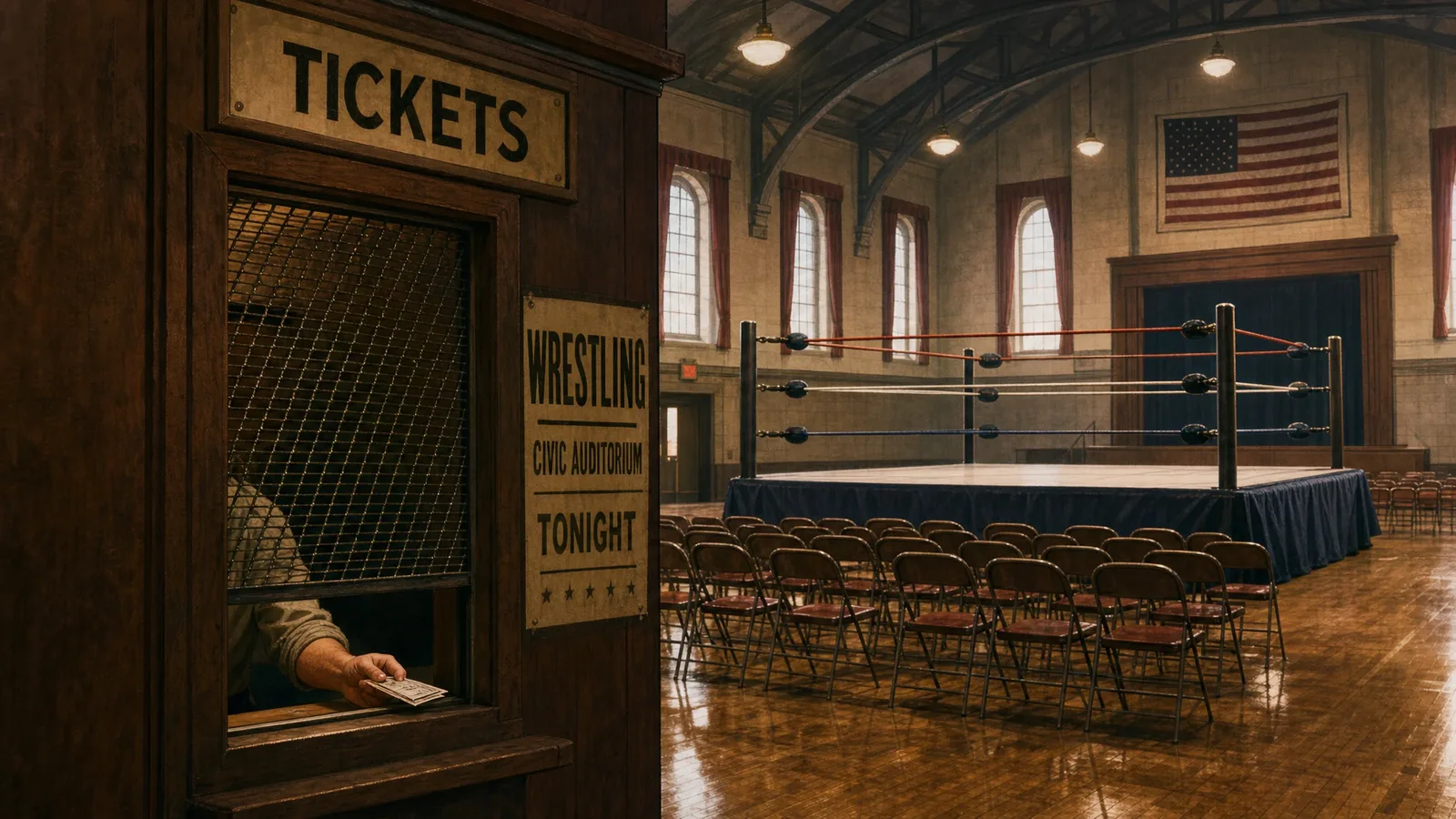
Historic wrestling is often remembered through the names of armories and civic buildings, but the surviving examples resist a one-size-fits-all picture. Louisville’s leading promotion ran Thursday cards at the Savoy, a vaudeville theater, in 1933, while a rival promoted heavyweight shows at the Armory. In Los Angeles, the Olympic Auditorium became a weekly wrestling site in 1945. Dallas’s Sportatorium was also a weekly home for World Class Championship Wrestling. A venue label alone, then, does not tell a viewer whether a building was used for a regular card, a competing presentation, or a major stop within a broader local market.
The useful question is what kind of continuity a room provided. A regular date could make wrestling part of a town’s calendar without making the building exclusive to wrestling. In Oshawa, weekly Tuesday cards in the early 1950s generally presented three bouts, with three-fall main events or semifinals. The WWE venue history similarly identifies weekly wrestling at the Olympic Auditorium and the Sportatorium. Those examples document an operational rhythm: a promoter could return to a recognizable room on a predictable schedule and present a repeatable card structure there.
A weekly room created a recognizable local appointment
Oshawa offers a particularly clear example of the difference between a building and the routine attached to it. Pat Milosh’s Tuesday format was modestly structured rather than built around an oversized program: three bouts were the general pattern, and the longer multi-fall matches were placed in prominent positions. That evidence does not show that every weekly card everywhere followed the same formula. It does show why researchers should examine advertisements, reports and surviving programs for the recurring night, the number of bouts and the billing hierarchy, rather than treating venue names as self-explanatory.
A recurring date also did not prevent an exceptional attraction from changing the scale of a particular night. Jack Dempsey refereed a 1952 Oshawa match that drew more than 3,000 fans to the arena, while the standard weekly format continued to illustrate the regular local routine. The contrast is valuable because it separates two ideas that are easily blurred in nostalgia: a venue may be a dependable weekly home, yet a special guest or attraction can make one card substantially different from the ordinary schedule. A single attendance figure should therefore be read alongside the card’s context.
Publicity could be tied directly to the venue night
The August 1947 Oshawa return demonstrates an unusually visible connection between a wrestling card and downtown promotion. A flute band paraded downtown before appearing at the arena that evening. More than 1,000 people attended the card, compared with reported recent crowds of roughly 500 to 600. The Pat Milosh profile presents this as a local publicity push with a markedly stronger gate. It is a concrete example, not proof that parades were a standard wrestling tactic across every market, but it shows how the route to the building could become part of the night’s promotion.
The same Oshawa record places media around the arena experience rather than only before it. Newspaper and radio coverage followed the cards, and CKLB broadcast weekly shows live from ringside for listeners who were not in attendance. For a fan reading old coverage, that creates several separate pieces of evidence: a listing or preview may establish the scheduled card, a report may document what happened, and a radio reference may show that the event reached beyond the ticket-holding audience. None should automatically be treated as a complete attendance or financial record.
Control of the room could include regulation and contested dates
Venue availability was not simply a matter of finding an empty hall. After a 1947 riot in Oshawa, the arena manager stopped further wrestling until crowd-control concerns were addressed. The Athletic Commission considered removing ringside seating following the disorder. This is a specific local case in which safety concerns and commission involvement affected the conditions under which wrestling could be presented. It cautions against viewing seating layouts as neutral scenery: ringside arrangements could be subject to scrutiny, and a promoter’s ability to run depended on more than the ring and the advertised talent.
Louisville supplies a different form of outside influence. Kentucky’s State Board of Athletic Control became involved with wrestling after a 1928 legal amendment. For the prized Derby Eve Armory date, the state awarded access to the promotion it judged to have submitted the best card. When Abe Finberg attempted to book the Armory directly for that date in 1933, conflict with local interests followed and the effort was abandoned after State Board pressure. The Derby Eve report therefore documents that a prestigious building date could be contested through regulatory and local power structures.
Capacity and paid admission were separate questions
A large building was not a guarantee of a large paying crowd. Finberg’s 1933 Louisville Armory shows drew 1,283 and 1,275, figures far below the Armory’s later reported capacity of more than 7,000 for Allen Athletic Club police-benefit events. On one March card, 2,000 attended but only 750 admissions were paid because broad free-entry offers had been made. These numbers are a practical reminder that capacity, attendance and paid admissions measure different things. A poster’s grand venue name cannot settle which of those figures a historical claim is describing.
The Louisville evidence also keeps ticket policy in view. Women admitted free to one card still had to pay the state-required amusement tax. That detail shows that a free-admission offer was not necessarily the same as cost-free entry, and that public levies formed part of the ticketing environment. More broadly, the Armory hosted wrestling by 1914 and a 1953 program advertised a benefit for the Louisville Police Widows and Orphan’s Fund. A civic-oriented room could thus appear in ordinary competition, special annual booking disputes and charitable presentations at different points in its history.
An Oshawa outdoor substitute brought weather exposure
The loss of a building could reshape a promoter’s map immediately. After Oshawa Arena burned in September 1953, Milosh began the next season in Bowmanville and then used an outdoor civic stadium in Oshawa. When Oshawa facilities were unavailable, he also expanded into Whitby, Cobourg and Port Perry. This does not establish that a single venue was unnecessary; rather, it documents a local circuit adapting around several available towns and buildings. For historians, a gap in one town’s venue record may therefore signal relocation or substitution rather than an end to the promotion’s activity.
The Oshawa stadium arrangement also recorded a practical vulnerability of that particular outdoor site. Rain repeatedly created refund pressure at the civic stadium, even as fans continued to attend weekly shows. Milosh advertised Kinsmen Stadium cards with Oshawa Arena as a rain alternative. The arrangement is useful because it makes contingency planning visible in the promotion itself. In this documented case, weather was a condition of presenting the outdoor card, and the advertised indoor alternative formed part of how the event was offered to the public.
Civic-scale rooms could be durable but not automatically available
Oshawa’s Civic Auditorium opened in 1964 after a local effort to build a new arena, and Milosh dealt with its first manager for 25 years. The building held more than 4,000 standing and on several occasions in the 1970s drew crowds close to capacity. Those details show a municipal-scale room that sat above a small local hall without being treated here as a national mega-arena. They also show why a long promoter-building relationship deserves attention: continuity can be documented through recurring access and long dealings with a venue manager, not only through a promoter’s public billing.
Yet durability did not equal guaranteed access. Milosh later said difficulty booking the Civic prevented him from obtaining television tapings, which instead went to Brantford Civic Centre. Sources also described 1970s difficulties in Oshawa involving both Civic bookings and talent. The evidence is limited to this promoter and market, but it corrects an easy assumption: a prominent civic building could remain central to local wrestling history while still being difficult to secure. When comparing towns, the key issue is not merely whether a suitable building existed, but whether the promotion could book it when needed.
The Cow Palace and Omni show two larger-arena patterns
The Cow Palace and Atlanta’s Omni provide a limited comparison between large venues with different documented wrestling schedules. The Cow Palace, originally built as the California State Livestock Pavilion for rodeo and sports, became a regular host for Roy Shire’s National All-Star Wrestling in the 1960s and seated nearly 13,000. The Omni began presenting weekly Georgia Championship Wrestling cards in May 1973, but by the early 1980s its pattern had shifted toward monthly major events in a 16,000-seat arena. These examples show that capacity alone does not identify a building’s wrestling role; the schedule attached to the venue also matters.
Other large-building examples underline the importance of frequency. Memphis’s Mid-South Coliseum hosted Jerry Lawler on Monday nights through much of the 1970s and 1980s. Mid-Atlantic-related crowds packed Greensboro Coliseum monthly, and the first four Starrcade events were held there after the NWA launched the event in 1983. Wrestling could also adapt to unusual available space: the later ECW Arena had been a railroad freight warehouse and then a bingo hall before becoming a weekly television-taping site in 1993. Taken together, these records point fans toward a better comparison: ask what schedule, scale and access pattern a building supported, rather than ranking venues solely by size or prestige.
Explore more
- History
- Reading Wrestling Posters as Local Advertising Evidence
- Reading Territory Feuds Through Town-by-Town Booking

Darryl Polo
Darryl Polo is a passionate wrestling fan covering WWE, AEW, TNA and beyond. He loves great rivalries, breakout stars and the moments that keep fans talking long after the bell. How we work.