
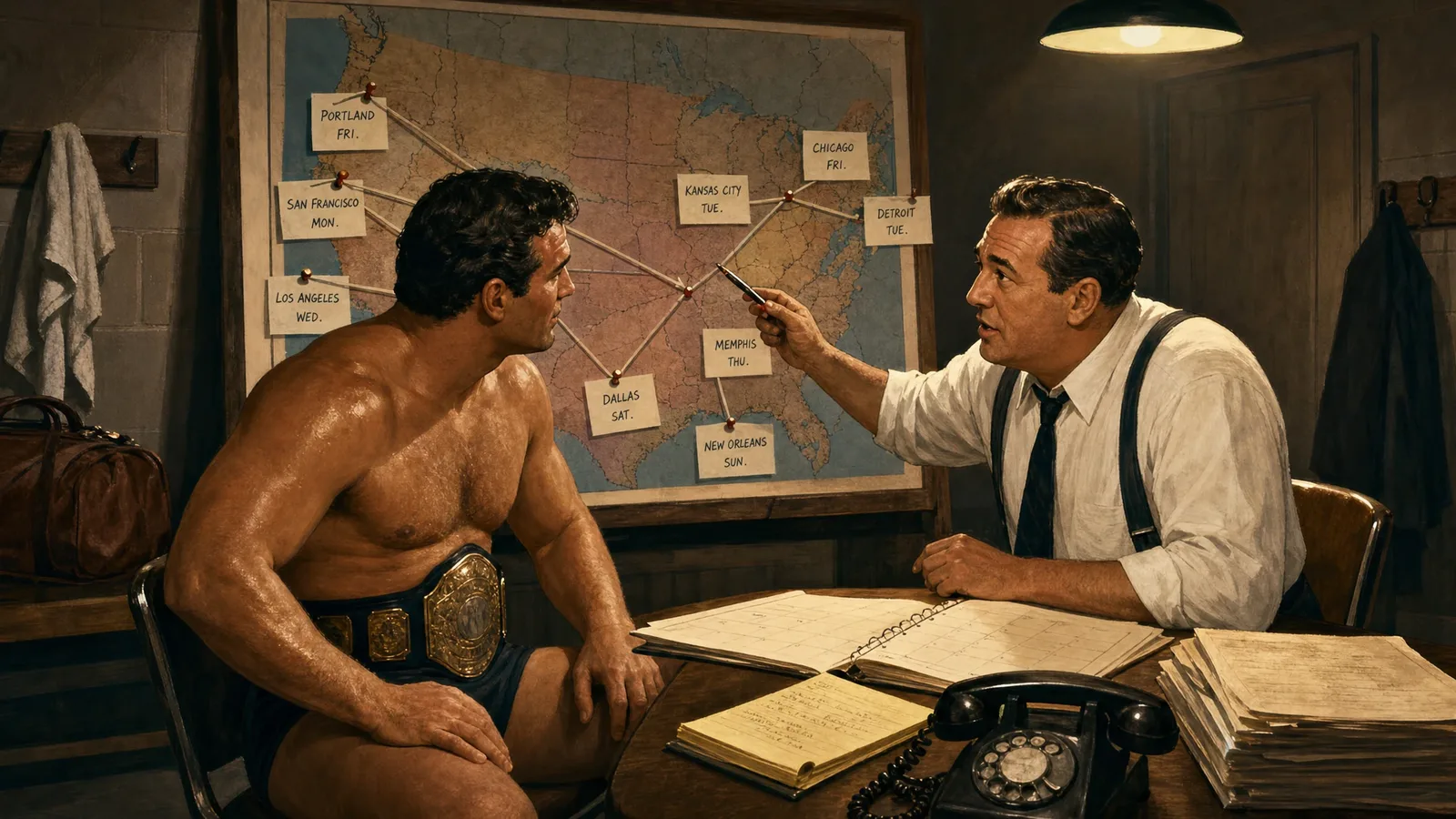
A world champion on a regional circuit map
The clearest starting point is that an NWA world champion was not simply a champion identified with one home promotion. One account describes the new champion as the public face of an alliance who toured its territories until he chose to step aside or until NWA directors and promoters wanted a change. That arrangement gave a single titleholder a role that crossed local boundaries. It did not erase the individual territories. Instead, the champion moved among them, arriving as the holder of a title presented beyond the regular local pecking order.
The travel itself was central to the job. The same account describes champions going from territory to territory, living in hotels and sometimes spending weeks or months away from home. They were also expected to defend the title repeatedly, rather than make purely symbolic appearances. For a viewer studying this period, that distinction matters: the touring champion was an active attraction whose schedule involved a succession of title matches, with the demands of night-after-night work built into the position.
It is useful to keep the scope precise. The documented NWA model concerns a shared world title moving through allied territories, not proof that every regional promotion used the same plan or depended on the same champion. The Pacific Northwest record includes a rival promoter denied membership and later regarded as an outlaw, while the Northeast history describes a promotion that left the NWA and promoted its own champion. A touring title could be prominent, but its presence was neither automatic nor uncontested across all markets.
Why the itinerary required organizational planning
Repeated defenses created a practical vulnerability: an injury or other inability to continue could interrupt the availability of the champion who was travelling from territory to territory. The account of the NWA therefore describes the value of a reserve or designated successor. If the reigning champion could no longer work, a change could be arranged quickly. This is a concrete way to understand succession planning in a touring model. It was tied to maintaining an active title attraction, not merely to deciding who would hold a belt in the abstract.
Lou Thesz’s 1956 transition to Whipper Billy Watson is presented as such a contingency. Thesz required a quick change after a skiing injury, and he dropped the NWA title to Watson in Toronto on March 15, 1956. The episode demonstrates that a title change could be arranged in response to a champion’s availability. It also cautions against treating a touring champion as an untouchable constant: the system had to account for the possibility that its travelling titleholder could no longer continue as planned.
Control over succession was distributed rather than personal. The account says the reigning champion did not alone choose his successor, even though respected champions could have substantial influence with directors and promoters. Promoters could also disagree, including because they favored wrestlers already active in their own areas and hoped title prestige and revenue would help their territories. A useful viewing question follows from this: whose interests appear around a title decision—the champion’s, particular promoters’, or the wider alliance’s? The available evidence shows that those interests could overlap, but they could also compete.
Local promoter ties could shape a champion’s stops
The Toronto title change also supplies an example of local relationships affecting where a major moment happened. According to the account, Thesz agreed to lose the championship to Watson in Toronto as a favor to Southern Ontario promoter Frank Tunney. This does not establish a universal rule for every title switch. It does show that an itinerary and a title change could be connected to a specific promoter relationship, rather than determined only by a simple, territory-neutral sequence of matches.
Watson’s subsequent defenses illustrate the difference between a world champion being used heavily in one circuit and holding that circuit’s separate title. About one-third of his roughly 120 NWA title defenses before November 1956 occurred in Tunney’s loop. The same account notes that Tunney held a share in the St. Louis promotion that year, where Watson also had a successful series of title bouts. Together, those details show an itinerary that could be concentrated in particular connected business settings while the championship remained the NWA world title.
That example offers a careful way to read a champion’s repeated appearances. Frequency in a circuit can show that a promoter had substantial access to the touring attraction, but it does not alone answer whether a world title and a local promotion’s own championship should be treated as the same thing. The documented details identify Watson’s defenses as NWA title defenses and connect his St. Louis activity with Tunney’s ownership interest. When assessing a sequence of defenses, viewers should ask both what title was at stake and what promoter relationships are documented around the schedule.
Return visits gave local challengers a continuing role
The Canadian Prairies provide a particularly clear example of a local wrestler meeting a travelling champion over more than one visit. George Gordienko first challenged Thesz for the NWA title in Edmonton on May 26, 1953. He met Thesz again in Edmonton in April 1955 and then in Regina two days later. This pattern is more informative than a single isolated match: the same regional challenger returned to the champion’s orbit over time, while the champion’s appearances connected Edmonton and Regina to the broader world-title circuit.
A title change was not necessary for the return matches to produce different competitive outcomes. Gordienko lost cleanly in the first Edmonton meeting, then later wrestled Thesz to a time-limit draw and a no-contest. By June 1955, Gordienko was recognized as Canadian Heavyweight champion before another challenge to Thesz. The sequence shows how a regional credential and a world-title challenge could coexist. It should not be flattened into a claim that the regional title replaced the NWA title; the evidence instead records two distinct forms of championship positioning around the same wrestler.
The first Edmonton defense also records the local scale of one touring-title event: Thesz versus Gordienko drew 3,000 people to the Sales Pavilion in 1953. The source situates these Canadian visits in a Prairie territory where Gordienko had become a leading contender through Stu Hart’s Big Time Wrestling, later known as Stampede Wrestling. This is a strong regional case study, but its value lies in its specificity. It documents one territory’s use of a leading local contender, not a formula that every territory followed in identical fashion.
The Pacific Northwest shows the value of recurring defenses
Historian Steve Verrier draws an important distinction in the Pacific Northwest. In his account, Thesz had limited work in the Northwest in 1945, but his major impact in Seattle and Portland came when he began returning during the 1950s to defend the NWA world title. That comparison helps separate an appearance from a continuing title program. A wrestler could work in a region without having the same documented local significance that came with later recurring world-title defenses.
The Northwest example should not be mistaken for a story in which NWA affiliation created the regional promotion from nothing. Don Owen’s operation joined the NWA in 1951 after the Owen dynasty was already established. Verrier’s account therefore treats membership as an addition to an existing local business. In practical terms, that framing helps explain why a touring champion can be understood as a feature brought into a territory with its own history, relationships and established operation, rather than as the source of that territory’s entire identity.
Even the affiliation process was locally contingent. Verrier attributes Owen’s acceptance in part to support from small Oregon wrestling commissions and to relationships with Washington promoters, except Ted Thye. Thye had been rejected for membership, was later considered an outlaw promoter, and supported investigation of practices he viewed as monopolistic and exclusionary. These details make the broader lesson narrower but stronger: a touring title moved through particular networks of relationships, not through a frictionless map in which every promoter occupied the same position.
A territory’s own champion was a different proposition
The Northeast provides a useful contrast to the NWA touring model. WWE’s historical account says Vincent J. McMahon believed Thesz would not draw sufficiently in that region, left the NWA, and promoted Buddy Rogers as his own champion. The key distinction is structural: rather than making the NWA world champion the leading attraction for that regional operation, the breakaway promotion elevated a champion of its own. This is why “world champion” and “territory champion” cannot be treated as interchangeable labels in every historical setting.
The history of Rogers’s physical belt further clarifies how title identities can change. WWE’s account says it had previously been defended as a United States Championship before becoming the first WWE Championship. A belt’s earlier regional identity and its later world-title presentation could therefore differ. For readers examining old programs, posters or title references, the practical question is not only whether an object is called a championship belt, but which title lineage and promotional setting the source actually identifies at that point.
WWE dates Bruno Sammartino’s defeat of Rogers at Madison Square Garden to May 17, 1963, beginning a 2,803-day WWE title reign. That event belongs to the Northeast promotion’s separate WWE title lineage, not to an NWA world-title defense. Read alongside the account of McMahon leaving the NWA and promoting Rogers as his own champion, it provides a contrast with the Prairie and Northwest examples of the NWA title moving through territories. The comparison supports a limited conclusion: touring champions were one documented model, not the only championship arrangement in pre-national wrestling.
How to evaluate a touring-champion story carefully
A careful reading begins by identifying the title and the local setting separately. Was the visitor defending the NWA world title, as Thesz did against Gordienko and later in Seattle and Portland? Was the local wrestler also carrying a regional credential, as Gordienko was recognized as Canadian Heavyweight champion? Or does the record instead concern a promotion’s separate championship lineage, as in the Northeast account of Rogers and Sammartino? These distinctions prevent a useful regional story from being turned into an inaccurate claim that all championships operated under one system.
Next, look for evidence of recurrence and relationships rather than assuming them. The documented cases include Thesz’s repeat Prairie matches with Gordienko, later recurring Northwest title defenses, Watson’s unusually heavy use in Tunney’s loop, and title activity connected with Tunney’s St. Louis share. They also include disagreement among NWA promoters over future champions. Those examples support a picture of the touring championship as active, negotiated and locally adapted. They do not justify assuming the same itinerary, level of cooperation or challenger-building pattern for every territory and every era.
Explore more
- History
- Recurring Local Buildings in Territory Wrestling Markets
- Reading Wrestling Posters as Local Advertising Evidence
- What Three Wrestling Office Accounts Show About Booking Authority

Darryl Polo
Darryl Polo is a passionate wrestling fan covering WWE, AEW, TNA and beyond. He loves great rivalries, breakout stars and the moments that keep fans talking long after the bell. How we work.