
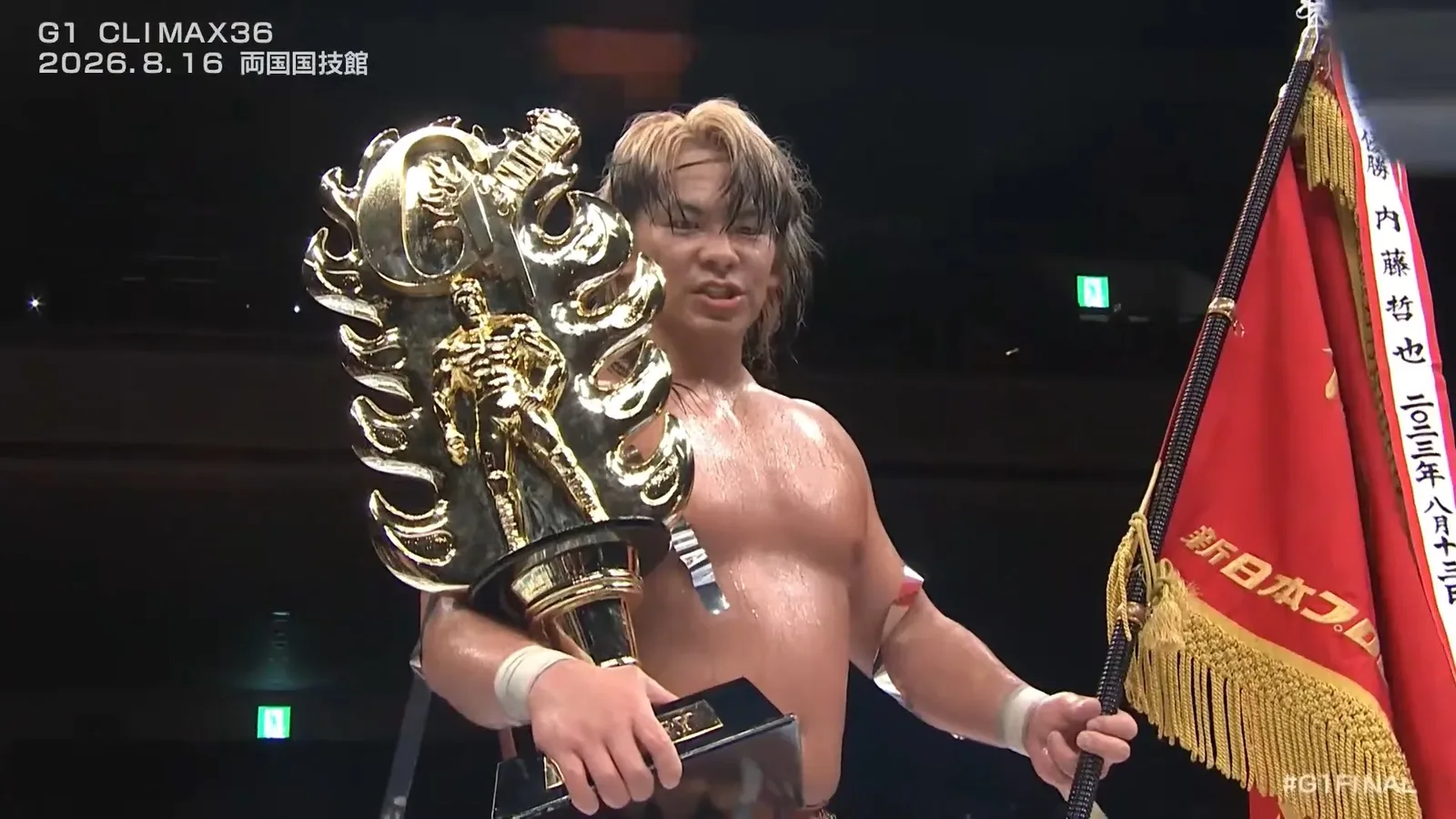
Shota Umino is not dismissing what Ryohei Oiwa has accomplished in New Japan Pro-Wrestling, but he is also not allowing Oiwa’s accelerated ascent to alter his own approach.
Oiwa’s rise has become one of the major talking points around NJPW’s current generation of talent. He holds the record for the shortest span between an in-ring debut and a G1 Climax match victory, an achievement that underlines just how quickly he has made an impression. His momentum will carry into October, when he challenges for the IWGP Heavyweight Championship at King of Pro-Wrestling.
For Umino, Oiwa’s success is worthy of praise rather than panic. The two are part of a group of wrestlers whose development has been closely followed by NJPW audiences, with their careers often discussed in relation to the promotion’s future at the top of the card. But Umino made clear that he does not view another wrestler’s fast progress as evidence that he needs to abandon the patient path he has chosen.
“That’s really impressive. When people come back from excursion you have some like Oiwa becoming very successful very quickly and then you have people like me who are taking one step as it comes. It’s the same thing with Callum Newman and his New Japan Cup win and IWGP title this year. It’s impressive, but it doesn’t rattle me in any way. Not quite the rabbit and the tortoise, but I’m making sure I’m taking every step properly, and when I’m at the top I’ll have every single tool I’ll need to stay there.”
For more background on this topic, read Shota Umino Details Concussion Recovery, Amnesia Symptoms and NJPW Return.
Umino Embraces a Deliberate Route
The most revealing part of Umino’s response is not simply that he remains composed amid the success of Oiwa and Callum Newman. It is the way he defines his own objective. Umino is not talking only about reaching the top of NJPW. He is talking about arriving there with the complete set of skills required to remain there.
That distinction matters in a company where championship opportunities, tournament performances, and major-event victories can swiftly change perceptions. A rapid breakthrough can create immediate excitement, but Umino’s comments suggest he is thinking beyond the moment of a title win or a marquee victory. His focus is on sustained preparedness: building the tools necessary to handle the expectations, opposition, and pressure that accompany a place at the summit of the promotion.
Umino framed that approach through the familiar comparison of the rabbit and the tortoise, while noting that the situation is not exactly the same. The point remains clear. He sees value in moving carefully, improving with every stage of his career, and refusing to let the pace of someone else’s journey dictate his own.
That is a notable perspective at a time when Oiwa’s trajectory is drawing increasing attention. A record-setting G1 Climax victory so soon after his debut is the kind of statistic that immediately separates a wrestler from his peers. Oiwa’s upcoming IWGP Heavyweight Championship match at King of Pro-Wrestling adds another substantial marker to that climb. An opportunity for NJPW’s top prize places him in one of the promotion’s most prominent possible positions.
Umino, however, did not answer Oiwa’s achievement with defensiveness. He called it impressive and acknowledged that some wrestlers return from excursion and become highly successful in a short period. Rather than minimizing the accomplishment, he accepted the reality of different career timelines.
Oiwa’s Momentum Heads to King of Pro-Wrestling
Oiwa now enters a pivotal October stretch with an IWGP Heavyweight Championship challenge ahead of him. The King of Pro-Wrestling event will provide the latest and largest test of the momentum surrounding him. Regardless of the outcome, the fact that Oiwa is set to compete for the championship reflects the significance of his standing within NJPW’s present landscape.
The G1 Climax has long been a proving ground for wrestlers looking to establish themselves against the promotion’s elite. Winning a match in that environment is meaningful under any circumstances. Doing so at a record-setting speed following one’s in-ring debut provides an especially striking measure of Oiwa’s early advancement.
There is also a broader generational element to the discussion. NJPW’s rising wrestlers are not moving in identical ways, and Umino’s comments identify that contrast directly. Oiwa has surged forward quickly. Newman’s New Japan Cup win and IWGP title reign this year represent another example of a major advancement. Umino, meanwhile, is emphasizing gradual development.
Those differing routes naturally invite comparisons from fans, opponents, and observers. In wrestling, comparisons often become louder when performers are connected by age, experience level, training background, or their place within a promotion’s future plans. A wrestler can be measured by tournament results, championship opportunities, major-event placement, and the speed at which those accomplishments arrive.
Umino’s stance is that such comparisons do not have to become a source of instability. He can recognize Oiwa’s accomplishment, point to Newman’s success, and still maintain confidence in his own development. His comments present a competitor who is aware of the race around him but is unwilling to let that race become the sole standard for his career.
Different Timelines, Shared Stakes
The reference to excursion is important in understanding Umino’s point. Returning from excursion can be a defining transition for NJPW wrestlers, bringing new experience and a clearer sense of identity into the next phase of their careers. Yet a return does not guarantee the same immediate results for everyone.
Some performers gain momentum quickly and find themselves in major matches soon after. Others take a more measured climb, adding experience through each rivalry, tournament, and high-pressure assignment. Neither route automatically determines the long-term outcome. Umino’s argument is that the latter path can have its own advantages if every step contributes to a stronger foundation.
His wording also suggests he is thinking about the demands placed on a top champion or central figure in NJPW. Reaching the main-event level is one challenge. Maintaining that level against a rotating group of challengers, through repeated headline situations, is another. Umino wants to ensure that when his opportunity comes, he will be equipped for more than a single breakthrough moment.
That outlook adds texture to the discussion around NJPW’s younger names. Oiwa’s rise can be celebrated as a major success story without turning it into a negative judgment on wrestlers progressing at another speed. Newman’s accomplishments can be acknowledged as evidence of his own ability without creating a mandatory template for everyone else. Umino’s answer rejects the idea that all competitors must follow the same schedule in order to become complete performers.
At the same time, Umino’s confidence should not be mistaken for complacency. His words carry an ambition that is unmistakable. He expects to be at the top eventually. The question he is concentrating on is how to make sure he is ready to stay there once he gets there.
A Clear Message From Umino
In an environment where fast-rising names can quickly reshape the title picture, Umino has delivered a simple message: he is paying attention, he respects what his peers are doing, and he remains secure in his own process.
Oiwa’s October title challenge will place an immediate spotlight on the record-setting young wrestler and on the possibilities ahead of him. Newman’s New Japan Cup victory and IWGP title reign already stand as major achievements this year. Umino is not trying to compete with either man through public declarations about speed or urgency. Instead, he is presenting his method as one based on preparation, patience, and durability.
That makes Umino’s response more than a reaction to Oiwa’s next opportunity. It is a statement of intent for his own future. He recognizes that NJPW’s landscape is evolving and that several wrestlers are making significant moves. But he believes his careful accumulation of experience will ultimately leave him with every tool he needs when his turn at the top arrives.
For now, Oiwa’s IWGP Heavyweight Championship challenge at King of Pro-Wrestling remains the next major chapter in this evolving picture. Umino will be watching the same changing landscape as everyone else, but he has made it clear that he will not be rattled by it.

Darryl Polo
Darryl Polo is a passionate wrestling fan covering WWE, AEW, TNA and beyond. He loves great rivalries, breakout stars and the moments that keep fans talking long after the bell. How we work.