
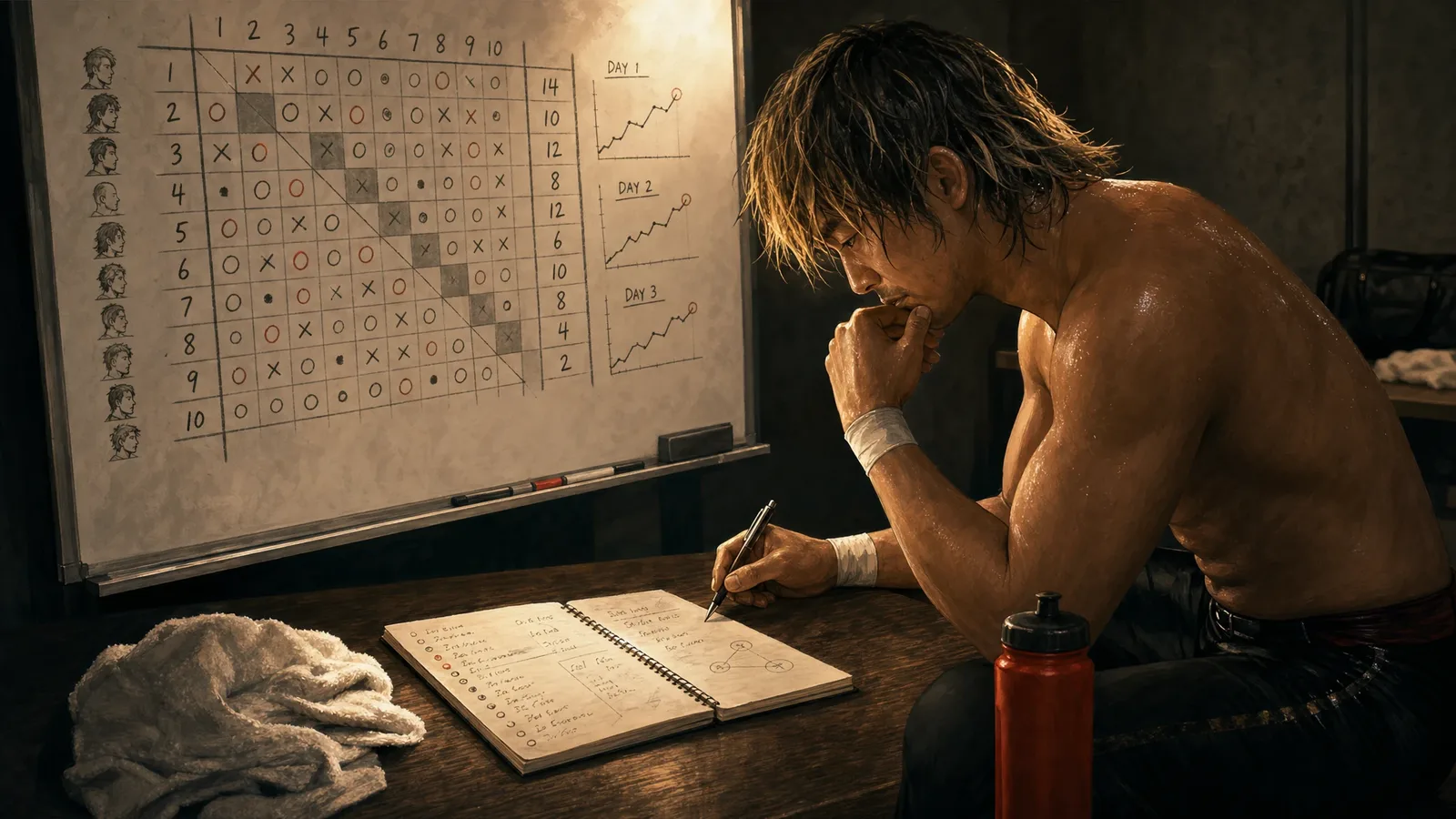
A completed campaign, not only a final
G1 Climax 28 is especially useful for reading a tournament as a campaign because its decisive A Block night, B Block night and final took place across three consecutive dates in August 2018. That sequence gives each night a distinct job. One block winner had to be determined, then the other, then the finalists met after their separate routes had been settled. Looking only at the final removes the information that made the matchup possible: the standings pressure, the matches that eliminated alternatives and the earlier results that decided a level table.
The basic structure of this edition was direct but consequential: A Block and B Block each produced one winner, and those winners advanced to the final. Hiroshi Tanahashi won A Block; Kota Ibushi won B Block. That means the final was not simply a match placed at the end of the schedule. It joined two completed block campaigns. A useful viewing habit is to ask two separate questions before assessing a final: what did each wrestler need to do to win his own block, and which particular results made that route possible?
The closing three days were held at Nippon Budokan because construction was taking place at Sumo Hall that summer. This is important as context, but it should not be mistaken for a permanent G1 convention. The venue does, however, give the stretch a shared setting. In this specific case, the building connected the decisive matches and also carried a documented memory for one B Block rivalry. A careful campaign reading can recognize that shared setting without turning it into a claim that venue continuity always shapes tournament outcomes.
A draw that decided A Block
Tanahashi clinched A Block by going to a 30-minute draw with Kazuchika Okada. The result is a useful corrective to the idea that only a win can create a decisive tournament moment. Here, the draw was not an unresolved interruption before a later decision. It settled the relevant issue because Tanahashi’s existing position in the block made the result sufficient. The question for viewers is therefore not merely who won the match, but what each available result would have done to the block race at that point.
The numbers explain the draw’s force in this one campaign. Tanahashi completed A Block on 15 points and Okada on 13, so the draw preserved Tanahashi’s lead. That makes the closing minutes legible in a different way than an ordinary match finish: Tanahashi did not require a pinfall or submission to emerge as block winner, while Okada needed more than the draw supplied. The standings do not replace the match itself; they identify why an apparently non-winning outcome carried a finality for the block.
The pairing also came with tournament-specific history. The 2018 draw was Tanahashi and Okada’s third draw in G1 competition. Their meeting followed an Okada victory over Tanahashi at Wrestling Dontaku earlier in May 2018, placing a recent result beside their repeated G1 stalemates. Reporting noted that Tanahashi used Okada’s tombstone piledriver in an effort to win. Those details offer concrete lenses for a rematch: prior results establish a record, while a familiar opponent’s signature offense can serve as a visible callback within a late tournament match.
Condition belongs beside the table
The A Block decider also carried documented physical context. Tanahashi had dealt with health problems during the preceding two years, and he tweaked his knee during the draw with Okada. This does not establish a universal rule that every late tournament match should be interpreted chiefly through injury. It does show why a campaign can be read through more than points and rivalry history. When a report records a physical issue, viewers can track how that condition sits alongside the competitive task still facing the wrestler.
In this case, the knee detail adds a second layer to the fact that Tanahashi reached the final. The block result answered the qualification question, but it did not erase what had happened in earning it. A responsible reading keeps those categories separate: the standings establish advancement, while the report of the knee issue supplies match-level context. That distinction avoids treating a wrestler’s condition as an explanation for every later development while still recognizing it as a documented part of the closing stretch.
B Block was decided across more than one match
B Block’s final night demonstrates why a campaign cannot always be followed through a single headline matchup. Before that night, Kenny Omega and Tetsuya Naito each had 12 points, while Ibushi had 10. Two matches were therefore necessary to determine the block: Ibushi faced Omega in the main event, while Naito faced Zack Sabre Jr. The setup asks viewers to follow the interlocking conditions. A wrestler’s path may depend on his own result, another contender’s result, or both at once.
Naito had to defeat Zack Sabre Jr. to stay alive in the B Block race. His match was thus directly relevant to the eventual block outcome even though it was not Omega versus Ibushi. Naito lost, ending his attempt to become only the third back-to-back G1 winner. That recorded ambition adds a longer historical dimension to one final-night defeat, but the immediate tournament point remains clear: a loss in a separate match changed the possible outcomes of the block around it.
Ibushi then defeated Omega and advanced to face Tanahashi in the final. Their match combined a qualification race with a repeat-opponent record: contemporary reporting described Omega as winless in three meetings with Ibushi after the loss. Omega entered as IWGP Heavyweight Champion, but that championship was not on the line in the G1 block match. The pressures were separate in this example. One was the champion’s status; the other was a tournament match whose result governed advancement rather than a title change.
The earlier wins that settled a tie
The final B Block totals make the value of earlier nights unmistakable. Ibushi, Omega and Naito all ended on 12 points, so the table alone could not identify the block winner. Ibushi advanced by tiebreaker because he had defeated both Naito and Omega during the round-robin. An earlier victory can therefore become decisive after the points are counted, even if it did not immediately end the race. For this campaign, the final-night win over Omega mattered, but it worked alongside Ibushi’s earlier win over Naito.
This is a precise reason to keep a running record of previous meetings inside a tournament. The headline total tells viewers that a tie exists; the head-to-head results explain how the tie is resolved in this case. Rather than treating the tiebreaker as an obscure administrative add-on, it can be viewed as the delayed payoff to matches already completed in the block. The useful question is simple: if the contenders finish level, which earlier results between them are already waiting to become decisive?
Omega and Ibushi also brought a venue-specific echo to their B Block meeting. They had wrestled at Nippon Budokan in 2012, six years before meeting there again in 2018. The documented framing around the match included that return to the same building. Venue memory is not the same thing as a standings advantage, and it did not replace the numerical and tiebreaker logic of B Block. It is better understood as an additional layer: the match had a competitive consequence while also revisiting a prior encounter in the same location.
What the final added to the campaign
The final placed contrasting tournament histories beside the immediate momentum of two block wins. Tanahashi entered seeking a third G1 victory, while Ibushi was pursuing his first. The winner was set to receive a world-title opportunity at Wrestle Kingdom 13 on January 4, 2019. Those facts define the final’s stated stakes without requiring broader claims about what the tournament meant beyond this edition. The campaign ended with a winner, but the prize also pointed forward to a later title opportunity.
That future opportunity had a stated limit. Contemporary reporting noted that the prior seven G1 winners had not converted their Wrestle Kingdom title opportunities into championship wins. Winning G1 Climax 28 therefore guaranteed neither a later title victory nor a simple end point for the story. It created a major opportunity. This qualification is valuable when discussing stakes: a prize can be highly significant while still remaining distinct from the later outcome attached to it.
Fightful’s event report records that Tanahashi defeated Ibushi in the final. Its match description also identifies a sustained physical thread: Tanahashi repeatedly targeted Ibushi’s knee, while Ibushi repeatedly survived or escaped submissions and other leg-focused attacks before Tanahashi won. This provides a contained way to read the closing match. Rather than describing it only as a showcase between block winners, viewers can trace the reported pattern of attrition and resistance that ran through the final.
Tanahashi ended the final with three High Fly Flows. That finish distinguishes the payoff from the mechanisms that produced it: A Block was decided through a draw that preserved a lead, B Block required a tiebreaker after three wrestlers finished level, and the final had its own documented knee-focused pattern before its closing sequence. Taken together, these are practical checkpoints for revisiting this campaign: standings before the night, relevant outside results, earlier head-to-head wins, repeat-rival history, recorded physical context and the match pattern that completed the tournament.
A compact viewing method for this edition
For G1 Climax 28’s closing stretch, start with the block position rather than the final result. In A Block, ask why a draw was enough for Tanahashi and insufficient for Okada. In B Block, ask why Naito versus Zack Sabre Jr. mattered alongside Omega versus Ibushi, then check the head-to-head results after the three-way tie on 12 points. These questions keep the viewer focused on the documented competitive structure instead of flattening every match into an isolated win or loss.
Then add the layers that were specific to the wrestlers and matches: Tanahashi and Okada’s G1 draw history, the recent Okada victory, Tanahashi’s recorded knee issue, Omega’s repeat-opponent record with Ibushi and the Budokan connection around Omega and Ibushi. Finally, distinguish the tournament win from the Wrestle Kingdom title opportunity it earned. This method does not claim that all tournaments operate identically. It shows why this completed G1 campaign accumulated stakes over multiple nights before Tanahashi’s final victory over Ibushi.
What this campaign makes visible
The A Block route shows that standings can change the meaning of a result without changing the result itself. Tanahashi and Okada wrestled to a draw, yet the existing point gap meant that Tanahashi left as block winner. The B Block route shows a different form of accumulation: a final-night win was essential, but an earlier win over Naito became equally necessary once three wrestlers shared the same total. The final then supplied a separate match-level thread through Tanahashi’s repeated attacks on Ibushi’s knee.
Taken on its own terms, G1 Climax 28 offers a narrow but useful campaign model. Follow the current points, then identify which results elsewhere affect the picture. When the totals are level, return to the recorded head-to-head meetings. When a rivalry has prior tournament draws, a recent encounter or a return to the same venue, treat those details as context rather than substitutes for the standings. Finally, keep the tournament victory distinct from the later title opportunity. Those distinctions preserve what each stage of this completed campaign actually decided.
Explore more

Darryl Polo
Darryl Polo is a passionate wrestling fan covering WWE, AEW, TNA and beyond. He loves great rivalries, breakout stars and the moments that keep fans talking long after the bell. How we work.