
A focused way to read the division
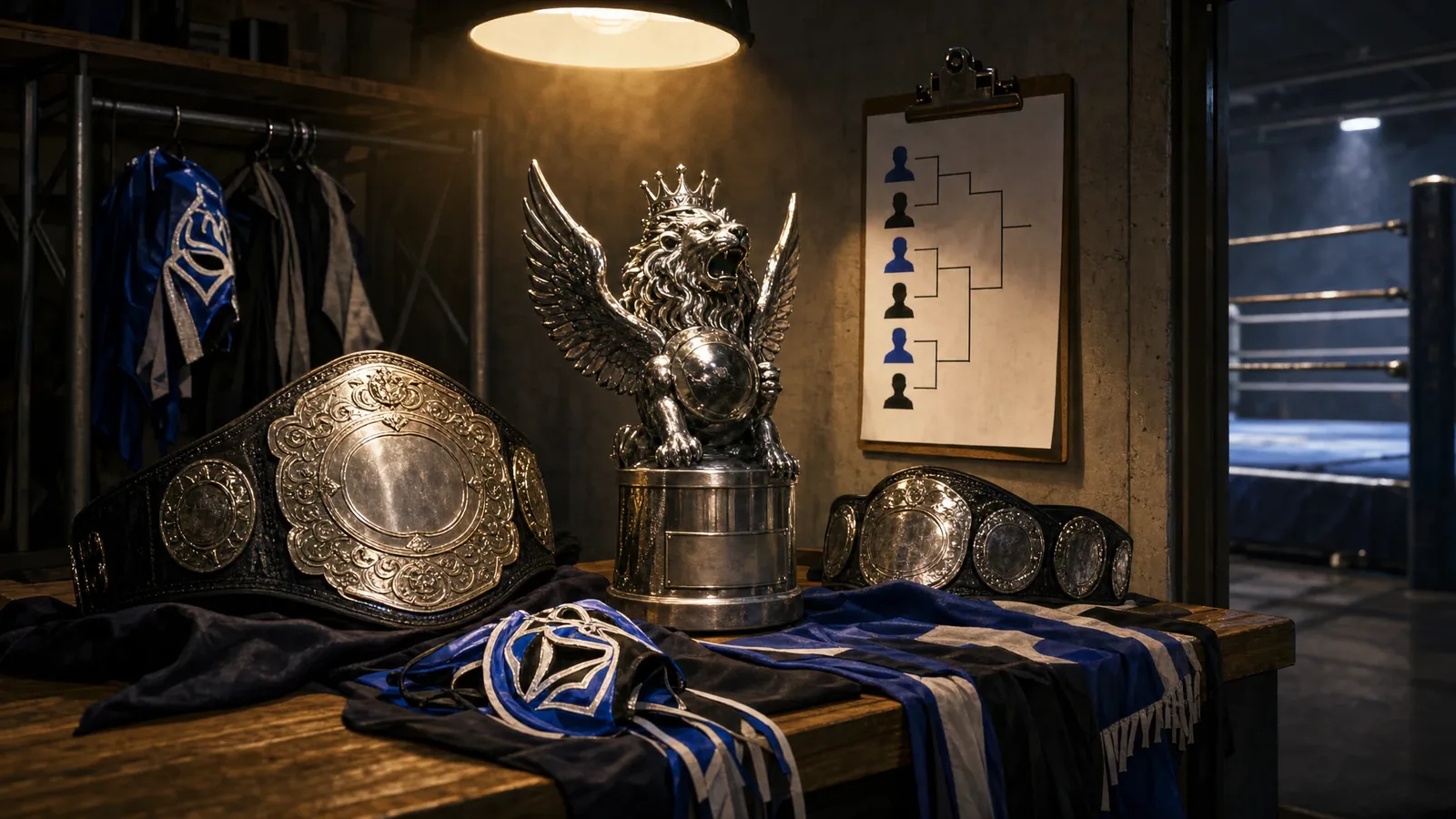
The clearest evidence here comes from three separated snapshots: Best of the Super Juniors coverage in 2017 and 2018, plus the 2024 tournament final. Those reports do not provide a complete history of NJPW’s junior heavyweight division, but they do show recurring ways the division was framed. A tournament could carry its own comeback story and final presentation; it could lead directly to a junior championship challenge; and junior-tag accomplishments could be distinguished from heavyweight-tag competition. Reading those elements together is more useful than assuming that a division is defined by one move set or one championship alone.
It is also important to separate what the reports establish from what they leave open. The 2017 coverage describes the Best of the Super Juniors field in lighter-weight terms, yet gives neither a numerical weight threshold nor a full eligibility rule. That means a viewer can recognize the tournament as junior heavyweight competition without turning an incomplete description into a universal rulebook. The historical framing is substantial: 2017 reporting said the tournament’s history reached back to 1988. But the available examples are best used to study presentation and stakes, not to make claims about every competitor or every era.
The tournament supplied a recurring division stage
Best of the Super Juniors provided a repeated named contest through which junior heavyweight competitors could be placed in direct comparison. In the 2017 final, KUSHIDA met Will Ospreay. The report added a layer of history by noting that Ospreay was seeking a second straight tournament win, with Tiger Mask’s 2004–05 run identified as the earlier repeat-win benchmark. That framing made the final about more than a single match result: the competitors entered with distinct tournament positions and a stated historical measuring point. For viewers, those references are a useful cue that the tournament had continuity beyond one annual field.
The 2018 final supplies another example of the tournament being treated as a major individual destination. Hiromu Takahashi defeated Taiji Ishimori in a 34-minute final at Korakuen Hall. In 2024, El Desperado defeated Ishimori in the Best of the Super Juniors 31 final at Dominion in Osaka-jo Hall. Desperado’s victory was reported as his first in the tournament. These examples do not establish an unchanging format or hierarchy for every tournament, but they show the competition being presented as an accomplishment with its own history and career significance.
A tournament final can be read on two levels at once. The immediate level is the winner and loser; the longer level is the path that made the meeting meaningful. The 2024 report specified that Desperado reached the final by defeating DOUKI and that Ishimori advanced by defeating TJP. In 2017, KUSHIDA arrived after overcoming a 3–1 deficit in his block and winning that block. Those details give a fan practical questions to ask while watching tournament coverage: What did each finalist have to overcome, and what information is being emphasized about that route? The answer will vary by year, but the route itself can be part of the stakes.
The 2017 final linked tournament form to a singles-title story
KUSHIDA’s 2017 victory over Ospreay, achieved in 27 minutes and 59 seconds, was presented within a comeback narrative. Earlier in the year, he had lost in two minutes to then-IWGP Junior Heavyweight Champion Hiromu Takahashi at Sakura Genesis. The final therefore was not described as an isolated tournament conclusion. It was positioned against a prior loss to the division’s champion, giving viewers a concrete example of how tournament competition and the junior singles championship could occupy the same story space without being the same prize.
The same 2017 coverage connected KUSHIDA’s tournament story with the introduction of Back to the Future as a finishing move. That detail matters because it places an in-ring development inside the tournament narrative rather than outside it. A fan following the division can therefore watch for more than standings or trophy imagery: reports may frame a new tactic, finish or recovery from setbacks as part of what a tournament run means. This is not evidence that every Best of the Super Juniors story works that way. It is a specific example of a singles competitor’s tournament presentation being tied to a championship-oriented context.
Match identity was broader than a high-flying label
The 2017 KUSHIDA–Ospreay final is especially useful for avoiding a one-note reading of junior heavyweight wrestling. The report characterized the match through holds, body-part targeting, aerial offense, counters, strikes and submission attempts. KUSHIDA’s strategy included attacking Ospreay’s right arm and knee. A viewer does not need to deny the aerial offense to notice the wider set of approaches described in the same match. The more precise conclusion is limited but valuable: this particular major junior heavyweight final was presented through multiple kinds of offense and strategy, not simply through flying.
Hiromu Takahashi made a similarly narrow, personal point in 2018. He said that his work had included England, the United States, Mexico and Japan, and said he did not need to be only a high-flyer to be a top junior heavyweight. That is testimony about Takahashi’s own approach, rather than a rule for the whole division. Still, alongside the 2017 match description, it gives fans two reasons to be cautious with broad labels. When watching a junior match, ask what the participants actually emphasize: targeted damage, counters, submissions, strikes, aerial offense, or some combination. The available examples do not support treating any one answer as mandatory.
Finals also used collective presentation
The finish of a tournament can present the winner as part of a larger junior heavyweight field. In 2017, Dragon Lee, Tiger Mask, Ryusuke Taguchi, Ricochet and Volador Jr. were placed around ringside for the final, with the stated purpose of deterring interference. Afterward, the presentation included a trophy, a ring gathering of tournament wrestlers, Jushin Thunder Liger’s participation and confetti. Those details do not prove how every tournament was staged, but they show a final being framed as a shared divisional moment as well as a contest between KUSHIDA and Ospreay.
Liger’s role gave the 2017 scene an additional point of continuity. He was on commentary for the final after wrestling his last Best of the Super Juniors match of his career a few days earlier. Taken with the post-match ring gathering, this is an example of tournament presentation connecting current finalists, other participants and a performer associated with the competition’s past. A fan can distinguish this kind of framing from match mechanics: it does not tell us who used which offense, but it does show how the event represented the tournament as something larger than its final result.
Junior-tag credentials and heavyweight tags were not interchangeable
The 2018 Young Bucks example provides the available evidence for reading the tag side carefully. They were described as seven-time junior heavyweight champions before challenging SANADA and EVIL for the IWGP Tag Team Championship at Dominion. The report presented that match as a move into the heavyweight tag division, and a win would have been their first IWGP Tag Team Championship reign. The distinction is important: success in junior heavyweight tag competition was acknowledged as a substantial credential, but it was not presented as identical to winning the heavyweight tag championship.
That example offers a straightforward viewing habit. When a team changes championship setting, identify which tag credential is being referenced and whether the presentation describes a move between junior and heavyweight competition. Doing so prevents a fan from flattening all tag achievements into one category. It also prevents the opposite mistake of treating a team’s junior history as irrelevant once it appears in a heavyweight context. The 2018 report did both at once: it recognized the Bucks’ seven junior heavyweight championship reigns and marked the heavyweight title pursuit as a separate first-time opportunity.
Individual, faction and tournament identities could overlap
The 2018 final shows that a competitor could enter junior singles competition with a faction identity still visible in the presentation. The report identified Takahashi as a member of Los Ingobernables de Japon while covering his win over Ishimori. This does not demonstrate how factions operated across all NJPW programming or establish that faction membership shaped every junior match. It does show that a junior singles tournament final did not require competitors to be presented only through the division label. For a viewer, that is a reminder to track several layers at once: tournament position, championship context and the affiliations explicitly named in coverage.
The reports also preserve individual differences instead of reducing participants to a single division-wide template. KUSHIDA’s 2017 account emphasized a recovery from block trouble, a previous short loss to the junior champion and a new finishing move. Takahashi’s 2018 comments addressed his own work across several countries and his preference not to be defined solely as a high-flyer. Desperado’s 2024 win was identified as his first Best of the Super Juniors victory. These are different kinds of information—story position, personal testimony and tournament milestone—but each makes a competitor legible in a distinct way.
The 2024 final made the tournament-to-title link explicit
In 2024, the connection between Best of the Super Juniors and the division’s singles championship was stated directly after the final. Desperado was confronted by IWGP Junior Heavyweight Champion SHO and challenged him to a steel-cage title match. This is the strongest available example of tournament success being immediately turned toward the junior championship. It does not establish that every tournament winner always receives the same next step, nor does it establish a general eligibility rule. What it does establish is that, in this case, the winner’s next presented objective was the title held by SHO.
The 2024 placement also shows that junior heavyweight stakes could occupy a particularly prominent slot on a major card. A fan vote put Desperado versus Ishimori in Dominion’s main event ahead of an EVIL versus Jon Moxley lumberjack match. Combined with the immediate SHO confrontation, the sequence offers a compact way to read the event: the tournament final was selected for the closing position, then used to launch a junior title challenge. That is evidence of the presentation of this specific final, not a claim about commercial impact, popularity across all eras or every NJPW card.
Explore more

Darryl Polo
Darryl Polo is a passionate wrestling fan covering WWE, AEW, TNA and beyond. He loves great rivalries, breakout stars and the moments that keep fans talking long after the bell. How we work.