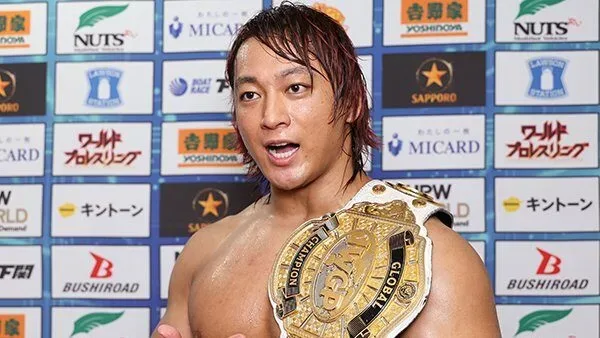
Shota Umino has offered a candid account of the concussion symptoms that sidelined him at the beginning of the G1 Climax, revealing that amnesia and sensitivity to blue light made even basic day-to-day tasks difficult during the first stages of his recovery.
The New Japan Pro-Wrestling star is now back in action and competing on the Road to Destruction tour. However, Umino’s latest comments underscore how serious the situation was immediately after the injury, as he spent two weeks largely confined to his home while following the medical guidance given to him.
Umino said that the initial period was marked by an inability to use devices such as his television and phone, as well as substantial problems with memory. The experience was not simply a matter of taking time away from the ring. It affected his independence, his confidence in routine decisions and his ability to complete ordinary errands.
“I was pretty much a shut-in for the first two weeks,” Umino said. “Blue light is a shock to the brain and I was dealing with amnesia, so for a fortnight I didn’t leave the house and I couldn’t use the TV or my phone.”
For more background on this topic, read NJPW Road To Destruction Results: United Empire and House Of Torture Score Wins in Hokkaido.
Memory Issues Made Everyday Life Difficult
Umino expanded on the consequences of the amnesia, describing a stretch in which household responsibilities and short trips outside became stressful challenges. He explained that he could not trust himself to remember whether he had turned off the gas, leaving him unable to cook for himself.
Even after he was able to venture out as far as a convenience store, the memory lapses continued to interfere. Umino recalled repeatedly returning to check whether he had locked his door, only to reach the store and realize that he had forgotten his wallet.
“I wouldn’t be able to remember whether I turned the gas off or not, so I couldn’t cook for myself,” Umino said. “And when I was able to go out as far as the convenience store, I would forget whether I locked the door or not. Like I would go back and forth three times, checking. And when I finally got there I’d realise I’d forgotten my wallet. That kind of thing.”
Those details put a human perspective on a concussion absence that can otherwise be reduced to a simple injury update. Wrestlers are often judged by how soon they return, but Umino’s account illustrates why recovery cannot be measured only in missed matches or tournament dates. The effects extended beyond the ring and into the most mundane parts of daily life.
Umino had been forced out of action at the start of the G1 Climax. For a wrestler in his position, missing time at the beginning of New Japan’s signature tournament is a major setback. The G1 is not merely a collection of matches; it is a central proving ground in NJPW, a demanding schedule that can shape momentum, rivalries and championship direction for the months that follow.
Still, Umino’s comments make clear that the priority had to be his health. The severity of the symptoms left no room for a rushed attempt to return to competition. Rather than framing his time away as frustration over a missed opportunity, he credited the speed and care of the medical response for helping him reach a point where he could safely resume activity.
Umino Credits Swift Medical Response
Umino said the symptoms were severe, but emphasized that he was evaluated quickly and followed the appropriate procedures. He stated that doctors found no abnormalities on his brain and that he has now been cleared to compete.
“The symptoms were pretty bad,” Umino said. “But I got it checked out relatively quickly, and the doctors were awesome at making sure I took the right steps. I went through the proper procedures and there’s no abnormalities at all on my brain, so I’m completely good to go.”
He specifically praised both the doctors involved and the company’s handling of the matter. Umino believes the decisions made early in the process played an important role in his recovery, a significant point given the seriousness of the symptoms he described.
“But taking the right steps quickly is a big reason for that,” Umino added. “All thanks to the company and the doctors making the right calls.”
The comments offer welcome reassurance regarding Umino’s present status. He says there are no abnormalities on his brain and that he is completely ready to return. At the same time, the path he described reinforces why an athlete’s clearance process must take precedence over the pressure of a schedule, a major event or the desire to get back in front of fans.
Concussions have become an increasingly important subject across combat sports and professional wrestling alike. While wrestling has unique physical demands, the central concern remains the same: a head injury must be treated seriously, and athletes need the time, evaluation and medical oversight required before resuming high-impact activity. Umino’s experience is a stark reminder that the visible moment of injury is often only the beginning of the story.
A Return on the Road to Destruction Tour
With the recovery process completed and his return underway, Umino is active on NJPW’s Road to Destruction tour. The tour gives him an opportunity to re-establish his in-ring rhythm after an absence that began at the start of the G1 Climax.
For Umino, returning to the road also represents a personal milestone. The wrestler known as “The Roughneck” has built much of his identity around intensity, resilience and a willingness to meet high expectations. His latest absence tested those qualities in a very different way. There was no opponent to outfight and no match strategy to adjust; there was only the discipline required to rest, follow medical direction and wait until he was cleared.
That context may make his comeback more meaningful than a standard return from injury. Umino did not describe a minor setback or a brief precautionary break. He described being unable to cook because he could not be certain whether the gas had been turned off. He described checking his door repeatedly before a simple trip to a convenience store, then forgetting his wallet when he got there. These are deeply unsettling symptoms for anyone, let alone an athlete accustomed to operating in an environment that demands precise timing, physical awareness and split-second decision-making.
His openness is notable because it provides a fuller picture of what concussion recovery can entail without minimizing the difficulty of the process. Umino has been direct that the symptoms were “pretty bad,” while also being equally direct that he has since undergone the necessary procedures and received a clean bill of health regarding brain abnormalities.
NJPW now has Umino back on the Road to Destruction schedule, and the focus can gradually shift toward his performances in the ring. There will naturally be attention on how he looks after missing the opening portion of the G1 Climax, especially given his standing as one of the promotion’s prominent younger stars. Yet the most important development is that his return came after he and the medical staff took the situation seriously.
The Bigger Significance of Umino’s Update
Umino’s words are valuable not because they turn a difficult medical issue into spectacle, but because they make the consequences of a concussion more understandable. Wrestling audiences regularly see bruises, cuts and joint injuries that have immediate visual evidence. Cognitive symptoms can be harder to see from the outside. An absence might look quiet on a tour schedule, while the wrestler involved is dealing with limitations that reshape every part of normal life.
By explaining the isolation, blue-light restriction and memory problems he faced, Umino has shown why recovery required patience. By explaining that he sought help quickly and followed the required steps, he has also highlighted the importance of a careful and structured response.
For now, Umino is back where he wants to be: competing for New Japan Pro-Wrestling on the Road to Destruction tour. His return follows a difficult recovery period, but he has expressed confidence in his current condition and gratitude toward the people who helped him get there. After a frightening interruption at the start of the G1 Climax, the next chapter of Umino’s season can finally take place in the ring.
Darryl Polo
Darryl Polo is a passionate wrestling fan covering WWE, AEW, TNA and beyond. He loves great rivalries, breakout stars and the moments that keep fans talking long after the bell. How we work.