
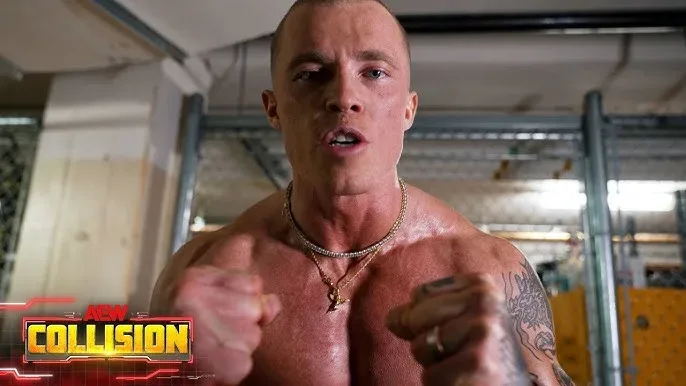
Kyle Fletcher has identified match review as one of the most important habits in his ongoing development as an AEW wrestler.
Fletcher, who has emerged as one of the promotion’s most prominent rising performers over the past several years, said he makes a point of watching every match he has after it takes place. For the Australian wrestler, the purpose is not simply to revisit highlights or relive the experience. It is a practical exercise in evaluating his performance from a more detached perspective and using what he sees to improve the next time he steps through the ropes.
Speaking with Westwood One Sports Night, Fletcher was asked whether he goes back and watches his matches. His answer made clear that reviewing the finished product is a central part of how he approaches his craft.
“Yeah. I try and watch every single match of mine back. I think it’s the- I think it’s a very important part of the feedback loop, being able to watch myself objectively removed from it and look at it as a finished product and be able to take that feedback and apply it to myself.”
For more background on this topic, read Andrade El Idolo Explains How AEW Fans Turned His Pants Removal Into a Signature Moment.
Fletcher Views Review as Part of the Feedback Loop
Fletcher’s description of a “feedback loop” speaks to the difference between performing a match in real time and assessing it once the physical pressure and emotion of the moment have passed. A wrestler experiences a bout from inside the action, reacting to an opponent, a crowd and the shifting demands of the match as it unfolds. Watching it back creates an opportunity to evaluate the presentation from another angle.
That distinction matters for a performer competing on a major platform. A match is not only defined by the moves executed in the ring. Timing, pacing, character work, positioning, crowd response and the way key moments come across to viewers can all shape the final impression. Fletcher’s approach allows him to examine the performance after it has become, in his words, a “finished product.”
His comments also underline a disciplined approach to improvement. Rather than treating feedback as something that comes only from coaches, opponents or outside observers, Fletcher is taking responsibility for studying his own work. The process gives him a chance to identify elements he wants to retain and areas he may want to refine in future bouts.
That type of review does not necessarily mean that every match requires wholesale changes. It can be as much about recognizing what worked as it is about noticing what did not. An effective sequence, a successful transition, a moment that connected with the audience or a choice that helped advance a match can all provide useful information for a wrestler looking to build consistency.
An AEW Career Defined by Continued Progress
Fletcher has become one of the standout young wrestlers associated with AEW’s in-ring scene. His rise has been marked by an increasing profile and a reputation as a highly capable performer, with his work placing him among the company’s notable emerging talents.
In a promotion with a deep roster and a major emphasis on match quality, the ability to keep developing is especially valuable. Fletcher’s willingness to revisit his performances offers insight into the preparation behind that progression. He is not presenting growth as an abstract idea; he is describing a repeatable method of watching, assessing and applying lessons.
The phrase “objectively removed from it” is particularly revealing. In the immediate aftermath of a match, performers may remember how a sequence felt, how difficult it was physically, whether communication was smooth or how the audience sounded from ringside. The television or recorded version can reveal something different. It shows the match as viewers saw it, rather than solely as the wrestlers experienced it.
That outside perspective can be useful in a number of ways. It can show whether the intended story was clear, whether the rhythm of the contest translated effectively, or whether a major moment was given the space it needed. It can also help a wrestler understand the relationship between their actions and the audience’s response. Fletcher did not specify particular aspects of his matches that he studies, but his explanation establishes that he values the broader ability to evaluate the complete performance.
The Importance of Seeing the Finished Product
Professional wrestling is a live form of entertainment, but it is also a product shaped by presentation. Camera angles, pacing, audience reactions and the structure of a match all contribute to the way a performance is ultimately received. For a wrestler, watching a bout back can provide a perspective that is unavailable while the match is happening.
Fletcher’s emphasis on the finished product suggests he understands that gap. In-ring instincts are essential, particularly when a match requires performers to adapt in the moment. Yet the ability to step back afterward and study the result can help turn those instincts into a more deliberate process. A wrestler can compare intention with execution and make adjustments for the future.
There is also an element of accountability in Fletcher’s approach. Saying that he tries to watch every single match indicates a commitment to review that extends beyond only major appearances or performances that immediately stand out. Each outing can offer some form of feedback, whether it is a marquee contest, a shorter television match or another opportunity to perform in front of an audience.
That habit is fitting for a wrestler whose profile has continued to grow. As expectations increase, the margin for refinement becomes smaller. The most meaningful adjustments are often not dramatic changes but details: a sharper transition, clearer body language, stronger timing, a more effective response to a crowd or a better understanding of how an opponent’s work complements one’s own.
Applying Lessons Rather Than Simply Rewatching
The key part of Fletcher’s comments is what comes after the review. He said he wants to “take that feedback and apply it” to himself. Rewatching alone is not the goal. The goal is to turn observation into something useful for future performances.
That is an important distinction in a profession built on repetition and evolution. Wrestlers may return to familiar elements of their style, but no two matches unfold in precisely the same way. Different opponents, settings and crowd dynamics demand adjustments. Reviewing previous work can help establish a foundation while still allowing a performer to adapt to whatever situation comes next.
Fletcher did not outline a specific checklist for his reviews, and he did not point to a single match that changed his outlook. Instead, he described a general philosophy: create distance from the performance, look at it honestly as a completed work, and use the result as feedback. It is a straightforward approach, but one that can be sustained across a long run of matches.
For fans, that mindset offers context for Fletcher’s continued development in AEW. The visible result is the performance in the ring. Behind it is a process of self-evaluation that Fletcher believes is vital to getting better. His comments show that he considers improvement to be an active, ongoing responsibility rather than something that occurs automatically with experience.
Focus Remains on What Comes Next
Fletcher has also recently discussed the possibility of eventually winning the AEW World Championship, signaling his ambition to reach the top of the company. While no specific title outcome is guaranteed, his remarks about match review provide a window into the work he believes is necessary to keep moving forward.
For Fletcher, every completed match can become the starting point for the next one. The performance is over, but the learning process continues once he sits down to watch it back. That cycle of competing, reviewing and applying feedback is one he regards as an important part of becoming better.
As Fletcher continues to build his standing in AEW, that commitment to objective self-assessment may remain one of the defining elements of his approach. The Australian star is not merely focused on the immediate result of a match. He is focused on understanding the finished product, recognizing what it can teach him and carrying those lessons into the future.

Darryl Polo
Darryl Polo is a passionate wrestling fan covering WWE, AEW, TNA and beyond. He loves great rivalries, breakout stars and the moments that keep fans talking long after the bell. How we work.