
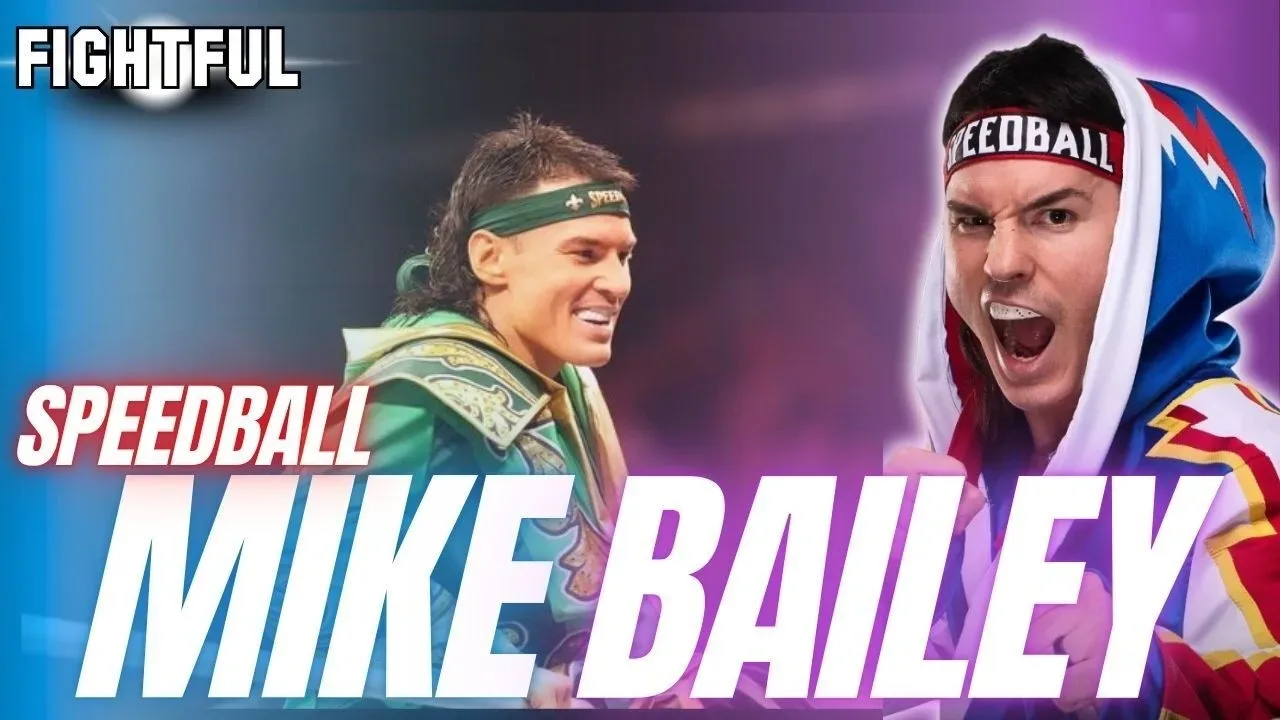
Mike Bailey sees AEW Grand Slam France as more than another international stop on the company’s calendar. For “Speedball,” the October 6 event at Paris’ Adidas Arena represented a chance to introduce professional wrestling to a broader French audience and help move the genre further into the country’s mainstream culture.
AEW’s arrival in France placed its wrestlers in front of a media environment that Bailey believes is still approaching wrestling differently from the way it is treated in the United States and several other established wrestling markets. During promotional appearances ahead of Grand Slam France, Bailey found himself not only discussing the event, but physically demonstrating what pro wrestling can look like for television viewers unfamiliar with it.
That led to a memorable segment in which Bailey applied a half crab to a French television host. Reflecting on the moment, Bailey joked that the choice of hold might have put him at odds, at least spiritually, with one of Europe’s foremost practitioners of the move: Michael Oku.
AEW’s Paris Event as a Cultural Step Forward
Bailey described the French media response as an interesting example of how professional wrestling is presented differently around the world. Wrestling has long been part of the fabric of American entertainment, with generations of fans growing up exposed to the industry through television, arenas, magazines, and increasingly social media. The level of familiarity is not identical everywhere, however, and Bailey believes France remains in an earlier stage of that wider cultural adoption.
For more background on this topic, read Billy Gunn Reflects On AEW’s Brawl Out Fallout And How Veterans Handle Conflict.
“I think it’s very fascinating to see how pro wrestling is captured by the media lens all over the world, right?” Bailey said. “Pro wrestling is ingrained in American culture as it is for many, many other countries, but France is still a few years behind.”
That distinction shaped the kind of promotional work surrounding AEW Grand Slam France. Rather than assuming every viewer already understood the conventions of a wrestling match, television segments could require a more immediate, visual explanation of the sport and its personalities. Bailey said that simply talking about wrestling may not always communicate its appeal to an audience that has not yet been exposed to it in depth.
“Pro Wrestling is evolving,” Bailey continued. “I think bringing AEW and Grand Slam to the Adidas Arena is a huge step in pushing pro wrestling to the mainstream in France, but sometimes they just feel like, ‘Our audience, if we just talk about it, they might not know what it is, so we kind of have to show them.’”
For a performer such as Bailey, who has built his reputation through speed, striking, technical precision, and a willingness to compete across the international independent scene, that kind of appearance offers a different challenge than a standard match. He has to represent wrestling in a setting where safety, clarity, personality, and entertainment value all matter in a compressed amount of television time.
Grand Slam France also carried significance beyond any individual media segment. A major AEW event at the Adidas Arena gave the promotion an opportunity to establish a more visible footprint in France, while putting wrestlers in front of new live and broadcast audiences. Bailey’s comments suggest he viewed that exposure as part of a longer process rather than a one-night accomplishment.
Why Bailey Chose the Half Crab
The half crab demonstration was not a random decision. Bailey explained that asking a wrestler to put a television presenter in a hold is not necessarily an ideal proposition, especially when the person receiving the move is not trained to react like an in-ring opponent. But Bailey has spent two decades navigating unusual promotional settings and believed a grounded submission gave him the most control over the situation.
“I think just asking a pro wrestler to put the host in a hold might not be the best idea,” Bailey said. “But I have been doing this for 20 years. I have been put in similar situations many, many times.”
His selected hold was the half crab, a lower-body submission in which the wrestler controls one of the opponent’s legs while applying pressure to the back. In a wrestling context, it can be a highly effective tool for wearing down an opponent and setting up a tap-out. In Bailey’s media-tour setting, it also offered practical advantages: it was visually recognizable, could be applied from a stable position, and reduced the unpredictability that can come with more explosive offense.
Bailey did acknowledge, with a sense of humor, that using the hold in Europe could be viewed as a playful slight toward Oku. The English wrestler has become closely associated with the half crab, making it a defining part of his in-ring identity.
“The half crab — which might be disrespectful to Michael Oku because he is the master of the half crab and I was kind of relatively on his turf, right? He’s English but still, Europe,” Bailey said.
The comment was clearly delivered in a lighthearted spirit, but it also reflects the way signature holds can become attached to specific wrestlers. A finishing move or favored submission is often more than a technique; it can be a calling card, a storytelling device, and an immediate reminder of a performer’s identity. Bailey knows the value of that association, even as he made the half crab his choice for a very different kind of assignment.
A Safer Demonstration Than Strikes or High-Risk Offense
Bailey explained that he deliberately avoided any option that could create more danger or uncertainty for the host. His style is known for its martial arts influence, including hard kicks and fast-paced attacks, but an interview set is not a wrestling ring and a news presenter is not a trained opponent.
“I think it was a much smarter hold than a high elbow guillotine or an open hand slap to do to a news presenter,” Bailey said.
The reasoning was straightforward. A submission can allow the wrestler to guide and control the movement rather than rely on a person with no wrestling training to take a strike, fall correctly, or respond to a rapid sequence. Bailey also noted that the host was not going to fight out of the position, which made the hold even more manageable in the context of a planned television feature.
Bailey’s explanation went into the mechanics of why he felt secure in the choice. He emphasized his confidence in both the half crab and the straight ankle lock, another submission that has been a prominent weapon in his arsenal. Once the position was secured, Bailey believed he could comfortably maintain control without the host being able to unexpectedly escape or shift the demonstration off course.
“Not only do I have a fantastic half crab, but I have an even better straight ankle lock,” Bailey said. “So once that locked in, I have full control of him. Also when I’m sitting on his lower back, he’s not going to be able to wriggle himself out. So I can sit there comfortably as long as I want which was a big part of my plan.”
His comments underline an often-overlooked aspect of wrestling-related media appearances. The goal is not to make the encounter look legitimately dangerous. Instead, the performer needs to create an entertaining visual that communicates what wrestling is while keeping everyone involved protected. In Bailey’s view, the half crab offered the right balance of spectacle and control.
Experience Beyond the Ring
Bailey’s confidence in handling the appearance came from extensive experience in wrestling environments that extend beyond traditional television. Having worked for years in front of diverse audiences, he has had to adapt his presentation to different promotions, countries, venues, and media demands. The ability to quickly judge what will work safely in a non-ring setting is a valuable skill, particularly as AEW continues pursuing larger international opportunities.
His reflections on France also point to the importance of wrestlers acting as ambassadors when a promotion enters a developing market. The assignment is not limited to promoting a card. It means helping audiences understand why the action matters, who the personalities are, and what makes the format compelling. Bailey’s half crab may have been a humorous moment, but it served that broader purpose by giving viewers a tangible demonstration rather than an abstract description.
Elsewhere in his discussion, Bailey addressed his Prestige Wrestling match with Mustafa Ali. While his thoughts on that bout offer another look at his schedule outside AEW, his comments on the France trip centered on the significance of wrestling being seen by new viewers.
For Bailey, AEW Grand Slam France was evidence that professional wrestling’s global evolution continues. Paris provided a major stage, the Adidas Arena supplied a notable setting, and the media attention created opportunities to reach people who may not yet know the difference between a half crab and a straight ankle lock. If Bailey had his way, they at least received a memorable introduction.

Darryl Polo
Darryl Polo is a passionate wrestling fan covering WWE, AEW, TNA and beyond. He loves great rivalries, breakout stars and the moments that keep fans talking long after the bell. How we work.