
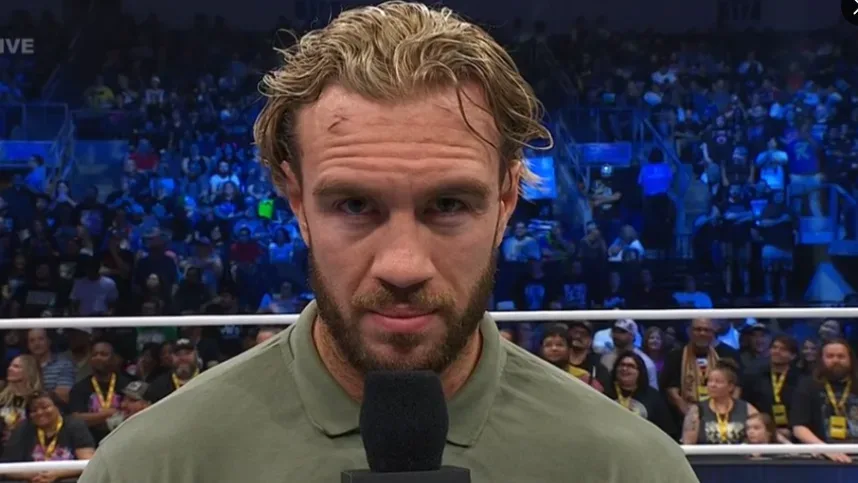
Will Ospreay has made clear that he understands why WWE questions regularly arise in wrestling interviews, even if they are not where he would prefer the conversation to stay.
Speaking with Brandon Kravitz, Ospreay was asked whether he has grown tired of being asked about WWE. The AEW star did not frame the questions as an off-limits subject or criticize interviewers for raising them. Instead, he said that comparisons and questions about other major promotions are simply part of the role that comes with being one of the most prominent wrestlers in the industry.
“Oh, it’s I just I know it’s a part of the gig,” Ospreay said. “Like, people always asking, like, I can only give my opinion. I don’t really care about it. Like, it’s just I’d rather focus on AEW and I’d rather focus on, like, what we’re able to do here, and, like, what I believe AEW is changing the face of professional wrestling, and I love what we present. I love what we do. I love our wrestling. I love everything that like we’re all about. So like, I couldn’t really care less about any other promotion.”
Ospreay accepts the question without centering it
The answer offers a measured explanation of Ospreay’s public approach. He acknowledged that WWE is a natural topic in a wrestling landscape where fans often compare companies, performers and creative directions. As a highly visible AEW name, and a wrestler whose career has prompted substantial discussion across multiple promotions, Ospreay is likely to encounter those questions repeatedly.
For more background on this topic, read Will Ospreay Praises The New Level’s Early Impact in AEW.
But Ospreay’s comments also establish a clear preference: he wants the emphasis to remain on AEW rather than on an ongoing conversation about another company. His point was not that discussion of WWE should never happen. Rather, he indicated that his own interest lies in talking about the work he and the AEW roster are doing, as well as the broader identity AEW seeks to present.
That distinction matters in an era when wrestling coverage and fan debate frequently turn into direct promotion-versus-promotion comparisons. Those conversations can involve television, live events, business matters, championships, rosters and individual performances. For wrestlers, however, an interview can also be an opportunity to address their current programs, their locker room and the product they are actively helping create.
Ospreay’s answer placed him firmly in that second category. He repeatedly returned to AEW, saying he would rather focus on what the company is able to do and on what he feels it represents for professional wrestling.
AEW’s wrestling identity is central to his response
The strongest part of Ospreay’s response was his endorsement of AEW’s in-ring presentation. He said he loves the wrestling the promotion presents, along with “everything” the company is about. That is an important statement from a performer widely associated with ambitious, athletic and high-impact matches.
Ospreay’s career has made his perspective on ring style particularly notable. When he speaks about AEW’s wrestling, he is not discussing it as a distant observer. He is talking as an active performer whose own matches and presence are part of the company’s presentation. His comments suggest that the style and creative opportunities available within AEW are key reasons he is enthusiastic about his current environment.
He also said that he believes AEW is “changing the face of professional wrestling.” That is a broad expression of confidence in the company’s influence and direction. Ospreay did not offer a detailed breakdown of what changes he had in mind, but he clearly connected that belief to the kind of wrestling AEW puts forward and the overall product he says he enjoys being part of.
For Ospreay, the topic is therefore bigger than avoiding a WWE comparison. His remarks amount to an affirmation of AEW’s value as a place for the type of professional wrestling he wants to champion. The conversation may begin with a question about a rival promotion, but his answer redirects attention to the company he represents now.
Why WWE remains a recurring interview topic
Questions about WWE are unlikely to disappear from interviews with major AEW figures. WWE remains an unavoidable reference point in the broader wrestling business, and the public has long been interested in the movement of talent, the differences between promotions and the competition for audience attention. Whenever a top wrestler discusses their career, their choices or the state of the industry, WWE can become part of the conversation.
Ospreay recognized that reality with his comment that it is “part of the gig.” That phrasing reflects an understanding of the modern wrestling media environment. Fans want opinions, comparisons and clarity from performers. Interviewers know that audiences are interested in the subject. A wrestler may prefer to discuss their own promotion, but that does not eliminate the public interest in the industry’s largest points of comparison.
At the same time, Ospreay’s answer shows the limitations of that framing from a talent’s perspective. If every discussion circles back to WWE, it can reduce the space available to talk about AEW’s own stories, matches and goals. Ospreay did not suggest that he has no opinion on the subject; he said he can only give his opinion when asked. Still, he made it clear that his priority is not to spend his interviews focused elsewhere.
That approach is also notable because it avoids escalating the broader promotional debate. Ospreay did not take aim at WWE, nor did he present the question as a grievance. He kept the focus positive by outlining what he appreciates about AEW. It is a straightforward message: he understands the question, but he would rather use his platform to discuss the promotion he believes in.
A message of commitment to AEW
Ospreay’s remarks carry the tone of a wrestler invested in AEW’s direction. His comments were not limited to saying that he is satisfied with his situation. He spoke in stronger terms about loving the company’s presentation, its wrestling and its overall mission. That level of enthusiasm makes his response more than a routine attempt to sidestep a question.
It also reflects how wrestlers can shape the discussion around their companies. While fans may approach every major signing, major match or media appearance through the lens of competition, talent can choose to emphasize the qualities they value in their own workplace. Ospreay chose to stress AEW’s ability to present wrestling that he is proud of and its potential to influence the wider industry.
There is no ambiguity in the central message: Ospreay would prefer that AEW be evaluated on its own output rather than only through comparisons with WWE. His belief that AEW is helping change professional wrestling is a direct statement of confidence, and his repeated praise for the company’s in-ring product underlines where his creative focus rests.
The broader interview context
Elsewhere in the interview, Ospreay also discussed the New Level joining AEW. While the WWE question drew attention because of the ongoing public discourse around inter-promotional discussion, that additional topic reinforces the wider point of his answer: Ospreay is interested in talking about developments within AEW.
For a performer of Ospreay’s stature, that focus is significant. His name naturally generates conversation well beyond any one promotion, and his candid interview style can produce headlines. Yet in this instance, he used the question to articulate a simple position. He accepts that WWE will be raised. He can offer his view when it is. But he is far more interested in highlighting AEW, its wrestlers and the kind of professional wrestling it aims to deliver.
As the conversation around wrestling companies continues, Ospreay’s perspective is a reminder that the people inside those promotions may not view every question through the same competitive framework as fans online. For him, the priority is the work in front of him: AEW’s presentation, AEW’s wrestling and the belief that the promotion is contributing something meaningful to the future of the industry.

Darryl Polo
Darryl Polo is a passionate wrestling fan covering WWE, AEW, TNA and beyond. He loves great rivalries, breakout stars and the moments that keep fans talking long after the bell. How we work.