
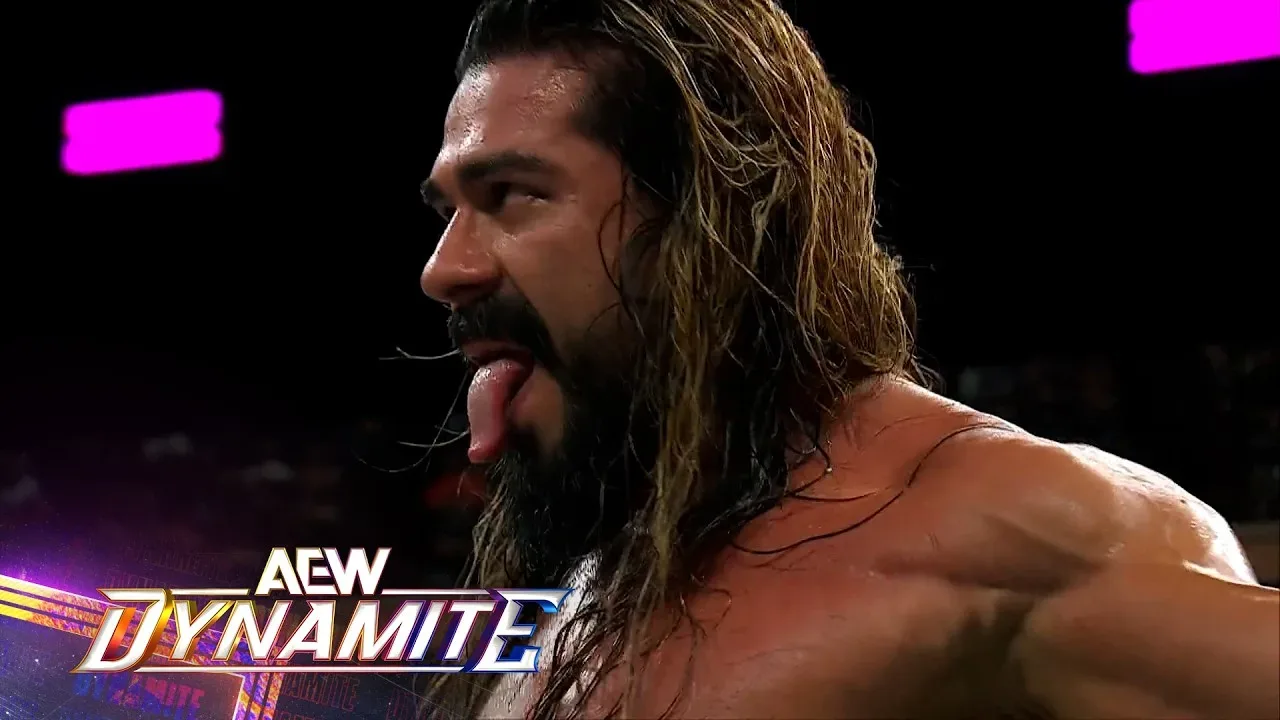
Andrade El Idolo’s presentation in AEW has included polished in-ring work, a self-assured attitude and a look designed to reinforce his larger-than-life persona. Yet one of the more unusual elements attached to his rise in popularity did not begin as a carefully mapped-out part of that presentation. It began with a crowd chant that Andrade did not immediately understand.
Speaking with Renee Paquette on Close Up, Andrade discussed the origin of fans chanting for him to take his pants off during matches. The chant has since become a familiar part of his AEW appearances, with the audience reacting loudly whenever he begins the process of removing the pants he wears over his gear. But Andrade explained that, in the beginning, he was confused rather than prepared to turn it into a recurring moment.
For Andrade, the situation stood out because it was so different from the chants wrestlers normally hear during a match. He said he takes pride in wrestling and in showing the audience his abilities once he steps through the ropes. When the fans first began chanting, however, he could not make out what they wanted.
“I love wrestling and I respect the ring,” Andrade said. “In the ring, I like to show who I am. I know I’m a good wrestler.”
For more background on this topic, read Toni Storm Tapes Surface at AEW WrestleDream, Reigniting Mystery Around Former Champion.
He recalled competing while the chant began to build, only to find himself unsure of its meaning. Andrade initially turned to the referee for clarification. Once he was told that the fans were asking him to take his pants off, he was surprised by the request.
Andrade noted that wrestlers are accustomed to hearing chants such as “Tables!” or “This is awesome!” Those are reactions tied directly to the action unfolding in the ring. A request for his pants, on the other hand, was not something he expected to encounter while trying to maintain the mindset of a villainous competitor controlling a match.
“It was weird because it’s usually ‘Tables! This is awesome!’” Andrade said. “But people saying ‘take your pants,’ I don’t understand.”
At first, Andrade considered whether the crowd might have been calling for a more aggressive attack. He was wrestling as a heel and beating his opponent, so he thought the audience could have been pushing him to throw more punches or escalate his offense. The chant continued, though, and he again asked referee Aubrey Edwards what the crowd was saying.
When Edwards confirmed the chant a second time, Andrade made the choice to play along. He began removing his belt and lowering the zipper, and the arena response immediately became even louder. That reaction made it clear that the chant was not a one-off distraction. The crowd had found a way to participate in his entrance-style attire and his on-screen charisma, and Andrade recognized the potential in the moment.
“Okay, you want the pants off,” Andrade recalled thinking. “I take my belt off, my zipper down, and the people go crazy.”
The bit has endured because it is both simple and organic. There is no complicated setup needed for the audience to understand it. Fans make their request, Andrade acknowledges it, and the reaction grows as he teases the removal of the outer layer of his gear. It can fit into a match without requiring a lengthy interruption, while also giving Andrade a distinctive interaction that belongs specifically to him.
His explanation also revealed a practical detail behind the moment. Andrade said he regularly wears trunks underneath the pants, not because he was always planning for the chant, but because wrestling gear can tear or malfunction during a match. The backup layer is a precaution. In one instance, however, he did not have trunks on underneath and instead had boxers. When the fans began the chant on that occasion, he still removed the pants and received the expected explosion from the crowd.
That detail underlines how little planning was involved in the chant’s initial creation. It was not born from a scripted promise that Andrade would reveal traditional ring gear at a designated point. Rather, fans noticed a visual aspect of his attire and made it part of the show. Andrade’s willingness to respond gave the audience ownership of the moment, and that connection has helped the chant remain relevant.
There is also an interesting contrast in Andrade’s account. He described himself as the heel in the match where the chant first caught on, yet the crowd response was overwhelmingly enthusiastic. In professional wrestling, audiences do not always react in the clean hero-versus-villain terms suggested by a performer’s alignment. A wrestler can be positioned as an antagonist while still receiving cheers for a memorable entrance, a flashy move, a catchphrase or, in Andrade’s case, an unexpected crowd ritual.
Andrade did not frame the reaction as something he was trying to force. Instead, he described adapting to what fans were already telling him. That is often how the most durable wrestling mannerisms take shape. A promotion can create a character’s broad outline, but crowds frequently decide which details they want to amplify. Once a response proves consistent, the performer can refine it without losing the spontaneity that made it work in the first place.
In Andrade’s case, the pants removal became another tool within an already confident persona. It plays into the arrogance and poise he brings to the ring, while giving fans an unmistakable cue to get loud. The reaction can also create a shift in atmosphere before the bell-to-bell action resumes, drawing extra attention to Andrade without needing a microphone segment or a major storyline development.
That kind of audience engagement has value for a wrestler whose matches are built around precision, athleticism and an ability to make offense look impactful. The chant may be playful, but it does not replace the wrestling. It is an addition to the overall Andrade experience: a recognizable beat that can happen in front of a live audience before he returns to the competitive side of the performance.
The timing of Andrade’s comments also comes after a significant result for him in AEW. At AEW WrestleDream, Andrade successfully defended the AEW National Championship against Tommaso Ciampa. The match featured a reminder that even a popular crowd interaction can carry some danger when it becomes part of an active contest. Andrade said the pants nearly cost him the match.
That point adds another layer to what otherwise appears to be a harmless tradition. Wrestling crowds often want performers to acknowledge chants and gestures in real time, but doing so can create an opening for an opponent. For a champion, especially, every distraction has potential consequences. Andrade was able to leave WrestleDream with the AEW National Championship still in his possession, but he indicated that the familiar pants moment brought him close to trouble against Ciampa.
The successful title defense keeps Andrade’s championship standing intact, while his story about the chant offers a look at how performers can discover new dimensions of their connection with fans. What started as a confusing request relayed through the referee became a recurring feature of his AEW appearances. Andrade’s first instinct may have been disbelief, but the crowd’s reaction convinced him to embrace it.
As long as fans continue to chant for it, Andrade appears to understand exactly what they are asking for now. The only question is whether he can keep turning that reaction into a memorable moment without giving future opponents the same opening Ciampa nearly used at WrestleDream.

Darryl Polo
Darryl Polo is a passionate wrestling fan covering WWE, AEW, TNA and beyond. He loves great rivalries, breakout stars and the moments that keep fans talking long after the bell. How we work.