
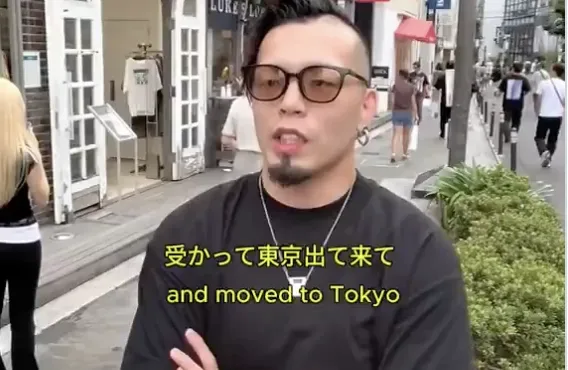
Kosei Fujita has offered fans a more personal look at his life away from the ring during an appearance on the TikTok account Anonymous/アノニマス.
The New Japan Pro-Wrestling competitor was approached on the street and asked to take part in a photograph for one of the creator’s videos. What began as a brief public encounter developed into a conversation about Fujita’s profession, his path into wrestling and the realities that come with performing in the ring.
Fujita discussed what being a professional wrestler means to him, addressing both the exciting side of the job and the physical pain that comes with it. The former three-time IWGP Junior Heavyweight Tag Team Champion also reflected on a life he described as messy, while making clear that he is enjoying where his career and life have taken him now.
View the referenced post on X
During the conversation, Fujita said that his upbringing was rough and explained that he still chose to chase the dream of becoming a professional wrestler. The comments gave the short-form interview a noticeably more candid tone than the typical street-photo format associated with the Anonymous/アノニマス account.
For more background on this topic, read NJPW Road to Destruction Results: Unbound Co. Closes Sendai Card With Main Event Win.
A Street Encounter Becomes a Look at Fujita’s Story
Anonymous/アノニマス has established a major audience on TikTok through videos built around meeting people in public, speaking with them and taking their photographs. The account has 1.4 million followers, while its videos have accumulated 56.4 million likes in total.
That format can produce quick snapshots of people’s personalities, but Fujita’s appearance also opened the door to a discussion of a career that is often easy to view only through its most visible moments. Wrestlers are seen competing before crowds, celebrating championships and presenting themselves with confidence, yet the profession also carries constant physical demands and personal sacrifice.
Fujita did not present wrestling as an uncomplicated dream. He spoke about the things that are cool about his line of work, but he also acknowledged what hurts. That contrast is central to professional wrestling: the opportunity to perform, travel and connect with an audience exists alongside the punishment absorbed by the body in training and competition.
His willingness to discuss both sides of the profession is especially notable in an informal setting. Rather than simply identifying himself as a wrestler, Fujita used the encounter to explain the kind of life attached to that identity. The remarks pointed to the persistence required to follow a dream despite difficult circumstances and to continue forward through the challenging parts of the journey.
Finding Enjoyment in the Present
Fujita’s comments about his life being messy were not framed as a request for sympathy. Instead, he paired that reflection with a positive assessment of the present, saying that he is enjoying things now. That perspective gave his appearance a message of resilience without minimizing the hardships he referenced.
Professional wrestling is a career built around perseverance. For performers, reaching a major promotion does not remove the pressure of the work. The physical nature of matches, the need to improve, the responsibility of representing a promotion and the challenge of making a connection with viewers all remain part of the day-to-day reality. Fujita’s remarks captured that tension in a simple way: wrestling can be painful, demanding and uncertain, while still being a source of genuine purpose.
His account of chasing his dream after a rough upbringing also offers a clearer sense of the determination behind his public image. Fans may know Fujita from his NJPW appearances and championship history, but the TikTok conversation focused less on match results and more on the person who decided to pursue wrestling in the first place.
That distinction matters for younger wrestlers and junior heavyweight competitors in particular. Success is frequently measured through titles, tournament performances and high-profile matches. Fujita’s appearance instead emphasized the personal value of reaching a point where he can enjoy the path he chose, even after acknowledging the disorder and pain that have been part of it.
Fujita’s Place in NJPW
Fujita is signed to New Japan Pro-Wrestling and has already built a notable championship record within the company’s junior heavyweight tag team scene. He is a former three-time IWGP Junior Heavyweight Tag Team Champion, a résumé point that places him among the wrestlers who have reached meaningful success in one of NJPW’s established divisions.
The IWGP Junior Heavyweight Tag Team Championship has long been a significant platform for wrestlers seeking to establish themselves in New Japan’s junior heavyweight ranks. Holding that championship on three occasions reflects sustained involvement at a competitive level and underlines that Fujita’s career is not defined solely by potential or aspiration. He has tangible accomplishments in NJPW while continuing to speak openly about the work and hardship behind the profession.
For Fujita, the TikTok appearance provides a different kind of visibility from a wrestling broadcast or arena event. It introduced him to an audience that may not necessarily follow NJPW closely, while allowing him to describe professional wrestling in direct and human terms. A street interview does not require viewers to understand title histories or promotions before they can relate to a person speaking honestly about pain, struggle and pursuing a long-held ambition.
The crossover is also a reminder of how wrestlers can reach audiences beyond traditional wrestling media. A performer’s in-ring work remains the foundation of their career, but short-form social platforms can offer a space for personality, reflection and accessibility. In Fujita’s case, the appearance centered on sincerity rather than promotion, with the conversation focusing on why his career matters to him.
The Reality Behind the Profession
Fujita’s explanation of the hurts involved in wrestling is a straightforward acknowledgment of a basic truth about the industry. The physical cost is inseparable from the spectacle. Wrestlers train to make difficult athletic performances look convincing, and the result can often obscure the strain involved in doing that work repeatedly.
At the same time, Fujita also highlighted the appeal of being a wrestler. The profession offers moments that are unlike ordinary work: competing in front of crowds, creating emotional reactions and pursuing success in a field that demands commitment. His comments did not separate those positive experiences from the difficult ones. They were presented as parts of the same life.
That balance made the conversation more meaningful than a routine celebrity encounter. Fujita did not suggest that chasing a dream guarantees an easy road, nor did he portray adversity as something that automatically disappears after success. He spoke from a place where the past remains part of his story, but does not prevent him from appreciating the present.
For a wrestler competing under the NJPW banner, that outlook carries particular weight. The company’s junior heavyweight division is associated with speed, athleticism and competition, but each athlete’s route into that environment is different. Fujita’s appearance did not attempt to define every part of his history. It simply offered a concise, personal explanation of why his current profession means so much to him.
A Personal Moment Beyond the Ring
Fujita’s appearance on Anonymous/アノニマス was brief in format, but it presented a side of the NJPW wrestler that is not always visible in a standard wrestling setting. Stopped in the street for a photo, he spoke about becoming a professional wrestler, the rewards and pain attached to the job, and the difficult circumstances he overcame while pursuing his goal.
The key point from Fujita’s remarks is not that his path has been perfect. He explicitly indicated otherwise. The significance lies in his belief that, despite the messiness of life and the hardship of his upbringing, he is able to enjoy what he is doing now.
As a three-time former IWGP Junior Heavyweight Tag Team Champion, Fujita already has achievements that stand on their own within NJPW. His TikTok appearance added a more personal layer to that record, presenting him as a wrestler who understands the pain of his profession, values its unique opportunities and remains grateful that he was able to chase the dream he once held.
Darryl Polo
Darryl Polo is a passionate wrestling fan covering WWE, AEW, TNA and beyond. He loves great rivalries, breakout stars and the moments that keep fans talking long after the bell. How we work.