
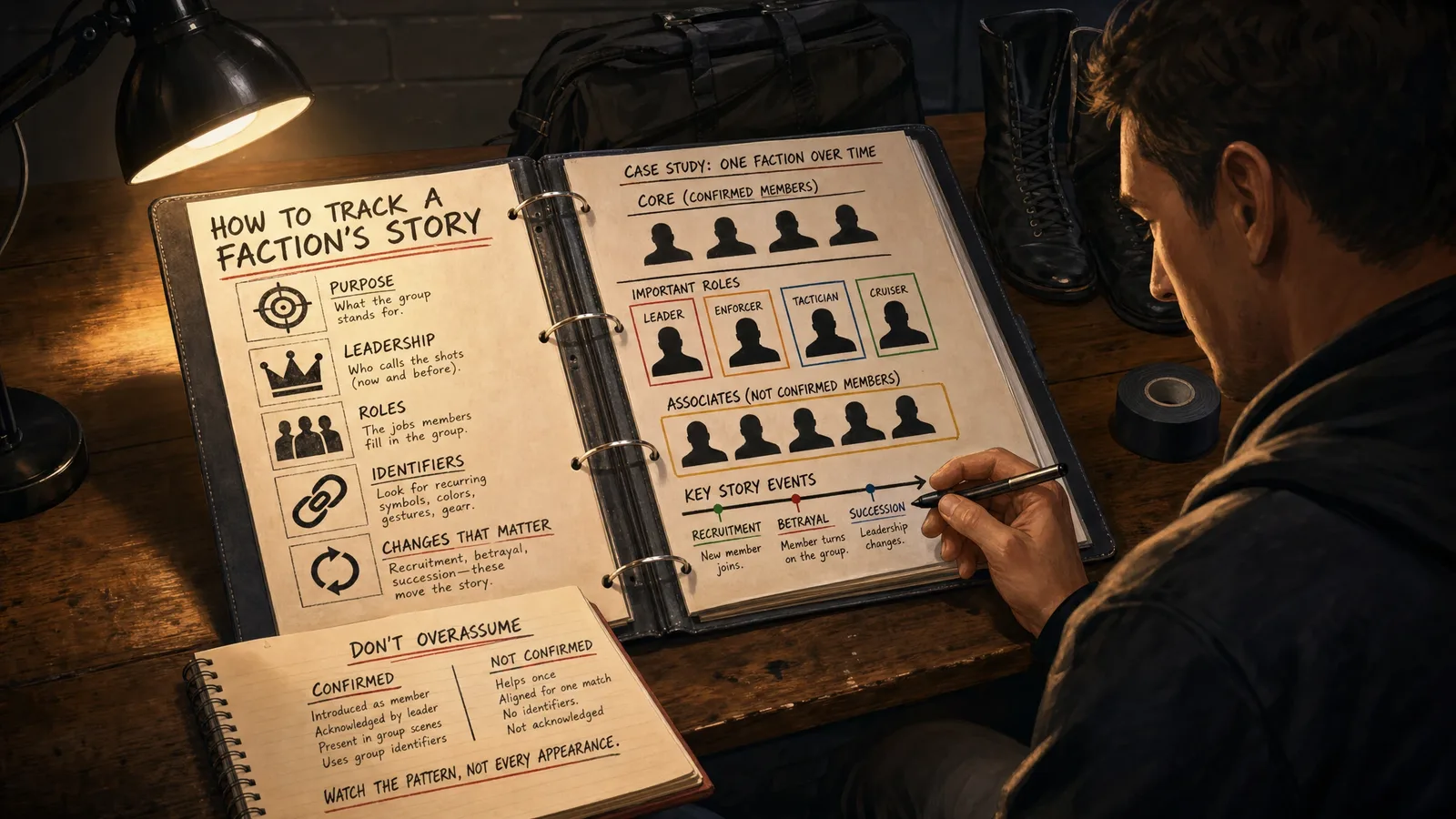
Start with a group’s clearest identity
A useful way to follow a faction is to begin with what the group says it is, rather than trying to memorize every person who has shared its side of a ring. The Blackpool Combat Club discussion points to a shared worldview or goal as a way to understand why wrestlers belong together. Its examples include family loyalty, national identity, pursuit of championships, opposition to authority and targeting a rival. Those are not interchangeable explanations; they are prompts for viewers to identify the particular idea that connects a given unit.
That starting point can keep a story legible when the lineup changes. Ask what the group is trying to accomplish, who speaks for that aim, and whether appearances reinforce it. WWE’s Corporate Ministry history describes The Undertaker seeking to overthrow Mr. McMahon, while Shane McMahon used the merger in connection with his own expanding power plan. Those stated actions give a viewer a frame for following the group beyond a long collection of names, without requiring every member to have the same role.
It also helps to separate a faction’s identity from an individual pairing inside it. The Blackpool Combat Club account traces Jon Moxley and Bryan Danielson from rivals to allies after William Regal intervened following their match, with Regal’s arrival marking the group’s formation in that telling. The key detail is not simply that three figures appeared together. It is the clearly described shift from rivalry to a new alliance, with Regal as the event that establishes the group’s beginning.
Make a membership ledger instead of a guesswork list
The clearest category is confirmed membership: a plainly presented formation, induction or recruitment. The Blackpool Combat Club’s early account gives viewers several entries that can be logged with confidence. Moxley and Danielson unite with Regal at the formation, while Wheeler Yuta and Claudio Castagnoli are presented as additions in the group’s first months. A fan need not assume that the original pairing is the finished roster when the story supplies distinct membership developments to track.
A second category is associate or collaborator. The same Blackpool Combat Club discussion places Eddie Kingston, Santana, Ortiz and Ruby Soho around the group’s activities, yet explicitly questions whether some of those associates were members. This distinction is valuable because proximity is not the same thing as induction. A wrestler may be important to a feud, share a side in a match or work repeatedly with a unit while the available presentation still leaves formal membership unresolved.
For practical note-taking, use three provisional labels: confirmed member, recurring associate and one-time cooperation. This is an editorial tool, not a universal wrestling rule. A clear recruitment or recurring group presentation may justify moving someone into the first category; a single rescue, feud-side appearance or multi-person match may call for a more cautious label. The point is not to deny that a temporary ally matters to a story. It is to leave room for uncertainty until the presentation makes the relationship clearer.
Treat roles as part of the lineup
A stable is not necessarily composed only of the wrestlers who take part in matches. In a 1999 interview, the Hollywood Hunks were described as a five-person heel unit in Ontario-area independent promotions: three in-ring wrestlers, manager Raquel and agent Otto Bahn. Counting only the active wrestlers would erase two named roles that the group itself used to explain its structure. When tracking a faction, note who wrestles, who manages and who represents the unit in another capacity.
Raquel’s role is especially useful for reading the difference between a generic ringside presence and a defined faction position. The Hunks described her as their manager rather than merely a valet. Otto Bahn was separately recruited as the group’s Hollywood Agent. Those descriptions show how a faction can assign different functions to people who may not be match participants, and why a viewer should preserve those labels instead of flattening every non-wrestler into the same category.
Managers can also provide continuity when the active wrestler lineup changes. The Blackpool Combat Club article observes that a manager-led stable can rotate active wrestlers while retaining a recognizable spokesperson or strategic center. This does not mean every stable has a manager or that every manager controls a group. It is a useful question to ask: if several wrestlers come and go, is there still a consistent figure who helps the audience recognize the group as the same unit?
Use repeated identifiers to recognize the unit
Visual continuity can make a group easier to follow across different matches and combinations. The Blackpool Combat Club discussion identifies common colors, outfits, symbols and consistent match presentation as readable signals that distinguish a stable even when its wrestlers have different styles. Such cues are best treated as supporting evidence alongside explicit presentation. They can help viewers spot the group’s shared identity, but clothing or branding by itself does not settle an uncertain membership question.
The article’s examples show the range of those signals: nWo black-and-white branding, the Dark Order’s coordinated purple-and-black masked presentation and Bullet Club merchandise. These examples are presentation devices that bind a group together visually. For a new viewer, the practical question is whether the same visual language returns consistently with the same unit. If it does, it can serve as a useful recognition marker even before every individual relationship has been fully explained.
Repeated names and combinations can be just as helpful. The Hollywood Hunks used a shared name and a team finishing move called the Box Office Smash. Their 1999 interview presents those recurring identifiers as ways to recognize the unit on different cards. Rather than attempting to catalogue every appearance, a fan can note the group name, signature combination, entrance or presentation habit that recurs. These are anchors for recognizing the faction’s presence when not every member is involved at once.
Read recruitment as a story event
Recruitment is more useful to track when it has a visible before-and-after. Jamie Jackson became the Hollywood Hunks’ third wrestler after previously feuding with Stunning Sean and the Custom Made Man as a babyface. His entry was tied to an alignment change: after taking Raquel away from the original duo, Raquel brought him into the Hunks as a heel. That sequence supplies a clear membership transition rather than requiring viewers to infer one from a single cooperative appearance.
The Ministry of Darkness provides another version of roster growth. WWE’s history lists The Acolytes, Viscera and The Brood as wrestlers recruited to accompany The Undertaker. This is the kind of language a membership ledger can prioritize because it directly identifies a process of expansion. It also lets a viewer distinguish the original group’s growth from a later, larger structure that may contain the Ministry alongside other allied figures.
Recruitment does not have to mean that a faction has found its permanent final shape. The Blackpool Combat Club account describes AEW alliances as fluid and gives examples of wrestlers moving among tag teams, groups and loose affiliations. The source frames that as an AEW-specific observation, not a rule for every promotion. It is a reminder to follow the terms and presentation of the particular company and story instead of assuming that all faction relationships work identically.
Separate change from breakup
A lineup change can matter without amounting to a betrayal or a dissolution. In the Hollywood Hunks interview, the group described pressure in the AWF to split or alter its presentation, including resistance to keeping Raquel and Otto with the act. That is significant because it puts the group’s structure at stake, even though the reported issue is not presented as a dramatic betrayal. Viewers can ask a narrower question: has the story changed the unit’s roles, access or presentation?
Alignment is a separate track from membership. The Hunks said they wanted to remain a team despite internal disagreements and discussed the possibility of a future move from heel to babyface presentation. That discussion does not establish that the proposed turn occurred. It does, however, give viewers a useful distinction to watch for: a change in alignment may be proposed or develop separately from a confirmed split, so the group’s continued presentation together remains a question worth checking.
Follow leadership changes and betrayal through clear events
Leadership becomes easier to follow when viewers identify who has authority and what action proves that authority changed. WWE’s Corporate Ministry history says Shane McMahon took control of the Corporation while Mr. McMahon was focused on Stephanie McMahon’s safety. Shane removed his father and replaced Pat Patterson and Gerald Brisco with the Mean Street Posse. These are concrete changes in control and personnel, not merely a new person standing near the group.
The Corporate Ministry then offers a bounded example of an umbrella faction. WWE dates its formation to the April 29, 1999 pilot episode of SmackDown, when The Undertaker’s Ministry of Darkness merged with Shane McMahon’s Corporation. The Ministry and Corporation had distinct earlier origins and purposes, so the merged name should not erase either side’s prior leadership or rivalries. The on-screen tableau of The Undertaker alongside Shane made the new alignment legible to viewers.
Finally, betrayal is most useful to track through the change it brings to stated loyalties and authority. WWE’s history says the June 7, 1999 reveal of Mr. McMahon as the Higher Power reframed the Corporate Ministry’s loyalties and made betrayal central to its story. This is a specific historical case, not a template for every faction. The Corporate Ministry lasted only months, and WWE’s account treats it as a particular 1999 merger storyline rather than a permanent membership list. That limitation is useful: follow the confirmed turns and power shifts in front of you rather than forcing each faction into the same pattern.
Explore more
- Reading Wrestling’s Ringside Roles: Managers, Seconds and Allies
- How to Read a Wrestling Character Turn Beyond the Surprise

Darryl Polo
Darryl Polo is a passionate wrestling fan covering WWE, AEW, TNA and beyond. He loves great rivalries, breakout stars and the moments that keep fans talking long after the bell. How we work.