
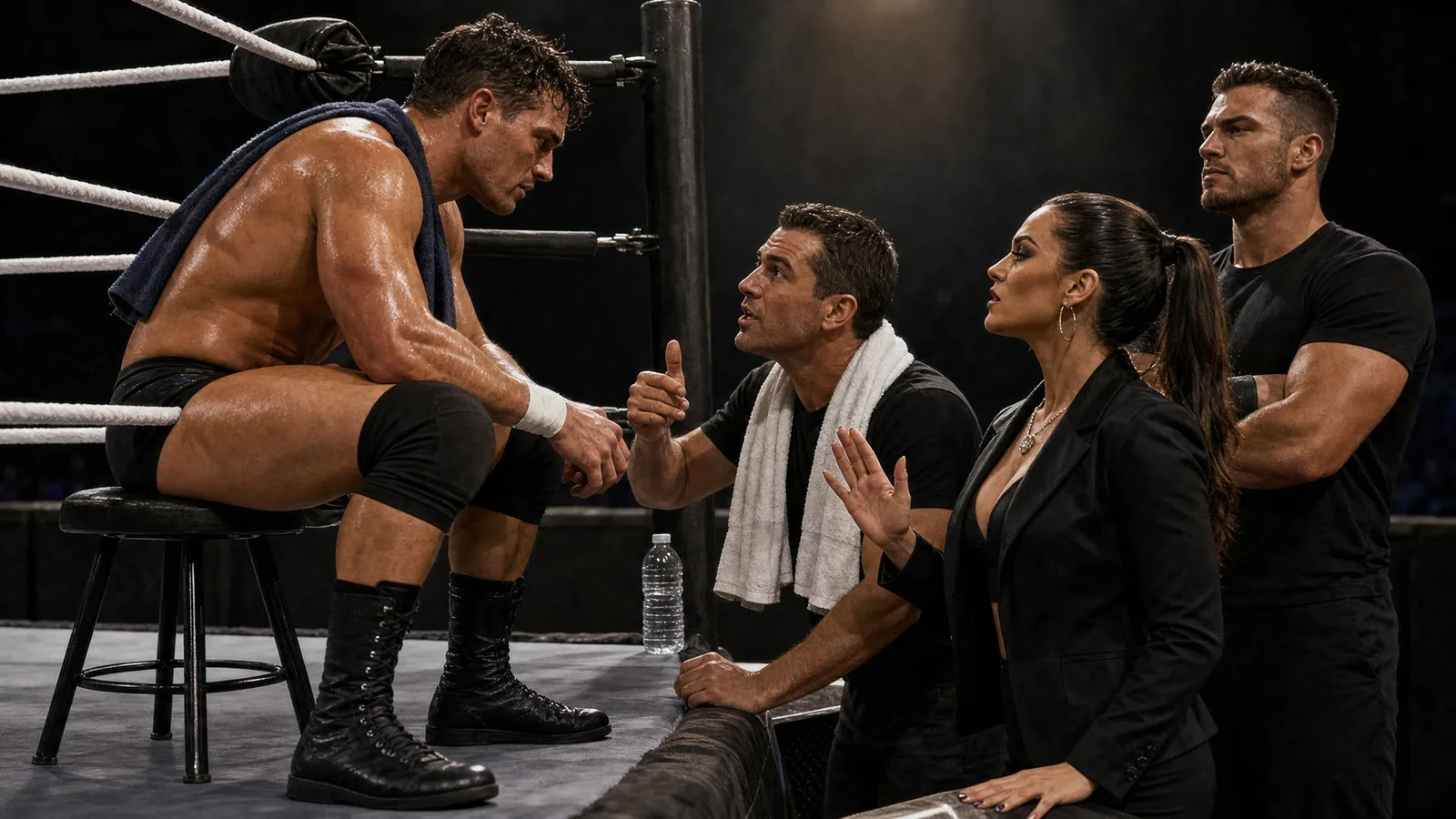
Labels describe presentation, not a universal job chart
Ringside terminology is flexible. WWE’s historical overview places advisors and valets within a broad discussion of managers, so the words used for a character do not create a fixed industry-wide set of job descriptions. A useful starting point is to treat the announced label as part of the presentation, then watch what the person actually does: speak for a wrestler, offer tactical guidance, reinforce an image, accompany a group, interfere, or exercise portrayed influence. One character can perform more than one of those functions over time.
That distinction matters because an on-screen association does not, by itself, establish a business arrangement or a personal relationship outside the program. It also does not prove that everyone walking out together shares identical duties. TNA’s official use of “w/” identifies that wrestlers are accompanied by named people, but the notation does not define each companion as a manager. For viewers, the more precise question is not simply “Who manages whom?” but “What role is this person playing in this segment or match?”
WWE’s account of Vickie Guerrero makes the overlap especially plain. She was called an associate, advisor and consultant at different points while aligned with Edge and Dolph Ziggler. Those terms did not, on their own, guarantee identical tasks. The profile emphasizes political maneuvering and influence, which makes this a power-broker or spokesperson-like presentation. A viewer can therefore separate a title from the depicted method: the key evidence is whether the character speaks, negotiates, directs events or otherwise advances an alliance on screen.
The manager can be a strategist or advocate
A manager need not be defined by physical involvement. WWE frames the central storytelling value of a manager as provoking audience emotion. That broad framing leaves room for different approaches: strategy, advocacy, mentorship, character development, distraction or rule-breaking. It is more accurate to describe a manager by the work the story gives them than to assume every manager exists to cheat. The same broad label can cover a quiet presence, a talkative representative or a planner whose ideas set a conflict in motion.
The Genius offers a historical strategy-centered example. Presented as an executive consultant to Mr. Perfect and the Beverly Brothers, he carried a title other than manager, yet WWE treats his plotting for wrestlers as managerial work. In the Mr. Perfect story, he devised a symbolic attack on Hulk Hogan’s championship and persuaded Perfect to carry it out. The important viewing point is the division of dramatic labor: one character originates or frames the plan, while the wrestler executes it.
Armando Estrada illustrates a more public-facing version of representation. His presentation with Umaga combined a prominent verbal presence, negotiation-style character work and steering his client into high-profile matches. Here, the manager is not merely standing nearby during the bell-to-bell action. He is portrayed as an advocate who can make the case, communicate the alliance’s position and help place the wrestler in consequential situations. When a companion is doing that kind of speaking and positioning, “spokesperson” may describe the function more clearly than “second.”
Michael Hayes’s association with the Hardy Boyz shows another possible emphasis: mentorship. WWE describes Hayes as managing the team and guiding their maturation. That framing is distinct from a scene built around a distraction or a confrontation with an official. It presents the ringside figure as someone whose story purpose includes guidance. Sensational Sherri’s association with Shawn Michaels similarly involved encouragement and character development, demonstrating that a manager can help establish how a performer is understood on screen as well as assist them in a specific contest.
Valets can emphasize image and emotional framing
A valet is often best read through presentation rather than assumed verbal authority. WWE describes Marlena as a valet whose role was to complement Goldust rather than overshadow him. That example directs attention to image, entrance presentation and character reinforcement. The valet’s contribution can be substantial even when it is not a speech, a tactical instruction or a physical intervention. In practical terms, ask whether the accompanying character makes the wrestler’s persona clearer and whether the segment remains centered on the wrestler rather than transferring the spotlight to the companion.
Miss Elizabeth provides a different historical illustration of a limited but meaningful ringside presence. WWE says she rarely spoke or became physical, while being presented as inspiring the wrestlers in her corner. This does not turn silence into a universal valet rule; it shows one presentation in which emotional framing mattered more than promos or interference. A viewer can recognize that a corner figure has a story role even if they never touch the action. The reaction, visual association and stakes of protecting that person can all shape the scene.
Cody’s match at AEW Revolution gives that final point a concrete match-level example. Cody had Brandi Rhodes and coach Arn Anderson at ringside, while MJF was accompanied by Wardlow. When Cody tried to answer Wardlow’s involvement, he accidentally struck Anderson. Anderson was not the intended target, but the incident made a supportive coach part of the dramatic stakes. A ringside role can thus affect the story through vulnerability and consequence, not only through the person’s own direct action.
A second or corner figure is defined by match-side support
“Second” and “corner man” are useful functional descriptions when the emphasis is on support beside the match rather than broad representation elsewhere in the program. WWE calls Teddy Long a cunning corner man and emphasizes his understanding of rules. That is a promotion-specific portrayal of tactical awareness, not proof of a single universal definition. Still, it suggests a helpful viewer lens: does the person’s role become most visible in the immediate conditions of the match, such as advice, positioning, awareness of an official or reactions to opponents?
Coaching can remain distinct from management even when both roles appear in the same scene. AEW’s Revolution report described Arn Anderson specifically as Cody’s coach, while Wardlow was the named companion for MJF. The wording itself preserves a difference between coaching and accompaniment. Rather than flattening every person at ringside into a manager, viewers can note the language a show chooses and compare it with behavior. A coach may be framed around guidance, while an accompanying ally may be there for solidarity, intimidation or a later physical role.
Christopher Daniels’s Revolution appearance further cautions against equating presence with a formal managerial designation. He was initially asked not to accompany SCU, then later appeared to rescue SCU and Colt Cabana. The reported sequence distinguishes being at ringside from being formally identified as a manager. Someone can be excluded from the entrance party, arrive later and affect the outcome of a ringside confrontation without the story assigning them a standing management role. Timing, stated affiliation and the action taken all matter.
Stablemates expand the scene beyond one companion
An accompanying stablemate is first an ally attached to a group, not automatically a manager or a second. Captain Lou Albano’s history of managing many tag teams demonstrates that a manager can be linked to a group. But group accompaniment can work differently: several wrestlers may surround one featured competitor without every member receiving the same title or assignment. TNA’s listing of Mustafa Ali with Order 4, including Tasha Steelz, The Great Hands and Special Agent 0, makes that difference visible in a single entrance-side arrangement.
The match action around Orange Cassidy at Revolution shows how stablemates can create a second contest at ringside. Cassidy was accompanied by Chuck Taylor and Trent of Best Friends. Later, the Lucha Brothers brawled with them while PAC applied a submission to Cassidy. The stablemates were not merely decorative companions: their parallel conflict changed the visual and dramatic environment around the legal action. This is a useful way to read faction support: watch whether the associates draw opponents away, become targets themselves or create a simultaneous problem outside the ring.
A faction can also divide its labor. Chris Jericho entered with Inner Circle members Santana and Ortiz, whose interference distracted the referee and aided him before the official acted. Jake Hager then ran in and distracted Jon Moxley; the report treats that as distinct from the members already present at the entrance. The sequence shows why “ally” is broader than “manager.” Some allies are announced with a wrestler, some arrive later, and some may contribute through a single timely action rather than a continuing ringside assignment.
Interference is an action, not the definition of every role
Interference is most clearly identified by what a companion does during the match. Wardlow held Cody’s legs during an MJF pin attempt, and the referee saw it. Mr. Fuji’s historical profile likewise includes distracting officials and using illegal tactics to help wrestlers. Sunny is described as a distraction-oriented manager who backed three successive tag champions in 1996. Together, these examples show several ways a ringside figure can affect a contest, while also underscoring that distraction is a specific tactic rather than the default purpose of every manager.
TNA’s Countdown match presents a layered version of the same idea. Robert Stone climbed onto the apron, creating an opening for Victoria Crawford to become involved. The point is not simply that outside help happened; it is that the helpers performed separate actions. One person redirected attention or occupied space at ringside, and another entered the developing opening. When watching a crowded corner, identify the sequence rather than assigning all credit or blame to the most visible companion. A scene may be built from coordinated but different contributions.
The Ali versus Elijah sequence supplies another detailed faction example. The Great Hands stopped Elijah from attempting a top-rope move, while Special Agent 0 pulled the referee from the ring. Those actions differ in target and immediate effect: one interrupts the wrestler’s planned offense, while the other removes the official from position. The report then says those three figures were ejected. Paying attention to who acted, against whom and under what circumstances gives a clearer account than saying only that a faction interfered.
Ejections create boundaries, not guarantees
An ejection should be read as a stated response within its own promotion and match sequence, not as a universal wrestling rule. At Revolution, after Hager struck Moxley, referee Aubrey Edwards ejected the Inner Circle. While the referee was occupied with that ejection, Sammy Guevara came from elsewhere and attacked Moxley with Jericho’s championship belt. The documented sequence shows the storytelling limit of removing named people from ringside: it can change the conditions and raise urgency, but it does not automatically prevent another outside intervention.
TNA’s Genesis report presents a closely related but separate sequence. After the Great Hands and Special Agent 0 were ejected, Tasha Steelz entered the ring, and Ali attacked Elijah with a guitar before winning. The comparable pattern is useful for viewers, but it remains specific to the reported match: some associates were removed, while another person later altered the scene. The best question after any ejection is therefore narrow and factual: who was ordered away, who remained available, and what happened after the official’s attention shifted?
Do not confuse accompaniment with officiating or presentation
Not every prominent ringside participant is there to support a wrestler. TNA identified Nic Nemeth as special guest referee for a Texas Death Match. That is an officiating authority within the stated match format, categorically different from an accompanying manager, second or stablemate. This separation is important because an official’s presence changes the administration of the match in the story, whereas a manager or ally is attached to a competitor’s side. Start with the announced capacity before interpreting later tension or involvement.
Speaking and accompanying duties can also be split among several characters. TNA reported that the Personal Concierge introduced Heather and M By Elegance, while Mr. Elegance accompanied them. The scene assigns a presenting function to one associated character and accompaniment to another. That arrangement is a reminder not to assume that the person holding a microphone is necessarily the sole manager, or that the person walking beside a wrestler is necessarily the spokesperson. Ringside roles become easier to follow when introductions, advocacy, coaching and interference are treated as separate observable jobs.
Explore more

Darryl Polo
Darryl Polo is a passionate wrestling fan covering WWE, AEW, TNA and beyond. He loves great rivalries, breakout stars and the moments that keep fans talking long after the bell. How we work.