
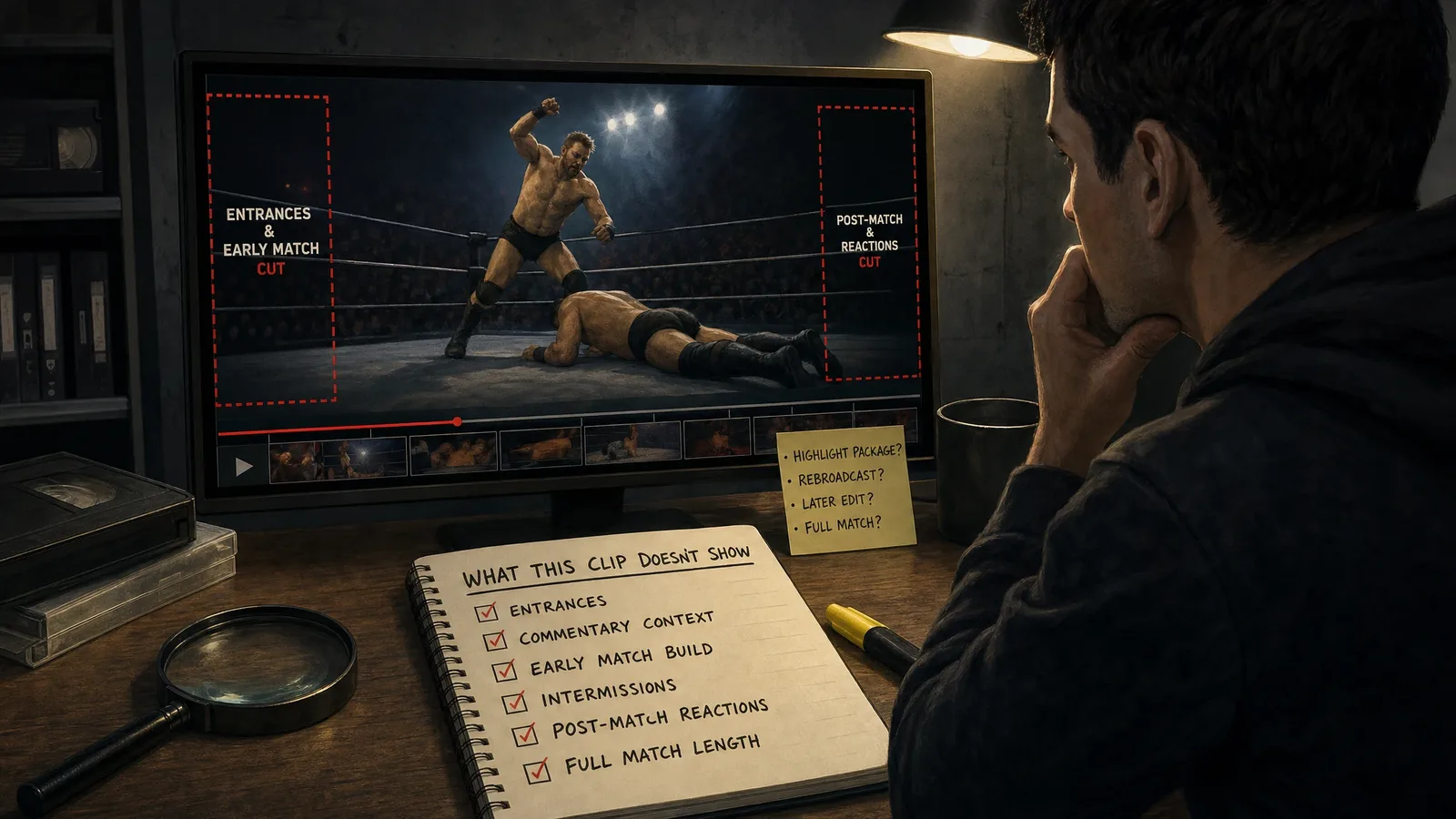
Start by identifying the kind of video
An archival wrestling video is not automatically a complete match simply because it shows recognizable in-ring action. A useful first distinction is between a full event or episode, a replay, a short clip, a highlights package and a later-produced program. WWE’s launch-era Network description itself separated an on-demand library from scheduled programming blocks, and it described original shows alongside historic material. Those categories can coexist on one platform, so the platform name alone cannot tell a viewer whether a particular upload is a direct presentation of an earlier broadcast, an excerpt, or another kind of program.
Labels are the fastest available clue. WWE used “full, uncut and uncensored” when describing classic WWE, WCW and ECW pay-per-views, while Sports Illustrated explicitly called its Wrestle Kingdom 12 presentation “highlights.” The contrast matters because “highlights” tells the viewer to expect selection, whereas a full-program label makes a more specific claim about completeness. Even then, read the scope closely. WWE’s full-and-uncut statement referred specifically to pay-per-views; it did not establish that every television episode, compilation or short-form video carried the same description.
Before interpreting pacing, crowd response or the apparent length of a contest, ask a basic question: what does the page actually call this video? If the answer is highlights, clips or a compilation, treat it as an account built from chosen material. If it is described as a replay or full event, that is a stronger starting point, but it still identifies the program rather than every surrounding item that may have been presented with it. The goal is not to rank formats as better or worse. It is to avoid giving a partial presentation the authority of a complete record.
A highlights package is selection, not continuous action
The Wrestle Kingdom 12 coverage offers a particularly clear comparison. Sports Illustrated said the entire card was available through NJPW’s streaming service while placing a highlights presentation on its own page. That wording separates two viewing choices: a full-event option and an abbreviated editorial package. A fan watching the latter can learn which sequences the article chose to foreground, but should not assume that the package contains every exchange, transition, reaction or stretch of downtime from the match. The difference is visible in the description, not something that needs to be guessed from the footage.
That highlights presentation selected discrete beats from the Jericho–Omega match: an announce-table sequence, a suicide dive, a powerbomb to the floor, a table spot, a counter of Omega’s finisher and the finish. Sports Illustrated presented those as separate highlighted moments. Their arrangement therefore records editorial selection rather than a continuous bell-to-bell account of all action between them. This does not make the chosen moments inaccurate. It means a viewer should reserve conclusions about the match’s full structure until they have watched a version presented as the full match or event.
A practical viewing habit follows from that example. Notice whether a video moves through named spots, embeds, chapter headings or isolated sequences, then ask what lies between them. Were there holds, reversals, recoveries, referee interactions or crowd responses that the package does not show? The question does not presume that anything important was removed; it simply recognizes the difference between selected moments and uninterrupted coverage. When a video advertises itself as highlights, its value is often in showing the editorially chosen peaks, not in documenting every moment of the contest.
Entrances may be included without making the upload complete
Presentation material can complicate a quick judgment. The Wrestle Kingdom 12 highlights page included separate headings for both Jericho’s entrance and Omega’s entrance. That is a reminder that a shortened package may preserve parts of the walkout, ring presentation or match finish while still remaining a highlights product. Seeing entrances is therefore useful evidence about what the editor elected to include, but it is not proof that the upload contains the whole match or the whole event. Completeness should be identified by the stated format, not inferred from one familiar component being present.
For viewers studying a wrestler’s presentation, separate two questions: “Is this entrance shown?” and “Is this the complete presentation?” A package can answer the first while leaving the second unanswered. The same caution applies to any video that opens just before the bell, begins during an entrance, or cuts directly to a major spot. Rather than filling gaps with assumptions, describe only what is visible: the upload includes an entrance segment, a portion of one, or no entrance at all. That language accurately reflects the version being watched.
This approach also helps when comparing clips shared by different accounts or platforms. One version may include an entrance and another may focus entirely on action, yet neither description alone establishes a full-match presentation. Compare the labels, the beginning and end points, and whether the material proceeds continuously. A comparison can tell you which visible elements differ. It cannot, without a stated full-program description, establish why those versions differ or which party made an edit. Staying with observable format details keeps the comparison useful and appropriately limited.
Commentary can belong to a different production moment
Sound deserves the same scrutiny as pictures. Sports Illustrated reported that Joey Styles did not call matches live at the ECW Arena unless the event was a pay-per-view. According to his account, commentary for non-pay-per-view ECW Arena matches was recorded as voice-over in post-production. That is a documented historical example of commentary heard on a wrestling program being added after the in-building action occurred. For a viewer, it means that a polished call is not by itself evidence that the announcer delivered those words live from ringside.
The exception in Styles’s description is as important as the general practice. He said pay-per-views were handled differently from other ECW Arena shows. A fan should therefore avoid extending one workflow across every ECW recording, much less across every promotion or era. The Sports Illustrated interview was published in 2016 and recounted an earlier practice; it is not a description of contemporary wrestling production generally. The defensible conclusion is narrow: the live-versus-post-production question can matter, and the answer may vary by program type.
Styles’s recollection of recording his “Oh My God!” call in post-production illustrates why audio can require its own context. He said the call later became an established catchphrase, but its presence in surviving footage can be connected to a later production session rather than the precise instant of the live action. That does not diminish the call or turn every memorable reaction into a later addition. It gives viewers a reason to ask whether an announcer was live, voicing over a show afterward, or working on a version with a different audio treatment.
Treat language and commentary tracks as version markers
A video’s language can be another identifying feature rather than a minor technical detail. In its Wrestle Kingdom 12 coverage, Sports Illustrated’s embedded event posts promoted an English-commentary option for the full stream. That shows why fans comparing archival material should note the commentary track they are hearing. Two versions of the same wrestling action may be presented with different language or commentary information. Recording that detail helps identify the version under discussion without claiming that one track supplies the only valid account of the match.
When comparing versions, make a simple inventory: What is the title or label? Does it name a full event, replay or highlights presentation? Which entrances appear? Is commentary present, and what language or track is identified? Where does the video begin and end? These questions turn a vague reaction such as “this is the match” into a more precise observation about a particular presentation. They also leave room for uncertainty when a page does not explain its production history or relationship to another available version.
Keep a replay separate from surrounding programming
A replay can sit beside other programming without being the same thing as that surrounding coverage. WWE’s launch-era description said replays of Raw and SmackDown would be available alongside live pre-shows and post-shows. Those are separate pieces of programming even when a service presents them together. For archival viewing, that distinction discourages a common shortcut: assuming that a replay includes every pre-match discussion, post-match reaction or adjacent segment that was available around the original television presentation. Identify the replay itself, then identify any companion material separately.
Likewise, a service’s access across multiple devices is a distribution fact, not proof that each device displays identical editorial content. WWE described the Network as accessible on multiple devices, but that statement does not establish sameness among every version of every program. A viewer who encounters differences should document the version they watched rather than use device availability as an explanation. The responsible question is not “what must have changed?” but “what can this particular label, beginning, ending and audio track establish about this particular video?”
Use historical labels within their stated limits
Archive descriptions often sound broad, so scope matters. WWE’s 2014 launch-era page characterized the Attitude Era material it was describing as unrestrained, uncensored and unedited. That wording should remain tied to the material and context named on that page, not treated as a universal description of all archive uploads. The same page said the on-demand library contained thousands of hours and would continue to grow, while also describing original shows and historic material. A library is a varied collection; one promotional phrase does not classify every item inside it.
Time is another limit on what a page can prove. WWE’s article was published before the service’s stated February 24, 2014 launch and thus describes launch-era plans and claims, not a current catalogue guide. Sports Illustrated’s Wrestle Kingdom 12 article was published on January 4, 2018, and its references to viewing options describe that presentation at the time rather than guaranteeing a route remains available. Historical pages are valuable for identifying how a program was framed then. They should not be converted into present-day availability claims without additional evidence.
Describe the version you watched, then state the limit
The most reliable fan discussion starts with a precise description. Instead of saying that an archival video proves how a whole match unfolded, say that the version watched is labeled highlights, includes specified entrances, uses a particular commentary track, or presents selected spots and the finish. If the page distinguishes a full-event stream from highlights, note that distinction. If a historical account documents post-produced voice-over for a category of shows, note the category and its exception. Precision does not make an observation weaker; it makes clear what the available version can actually support.
A final checklist can keep conclusions proportionate: Is the upload labeled as highlights, a replay, a full event or something else? Does it run continuously, or does it move among selected beats? Are entrances included, absent or partial? What commentary language or track is identified? Is there evidence that the commentary practice varied by show type? And does the source describe a historical viewing option rather than a current one? Answering those questions will not reveal every missing detail. It will help viewers distinguish what they saw from what they merely assumed was there.
Explore more

Darryl Polo
Darryl Polo is a passionate wrestling fan covering WWE, AEW, TNA and beyond. He loves great rivalries, breakout stars and the moments that keep fans talking long after the bell. How we work.