
Start with the question the number answers
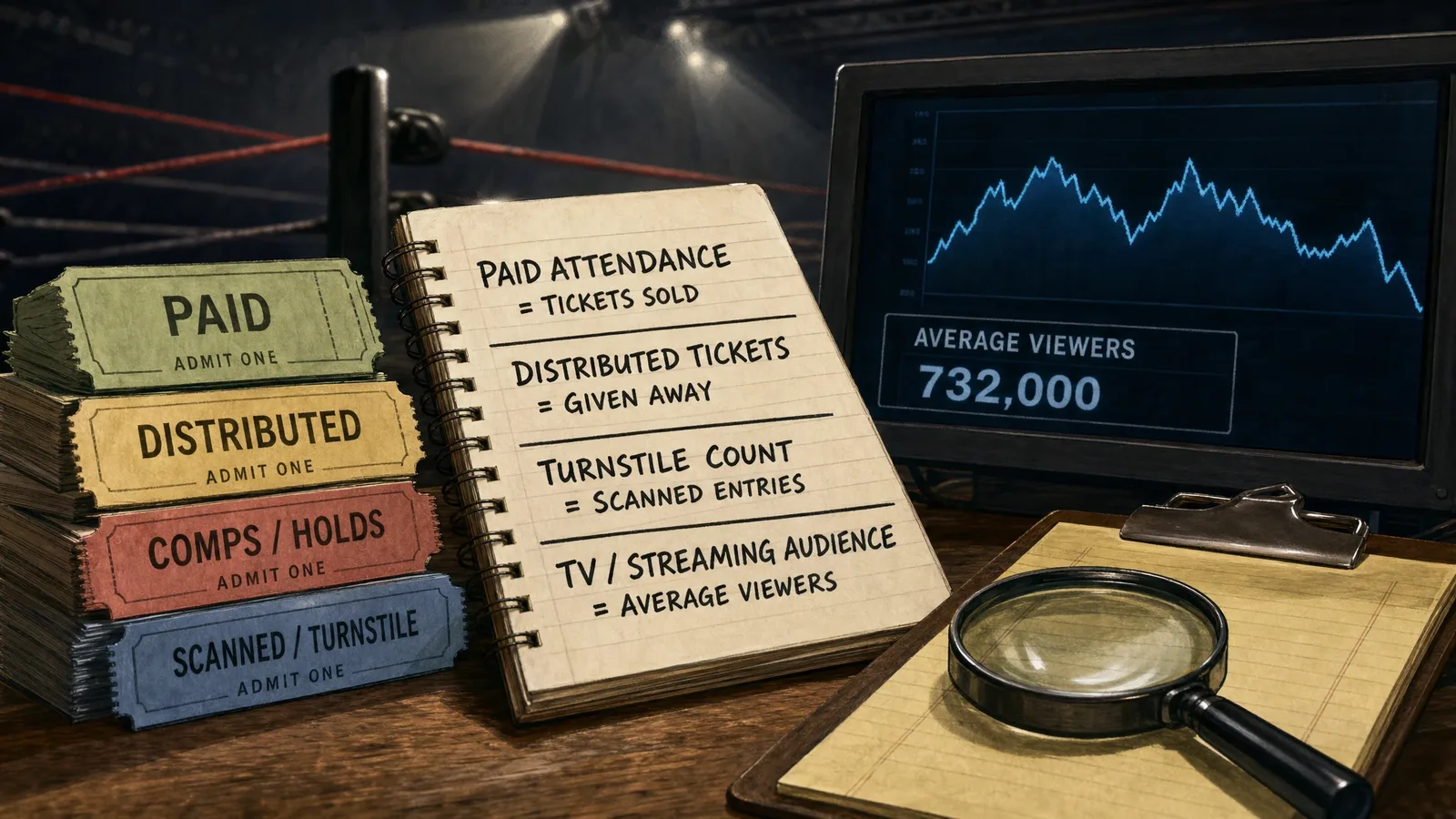
An audience number is most useful when its label stays attached. A figure may describe tickets sold, tickets distributed, people who entered a venue, or an average audience measured across screens. Those are related ideas, but they are not interchangeable counts. Before comparing two claims, identify the unit first: is it a ticket, an entry, or an average viewing audience? Then identify who reported it and what collection method is named. This prevents a familiar number from acquiring a broader meaning than its source actually gives it.
The distinction matters even within a single event. AEW’s post-event announcement for its August 2023 All In at Wembley Stadium said that more than 80,000 fans had converged on the stadium. The same announcement reported 81,035 tickets sold and claimed a professional-wrestling record for paid attendance. The wording supplies both a broad description of fans at the stadium and a ticket-sales figure, while the record claim remains AEW’s own characterization. A careful reader can report those statements without treating either as a substitute for a turnstile count.
A useful reading habit is to turn every headline number into a complete sentence. Rather than retaining only “81,035,” retain “AEW reported 81,035 tickets sold and claimed a paid-attendance record.” That sentence identifies the reporter, the ticket measure and the scope of the claim. It also avoids converting the promotion’s language into an assertion about scanned entries. In attendance reporting, the noun after the number often does more explanatory work than the number itself.
Read paid-attendance language with attribution
“Paid attendance” can sound like a headcount of everyone inside a building, but the Wembley example shows why readers should not assume that meaning from the phrase alone. AEW reported 81,035 tickets sold and separately described the event as setting a paid-attendance record. Neither statement by itself establishes how many ticket holders arrived at the venue. The disciplined approach is to preserve the organization’s wording, identify the ticket-sales claim as such, and avoid relabeling it as turnstile attendance.
Source type should stay visible as well. AEW’s 81,035 figure appeared in an event-promotion announcement published after the show, not in an independent venue audit. That does not make the claim unusable. It tells the reader what kind of evidence is being presented: a promotion’s announced ticket figure. The same applies to AEW’s record language. Because the promotion described the total as a professional-wrestling record, both the number and the superlative should be attributed to AEW rather than presented as an unqualified finding.
When a report uses paid-attendance language, ask three short questions: Who is making the claim? Does the source separately state a ticket-sales figure, or use different wording? Does it identify a separate entry count? Answers to those questions determine whether the number can be compared directly with another ticket-sales claim. They also keep a later retelling from turning a promoter’s announced category or record claim into an assertion that every ticket holder occupied a seat.
Distributed tickets are a separate category
Ticket distribution is another quantity that needs its own label. In Fightful’s account of the Wembley event, AEW’s announced 81,035 figure was reported separately from 83,131 tickets distributed, a figure attributed to WrestleTix. Because the report treats distribution and AEW’s announced attendance figure as different measures, neither label should be silently exchanged for the other. A comparison should say whether it is comparing ticket distribution with distribution, ticket sales with ticket sales, or two unlike categories.
The practical implication is modest but important: a distributed-ticket total is not automatically a paid-ticket total. It can be a relevant measure of how many tickets were distributed, but its meaning should not be expanded without evidence that it uses the same accounting definition as another figure. In the Wembley reporting, the two totals are close but nonidentical. That is a reason to preserve both labels, not a reason to select one as the event’s single definitive audience number.
A reader encountering an unattributed graphic can use a simple label check. Look for “sold,” “paid,” “distributed,” “attendance,” “turnstile,” or “entered.” If the post supplies only a large number with no label or source, the responsible conclusion is that the metric has not been identified. A precise number without a defined unit is less comparable than a smaller amount of clearly described information.
Turnstile counts measure entry, not every ticket
Venue-entry reporting answers a different question: how many patrons went through the turnstiles. Fightful reported that Brent Borough Council said Wembley Stadium registered 72,265 patrons entering turnstiles for All In. That is an entry measure, also describable as a scanned-entry or turnstile count. It is not presented as a count of tickets sold. Its value is its specificity about physical entry, not an implied answer to every question about the event’s ticketing.
The council’s caution is central to interpreting that figure. According to Fightful, the turnstile total did not measure how many tickets had been sold and did not include ticket holders who possessed tickets but did not attend. This explains why an entry total can differ from a sales or distribution total without either figure necessarily refuting the other. They observe different points: ticket accounting on one hand, stadium entry on the other.
The Wembley case therefore contains three distinct reported quantities for one show: 72,265 gate entries, 81,035 tickets sold as reported by AEW, and 83,131 distributed tickets attributed to WrestleTix. AEW also described its event as setting a paid-attendance record. Treating the figures as a contradiction misses the key lesson. Each number is tied to a different source or collection stage. A useful comparison table would give every figure its full label, attribution and method before placing totals alongside one another.
Do not turn a reported pattern into a conversion rule
Fightful also quoted an outside report that typical AEW turnstile counts were about 80–90% of paid attendance or tickets distributed. This can help explain why attendance discussions sometimes use percentages, but it is not a universal formula. The report frames it as an attributed, promotion-specific generalization. It should not be used to calculate an unreported gate figure for another promotion, another venue, or another event as if the result were an observed fact.
This is where wording such as “estimated” needs special care. An estimate may be useful when it remains visibly an estimate, names the source, and explains the inputs when they are given. It becomes misleading when it is repeated as an audited total or when a pattern from one setting is applied everywhere. For historical comparisons, keep promotion announcements, venue or local-government entry records, and third-party ticket-tracker figures in separate columns rather than blending them into one claimed attendance.
Screen audiences require a method label too
Screen-audience figures create a parallel problem. ESPN’s 2022 report on a Prime Video Thursday Night Football opener described a 15.3 million average audience across all platforms, using Nielsen data together with Amazon’s first-party measurement. It also reported a 13.0 million average using Nielsen ratings alone. The numbers should not be framed as dueling accounts of precisely the same measure: one is Nielsen-only, while the other combines two measurement sources.
The report said Amazon’s additional measurement could account for viewing on connected televisions, Amazon applications and a separate Twitch feed. That detail illustrates why a label such as “all platforms” matters. It identifies a combined measure with a broader stated measurement approach than the Nielsen-only number. When reading a wrestling television or streaming claim, look for comparable information: whether the figure is an average, which measurement provider is named, and whether the total combines platforms or reports one measurement system alone.
A distribution detail can also shape what a screen figure represents without making it directly comparable to another program. ESPN described that first regular-season Prime Video game as exclusive to the service. The report also noted that Nielsen had only recently begun including a streaming service in its ratings tracking through a three-year agreement with Amazon. These details do not create a universal rule for wrestling coverage. They demonstrate why platform availability and measurement arrangements belong beside any audience figure before comparisons are made.
Keep forecasts, sign-ups and viewers apart
Not every number associated with a broadcast is an audience measurement. ESPN reported that Amazon had told advertisers it expected a 12.6 million seasonal average based on Nielsen numbers. That was an estimate for a season, not the realized audience for the individual opening game. The report separately noted a record number of Prime sign-ups during the game. Subscriber acquisition is another outcome measure, not a replacement for average viewers. The same discipline applies whenever audience reporting mixes forecasts, subscriptions and viewing figures in one discussion.
Build comparisons that stay honest
A reliable comparison starts by matching like with like. Compare a promotion’s stated ticket-sales total with another clearly defined ticket-sales total only after noting the respective sources. Compare turnstile entries with turnstile entries when the available evidence identifies them that way. Compare screen averages only when their measurement systems and platform scope are stated. If the labels do not match, the comparison can still be informative, but it should be presented as a contrast between different measures rather than as a ranking.
Finally, avoid asking any one number to prove more than it measures. A live-event attendance total and a television or streaming average describe different populations gathered through different systems. Neither figure alone establishes the other event’s popularity, revenue or match quality. The most informative fan discussion is often not “which number is bigger?” but “what was counted, by whom, and at which stage?” Once those questions are answered, the limits of a comparison become easier to see and explain.
Explore more

Darryl Polo
Darryl Polo is a passionate wrestling fan covering WWE, AEW, TNA and beyond. He loves great rivalries, breakout stars and the moments that keep fans talking long after the bell. How we work.