
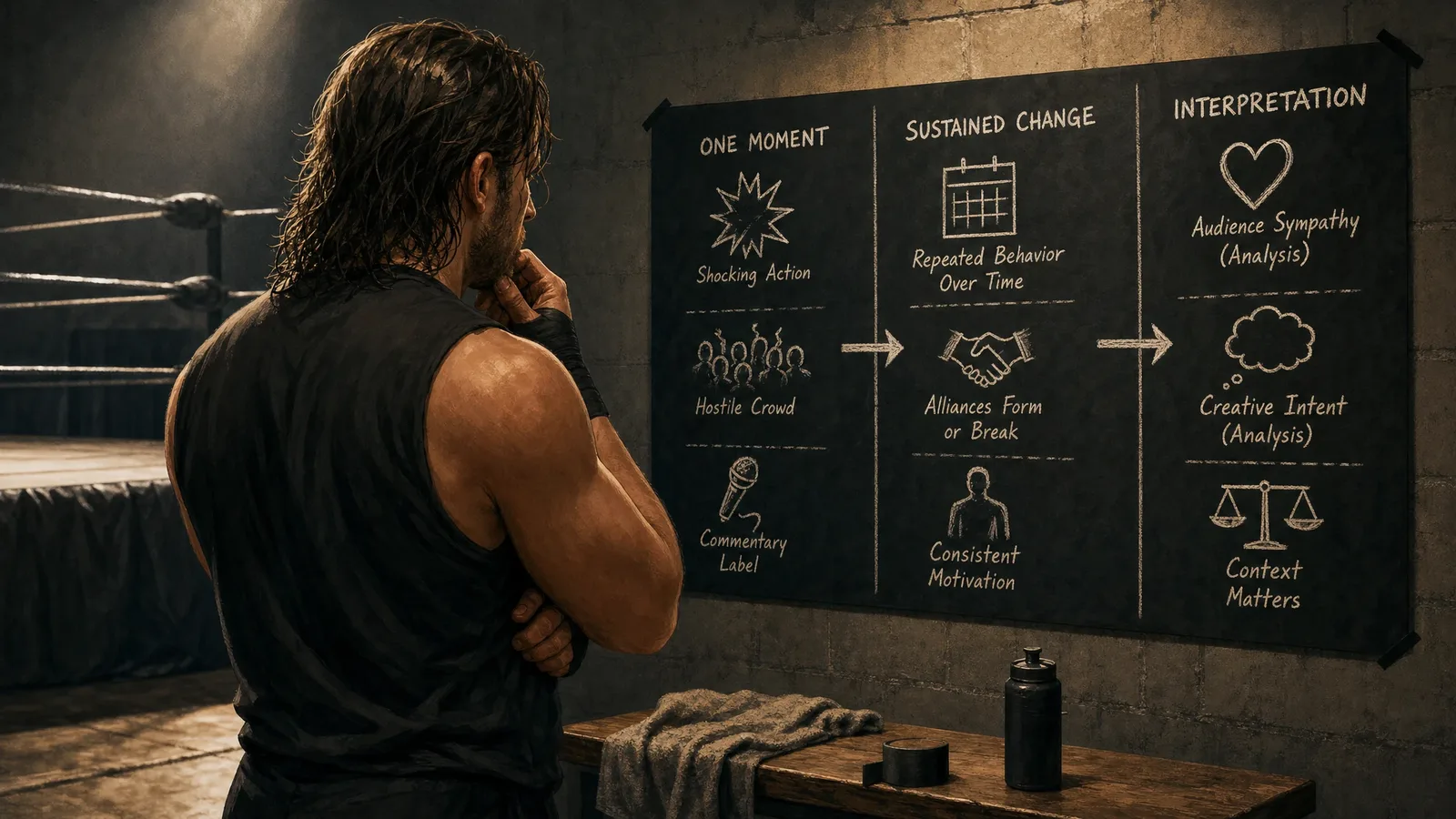
A turn is a reading problem, not just a moment
In wrestling coverage, a turn commonly names a change in character alignment. That label can sound immediate and simple: somebody attacks a partner, accepts help from an old enemy, or suddenly receives a hostile reaction. Yet the evidence behind the label comes in different forms. An observable action tells viewers what happened in a segment. An affiliation identifies who the character stands with. Commentary and official recaps show how a promotion is presenting the moment. Later appearances reveal whether the apparent shift became a continuing pattern. Keeping those categories separate makes a fan’s reading more precise.
The most useful first question is not “Was that a turn?” but “What changed on screen?” A betrayal, interference or unusually underhanded tactic may be strong evidence that a change is beginning. It does not automatically establish how durable that change will be. Repeated conduct, continued partnerships and follow-up matches provide firmer grounds for describing a new alignment. This approach leaves room for the surprise of a single segment while recognizing that wrestling stories can clarify its meaning through subsequent programming.
This also prevents a common shortcut: treating crowd noise as a final ruling on character alignment. A cheer, boo or chant is evidence of one audience’s response at one point. It is not, by itself, proof of a formal face or heel change, and it cannot show that every audience will react alike. In some stories, the gap between official villain presentation and audience support is not a contradiction to explain away; it is part of what viewers are being shown.
Four kinds of evidence to keep apart
Start with conduct. What did the wrestler actually do? Did they attack a partner, use tactics presented as underhanded, interfere in a match or assist someone else? This is the most direct level because it describes a visible event. Still, conduct alone has limits. A single hostile or underhanded act can point toward a turn, but later episodes are what show whether the act represented a lasting realignment rather than an isolated development. A careful description can be decisive about the action without overclaiming its long-term meaning.
Next, examine relationships. Joining a group, accepting aid from a previous enemy or remaining beside new allies gives a potential turn narrative structure. Official language matters too, but it should be identified as presentation. A promotion may use forceful moral or evaluative descriptions of its characters. Those words tell fans how that promotion frames the story; they are not neutral descriptions of real people, nor do they independently establish creative intent. A third layer is audience reaction, which should remain distinct from both the action and the official framing.
Austin and McMahon: a cluster of confirmation signals
The WrestleMania X-Seven title match between Steve Austin and The Rock offers a historical case in which a turn is legible through accumulating signals rather than one act alone. Austin challenged The Rock for the WWF World Heavyweight Title in a No Disqualification match. Slam Wrestling described Austin’s established character before the match as a worker-rebel opposed to Vince McMahon. That existing opposition gave special significance to any later cooperation between the two: viewers were not merely seeing assistance, but a reversal of a known relationship.
Slam Wrestling’s match account also recorded conduct presented as more overtly dirty than Austin’s usual behavior. Its examples included confrontations with officials and production staff, a ringbell, an eye rake involving a knee brace and a submission associated with an earlier persona. The report treated these developments as foreshadowing, not as its sole basis for identifying an alignment change. That distinction is valuable. Escalating tactics can prepare viewers to question a character’s direction, but foreshadowing becomes more meaningful when the story later supplies a clear relational development.
That relational development arrived when McMahon interfered for Austin, supplied a chair and helped create the conditions for Austin to defeat The Rock. After the title win, the two shook hands and drank beer together; Austin then struck The Rock again with the championship belt. Taken together, the changed conduct, help from a former enemy, visible alliance and post-match attack make a stronger case than any individual beat would. The point is not that every turn requires this exact sequence, but that several forms of evidence can reinforce one another.
Booked alignment and a local crowd can diverge
The same Austin account supplies an important caution about audience response. Slam Wrestling said WWF was attempting to present Austin as a villain in Texas while also noting that local fans strongly supported him there. The source therefore records two things that should not be collapsed into one: the promotion’s apparent alignment presentation and the response of that local audience. A viewer can recognize both without declaring either one invalid. Officially villain-coded conduct does not guarantee boos, particularly in a setting where a performer has strong local support.
It is equally important not to turn a reviewer’s verdict into a broad measurement of fan opinion. Slam Wrestling’s positive assessment that the Austin gamble paid off was the report’s judgment. It was not a universal finding about every spectator’s reception of the change. When revisiting an angle, fans can say that a report described a particular response, or that a review praised the presentation. Those are more accurate claims than treating a local reaction or one critic’s conclusion as a complete account of an entire audience.
Jack Perry: continuity outweighs one attack
AEW’s All Out 2024 preview presents Jack Perry’s then-current role through a longer chain of breaks and associations. In its retrospective account, Perry had been betrayed by Christian Cage and Luchasaurus, betrayed HOOK and rejected support from AEW fans. It also states that he reappeared in New Japan Pro-Wrestling after months away, aligned with House of Torture, returned to AEW at Dynasty 2024 and helped The Young Bucks retain the AEW World Tag Team Championship. That sequence gives viewers multiple points to track rather than asking one attack to carry every interpretive burden.
After returning, Perry was presented alongside The Elite and took part in their attack on AEW CEO Tony Khan. For a viewer, those continuing associations can be read as stronger evidence of a sustained villain-coded role than an isolated attack alone, because they extend the apparent direction beyond one segment. The useful viewing lesson is straightforward: after a startling development, watch who remains at the character’s side and whether that relationship continues to organize later scenes. A stable group connection can make a new direction easier to identify even when an individual match contains behavior that seems less easily categorized.
Perry’s account also shows why one clean-looking sporting gesture cannot settle alignment by itself. The preview notes that he won the TNT Championship ladder match without Elite interference and later issued an open challenge, even as it otherwise framed him as aligned with The Elite. A clean victory or open challenge may add texture to a character, but it does not erase the wider storyline pattern. Fans need not force every action into a simple moral ledger when the surrounding relationships and presentation continue to point in another direction.
Swerve and Page: when support becomes story material
AEW’s preview offers a different complication through Swerve Strickland. It described Swerve as gaining fan support over time despite earlier storyline actions it characterized as unethical or harmful. The same account said that support was growing before the 30-minute draw involving Swerve and Hangman Page, and described crowd reaction as favoring Swerve over Page as far back as WrestleDream 2023. This is not evidence that past actions disappeared. It is evidence that audience support and a promotion’s account of a character’s earlier conduct can exist side by side.
AEW further presented Page as responding not only to Swerve’s actions but to fans continuing to choose Swerve. That is storyline narration about Page’s motivation, not independent proof of why real spectators supported either character. The distinction matters because the crowd itself can become a subject inside the angle. Viewers can observe that a story invokes audience preference while remaining cautious about claims concerning the private reasons behind a whole crowd’s reaction. Promotion framing, live response and interpretation remain related but separate layers.
Strong and Dunne: follow-up gives betrayal its shape
WWE’s account of Roderick Strong and Pete Dunne is a compact example of later structure confirming the meaning of a betrayal. WWE identified Strong’s turn on Dunne as taking place at the close of the Dusty Rhodes Tag Team Classic Finals at NXT TakeOver: New Orleans. The match was also for the NXT Tag Team Championship, meaning the break affected both a partnership and a title situation. Strong then joined Undisputed ERA and helped the group retain the titles, immediately attaching the surprise to a new affiliation and competitive consequence.
The follow-up is what stops that ending from functioning only as a shock. WWE’s later premise had Dunne seeking revenge against his former partner while Undisputed ERA watched. The new group remained relevant, the broken partnership supplied the conflict and the title interests remained part of the situation. This is a useful model for viewers assessing a fresh betrayal: look beyond the initial strike. Does the former partner become an opponent? Do new allies remain involved? Does later programming build matches or a feud around the break? Those answers reveal whether the story is treating the event as a durable change.
A practical checklist for watching an apparent turn
When a segment seems to signal a face or heel turn, begin with a narrow observation: identify the visible action and avoid adding a conclusion before the follow-up arrives. Then ask whether the character has formed or revived an alliance, whether that alliance persists, and whether later matches or feuds are organized around the changed relationship. Notice how the promotion frames the character, but attribute evaluative language to that presentation. Finally, describe cheers and boos as responses from that audience in that moment, rather than as automatic proof of a universal alignment.
This method does not create a universal timetable. The documented Austin, Perry and Strong sequences each use different combinations of conduct, affiliations, framing and continuation. Their shared lesson is modest but useful: a surprising act may begin the question, while subsequent behavior and story structure provide the clearer answer. A fan can therefore hold a provisional view without pretending certainty. Say what occurred, note how it was presented, watch what repeats, and separate a personal interpretation from evidence of an on-screen development. That is often the clearest way to tell a momentary shock from a sustained character change.
Explore more

Darryl Polo
Darryl Polo is a passionate wrestling fan covering WWE, AEW, TNA and beyond. He loves great rivalries, breakout stars and the moments that keep fans talking long after the bell. How we work.