
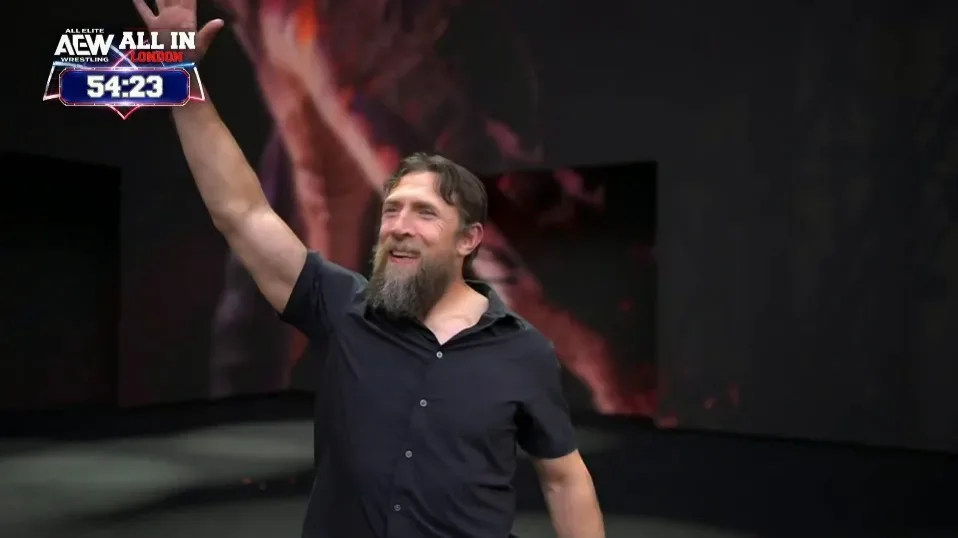
Bryan Danielson has explained why fans should not expect to see him regularly posting online. The AEW star said social media has never been a natural fit for him, and that his most frequent reason for checking it is connected to his work as the company’s head of discipline.
Speaking on The Nikki & Brie Show alongside his wife Brie Bella, Danielson offered a blunt summary of his relationship with the platforms. Rather than treating social media as a place for constant promotion, commentary, or personal updates, he described it as something he generally avoids until an AEW-related issue requires his attention.
“I only get on social media when somebody at the company I work for gets in trouble,” Danielson said. “I’ve never been deep in the social media game. I can’t even understand why people would want to be on social media.”
The comments offer a clear look at Danielson’s approach to an area that has become central to modern professional wrestling. Social platforms can be a direct line between wrestlers and their audiences, a place to build anticipation for matches, clarify public statements, celebrate victories, or continue rivalries outside television. They can also become a flashpoint quickly, particularly when a post, video, comment, or disagreement attracts widespread attention.
For more background on this topic, read MJF Draws a Line Between Constructive AEW Criticism and Online Hate.
For Danielson, however, the appeal is limited. He acknowledged that he understands the promotional value of being online, but said the experience itself is not for him. That distinction is important: Danielson is not dismissing the usefulness of social media for performers or companies. He is saying that he does not personally enjoy participating in it and does not make it part of his routine.
Danielson’s AEW Responsibilities Add Context
Danielson’s reference to checking social media when someone at AEW “gets in trouble” reflects the specific responsibility he identified: serving as the company’s head of discipline. That role naturally places him in a different position than a wrestler who uses an account only to communicate with fans or promote upcoming appearances.
When public issues emerge involving talent or other people associated with a wrestling company, social media can be among the first places where information, reactions, and controversy spread. Danielson’s remarks suggest that his work can require awareness of those situations even if he has little personal interest in browsing the platforms day to day.
He did not identify any particular incident, person, or disciplinary matter during the discussion. His comments were instead a broader explanation of why he is seldom active online. There was no announcement of a new policy, a specific AEW investigation, or a disciplinary decision.
That measured framing fits the larger point Danielson made. He was not presenting himself as an online personality, nor was he teasing an increased social-media presence. If fans encounter a Danielson post, it may not necessarily signal that he has suddenly embraced the format. His comments indicate that his attention can be drawn there because of professional responsibilities rather than personal enthusiasm.
A Different Relationship With Wrestling Promotion
Professional wrestling has changed dramatically in the social-media era. Wrestlers can promote a match moments after it is announced, share travel photos, respond to fan questions, post training footage, or create content that reaches viewers who may not be watching every weekly program. For many performers, that visibility has become an important extension of their public persona.
Danielson’s view represents a different approach. He understands why promotion matters, but he does not see the appeal in spending significant personal time on the platforms. There is a difference between recognizing that an advertising tool works and wanting to make that tool part of one’s everyday life. Danielson drew that line plainly.
His stance also illustrates how a social-media account can be misleading as a measure of a wrestler’s investment in their career or their connection to an audience. Some wrestlers choose to post constantly, while others communicate largely through television, live events, interviews, and the work they do in the ring. Danielson has long been a figure whose professional reputation is tied most strongly to his wrestling, his intensity, and his perspective on the craft rather than a nonstop digital presence.
That does not mean he is unaware of the online conversation around wrestling. His discipline position requires that he may need to be aware of it at particular times. But there is a major difference between monitoring a situation when necessary and being immersed in the broader cycle of daily posts, debates, reactions, and trends.
No Suggestion That Every Post Comes Directly From Danielson
Danielson’s remarks also reinforce why fans should be cautious about assuming every message connected to a wrestler’s social account reflects that person sitting at a phone and posting in real time. In professional wrestling, accounts can be used for promotional purposes, coordinated announcements, event promotion, or communication handled with assistance. Danielson’s limited interest in social media makes that broader reality especially relevant in his case.
The key point is not that Danielson rejected promotion. He specifically said he understands it. Rather, he made it clear that the activity is not something he seeks out for enjoyment. The practical side of social media has value; the personal experience of using it does not hold much appeal for him.
That perspective may resonate with fans who see only the most visible side of the industry. A wrestler’s online presence can create the impression that every performer is expected to react immediately to every development. Danielson’s comments are a reminder that there are still prominent figures in the business who prefer distance from that environment, even while working in a company that operates in a highly connected media landscape.
Danielson Keeps the Conversation Light
Despite the serious workplace context of discipline, Danielson’s discussion was not solely focused on policies or controversy. He also kept the conversation light by bringing up another subject he enjoys: mushrooms. Danielson said mushrooms are “hot,” adding a humorous personal note to a conversation largely centered on why social media is not his preferred pastime.
The contrast is fitting for a performer who has often maintained a distinctive perspective both inside and outside the ring. Social media may be a major part of the wrestling business, but Danielson made it clear that he would rather devote his attention elsewhere unless work demands otherwise.
For AEW fans, the practical takeaway is straightforward. Danielson is not positioning himself as someone who will offer a constant stream of online updates, opinions, or reactions. His social-media involvement is limited, and when he does check in, it can be because an issue involving the company has reached the level where his disciplinary responsibilities matter.
There is no indication from his comments that this approach is about to change. Danielson understands the promotional side of social media, but his preference remains firmly on the other side of the screen. In an era where online engagement can seem unavoidable, he remains notably direct about not wanting to be part of it any more than necessary.

Darryl Polo
Darryl Polo is a passionate wrestling fan covering WWE, AEW, TNA and beyond. He loves great rivalries, breakout stars and the moments that keep fans talking long after the bell. How we work.