
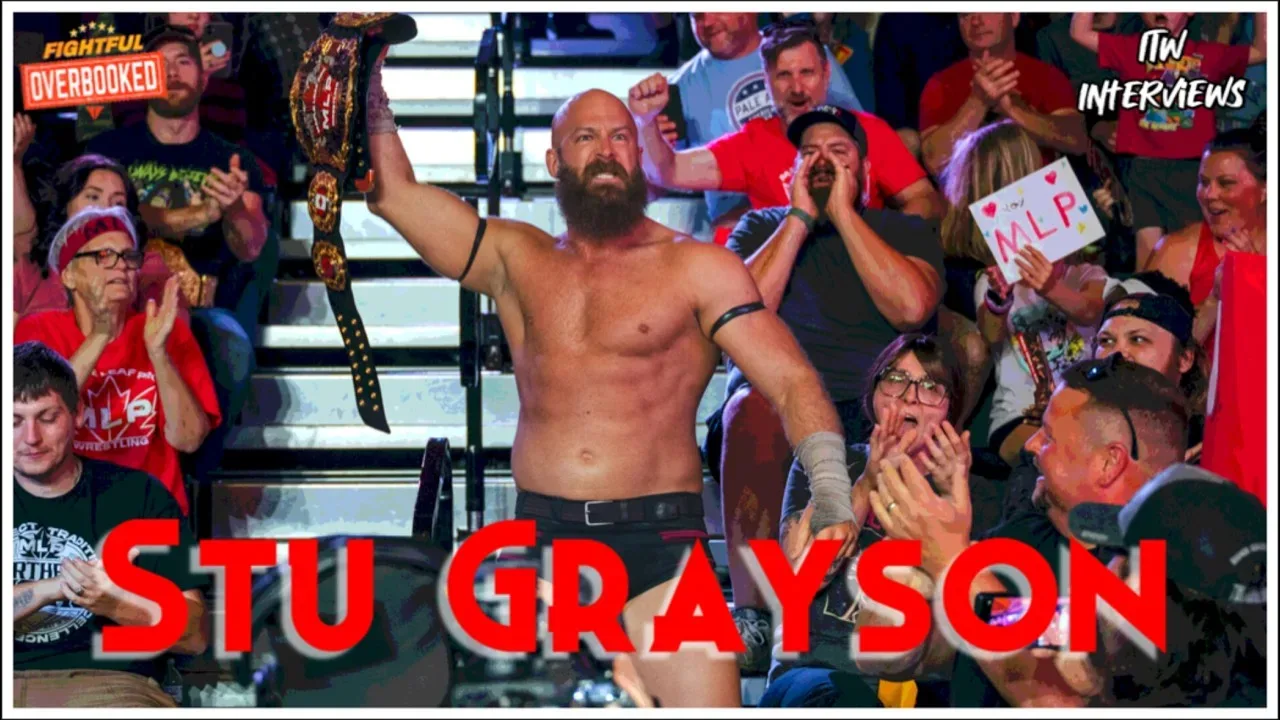
Stu Grayson’s recent clash with Josh Alexander at Maple Leaf Pro Wrestling Northern Rising was not simply a meeting between two established Canadian names. In Grayson’s view, it was a showcase for an evolving style of wrestling rooted in the country’s technical traditions while embracing a far more explosive modern presentation.
Grayson and Alexander met on October 3 in a Canadian Championship unification match at MLP Northern Rising, with Alexander emerging victorious. The bout carried added significance for both competitors, not only because of the championship stakes but because it reunited two wrestlers who had already learned years earlier that their respective approaches fit together naturally.
Their last singles meeting had come in Montreal in 2018. Grayson recalled that the pair had enjoyed that encounter and recognized early on that their styles complemented each other. Both men can work from a technical base, but neither confines himself to a conventional mat-heavy identity. Their offense also incorporates power, speed, sharp striking and a willingness to raise the intensity as a match develops.
A Shared Foundation, Different Expressions
Grayson described himself and Alexander as classic Canadian professional wrestlers in terms of their underlying fundamentals. He also believes the label needs to account for how the style has changed. The traditional expectation of sound technique remains, but today’s performers have added greater athleticism, innovation and urgency to that base.
For more background on this topic, read David Finlay Explains Why AEW Offered the Right Next Chapter After NJPW Exit.
He called it an “explosive Canadian technical style,” a description that captures the mixture at the heart of his work with Alexander. The fundamentals remain important, whether the action is based around holds, counters, positioning or physical control. From there, however, the performers can accelerate into the sort of forceful offense and high-impact sequences expected from contemporary wrestling.
“Canadian pro wrestling has always been about being technically sound, but we are more explosive more than ever,” Grayson said.
For Grayson, that evolution is visible in the breadth of offense used by Canadian wrestlers. He pointed to his own power-based and aerial attack, while identifying Alexander’s combination of striking and technical ability. He also named Speedball and Kenny as examples of wrestlers whose high-flying, striking and explosive styles reflect the same wider movement.
The key is not that every wrestler executes the exact same moves or follows one rigid template. Instead, Grayson sees a common foundation that allows each performer to take a distinct route. He and Alexander, in particular, share enough of that foundation to make their exchanges feel natural, while their individual differences create the friction that makes the matchup compelling.
That is why Grayson believes he and Alexander have consistently worked well together. They understand the same basic language in the ring, but they speak it with different accents. Grayson can introduce his power and aerial elements, and Alexander can answer with his own blend of hard strikes and technical control. The result is a match structure that can begin with familiar wrestling logic before escalating into something much more volatile.
Making the Unification Match Physical
Grayson said the Northern Rising contest was “extremely physical,” and that was no accident. Before entering the ring, he and Alexander made clear to one another that they were prepared to push the pace and see just how far the match could go. It was a mutual challenge rather than a carefully protected performance.
“Brace yourself” was the message Grayson said they exchanged before the bell. Each knew the other was coming in ready to deliver a hard-hitting match, and each intended to see whether the other could continue meeting the escalating demands of the contest.
Grayson framed that mindset as a test. The two men were not only working to produce a memorable championship match for the audience; they were probing their own endurance and resilience. That approach fits the version of Canadian wrestling he was describing. Technical precision is important, but it is paired with a desire to make the action feel immediate, forceful and earned.
In that environment, the match’s violence and intensity become part of the story. The competitors are not merely trading impressive offense. They are responding to one another’s challenge, trying to establish who can absorb the punishment, maintain their timing and keep driving forward when the physical toll begins to mount.
Alexander ultimately won the unification match, but Grayson’s comments make clear that he viewed the experience as a successful meeting of two wrestlers determined to deliver a demanding bout. He said wrestling Alexander is always enjoyable because of the way their styles connect, even when that connection produces a grueling contest.
Alexander’s Return Added Another Layer
Grayson also addressed the personal motivation he felt Alexander carried into the match. Alexander had recently returned from a knee injury, and Grayson said his opponent had not received as much ring time as he would have wanted during that period.
That created an added reason for Alexander to push himself in a major setting. Grayson said wrestlers who are used to competing frequently can feel a strong need to prove something to themselves after an injury layoff or another break from regular in-ring work. The goal is not necessarily to silence outside criticism. Often, it is an internal question: can they still perform at the same standard they held before they were sidelined?
Grayson believed he was an ideal opponent for Alexander in that situation. Their shared willingness to work a physical and explosive match gave Alexander a chance to measure himself in a high-pressure environment. The Canadian Championship unification stakes only raised the importance of that challenge.
Grayson said the need to prove oneself after time away is “not even to anyone. It’s to yourself.”
That perspective also explains why Grayson embraced the role. He likes wrestling at an intense level, and he understood what Alexander needed from the match. Rather than reducing the encounter to a cautious return performance, the two wrestlers chose to make it a full-scale test of conditioning, toughness and confidence.
For Grayson, the fact that they could approach the bout in that way speaks to the trust built through their prior experience and shared instincts. A match can only become that physical when both performers understand the purpose behind the escalation and are prepared to support one another through it.
The Drive Home Told the Story
The aftermath offered a striking illustration of just how much the match took out of Grayson. Once the event was over, he drove from Toronto to Ottawa, a trip he estimated at roughly five hours. At the time, he was relaxed enough to listen to music, enjoy the drive and get a solid night of sleep.
The next morning, though, the evidence of the match was impossible to miss. Grayson woke to find blood on his pillow and said he had three sizeable holes in his head caused by a screwdriver spot during the bout. Despite that grim detail, he summed up the experience positively.
It is a fitting final image for the type of match Grayson says he and Alexander set out to create. The contest was built from established wrestling fundamentals, but it did not stop at a traditional technical exhibition. It was intended to be explosive, punishing and personal in the sense that both men were measuring themselves against a demanding opponent.
Alexander left Northern Rising with the win and the unified Canadian Championship. Grayson left with the physical scars of a match that tested both competitors, as well as another example of why he believes their rivalry works so well. Their styles are similar enough to create cohesion, different enough to create tension, and intense enough to make every escalation feel like a challenge worth accepting.

Darryl Polo
Darryl Polo is a passionate wrestling fan covering WWE, AEW, TNA and beyond. He loves great rivalries, breakout stars and the moments that keep fans talking long after the bell. How we work.