
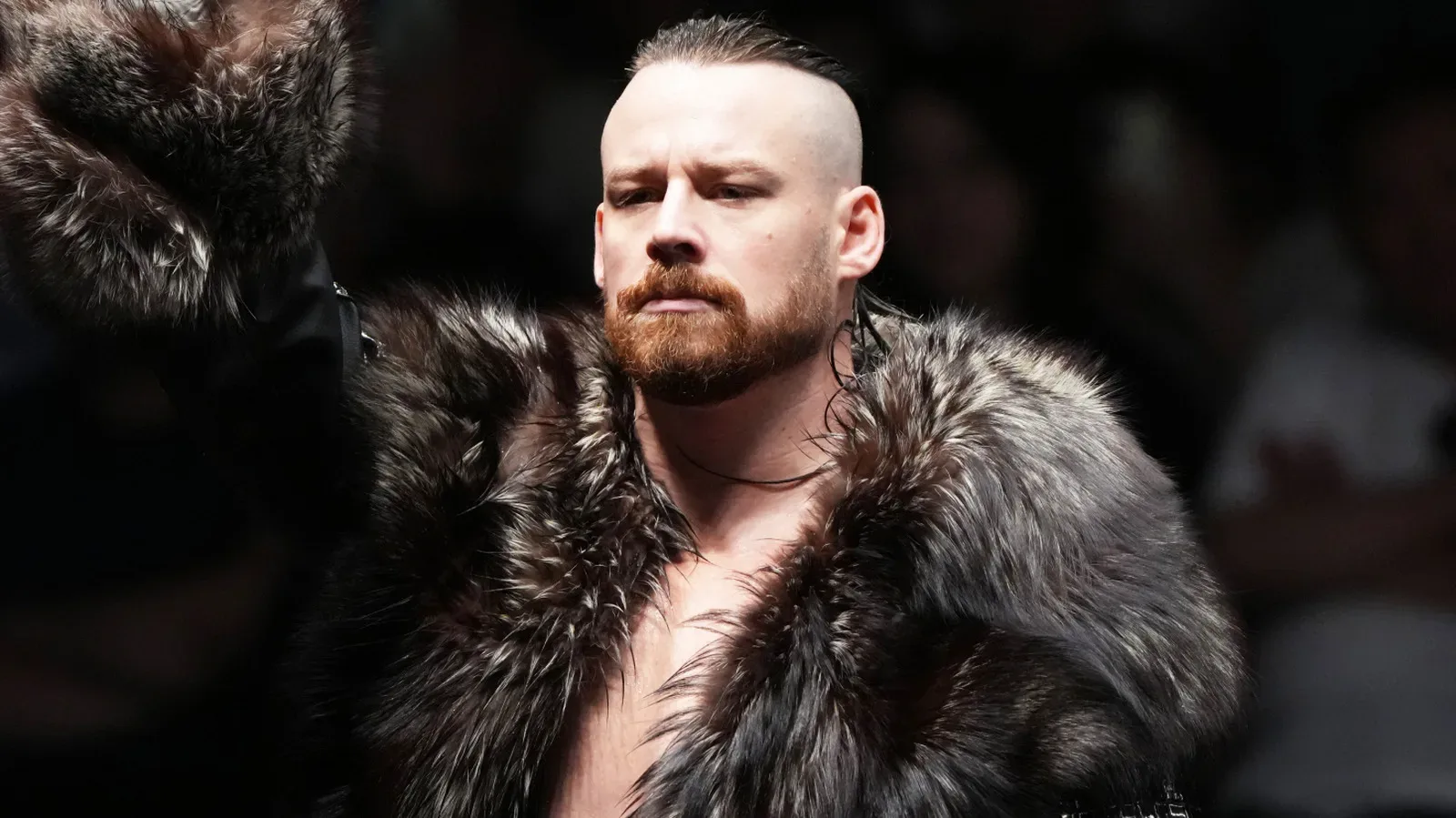
David Finlay’s decision to leave New Japan Pro-Wrestling marked the end of an 11-year run that saw him develop from a young prospect into one of the company’s most prominent foreign stars. By the time his NJPW tenure came to a close, Finlay had been a two-time IWGP Global Heavyweight Champion, led the Bullet Club War Dogs, and wrestled eight times at the Tokyo Dome.
That body of work made his next destination a major subject of discussion. WWE NXT was widely viewed as a possible landing spot, particularly because of Finlay’s family connections within WWE. Instead, Finlay signed with AEW in March 2026, reuniting with former War Dogs stablemates Gabe Kidd and Clark Connors.
Speaking on Talk is Jericho, Finlay explained that the choice was not about simply following the people closest to him. He had personal connections and familiar faces on both sides of the decision. In AEW, there were his former Bullet Club allies. In WWE, his brother Uriah Connors and his father, Fit Finlay, provided an equally meaningful connection.
Ultimately, Finlay said the offers themselves made the difference. The financial terms and schedule mattered, but so did the ability to maintain the identity and freedom he had established over more than a decade in Japan.
For more background on this topic, read Buddy Matthews Pulled From WSW Megamania Tour Due To Scheduling Conflict.
“Just the overall package of, like, obviously pay and schedule, but just like, ‘Alright, all my friends are in AEW. Then my brother and dad are in NXT, cool,’” Finlay said on Talk is Jericho. “But yeah, it didn’t have any bearing on it, like it would have been cool, but it’s like no, I want to go keep doing what I’m doing, have the freedom to do what I want to do and if I can be with my friends, that’s a great bonus.”
Finlay did not want to restart from the bottom
For Finlay, the prospect of joining WWE carried a unique professional challenge. A move to NXT could have brought him closer to family and placed him in a system where his father has long been respected, but it also could have required him to begin again in a developmental environment.
That was difficult to square with what Finlay had already achieved in New Japan. He had spent years working through the promotion’s system, growing into a major player and taking on a more forceful role as the leader of the War Dogs. His Tokyo Dome experience and championship history were not theoretical accomplishments; they were the result of a long, sustained climb in one of wrestling’s most demanding environments.
Finlay acknowledged that he might have struggled with the level of humility WWE’s structure could have demanded from him after reaching that point in his career.
“I think I would have struggled re-humbling myself to the level that they would have wanted me to humble myself to,” Finlay said. “It’s like I’ve already been here and I’ve already proven myself.”
That does not necessarily mean Finlay viewed WWE or NXT as an inferior opportunity. Rather, his comments illustrate how much value he placed on continuing the momentum he had built in Japan. A performer who had already carried high-profile singles championship responsibilities and performed on NJPW’s biggest stage was looking for a situation that allowed him to remain established, not one that required him to prove the basics of his value again.
AEW provided an avenue to continue as an experienced, fully formed wrestler while also offering a familiar locker-room connection through Kidd and Connors. For a performer whose presentation had become closely tied to the hard-edged War Dogs identity, the chance to work alongside those associates was a meaningful benefit, even if Finlay stressed it was not the sole factor behind his selection.
Family was central to leaving Japan
Finlay’s move west was also about far more than where he would wrestle next. The larger issue was where he wanted to spend his time away from the ring. After living and working in Japan for much of his adult life, he reached a point where the demands of international wrestling became more difficult to reconcile with raising a child.
Finlay said his wife had been part of his life throughout his time in Japan, and the two had become accustomed to the challenges created by his career. Becoming a father changed the emotional weight of those absences. The issue was not merely missing events or time at home. It was returning from extended tours and recognizing how much his child had changed while he was away.
“I had a kid,” Finlay said. “It sucked. My wife has been in the picture the entire time I’ve been in Japan so like we’re used to that, no problem. But when I leave for a G1, come back, and my kid’s got 20 new tricks, I’m like, ‘I’ve missed so much,’ which comes with wrestling.”
The G1 Climax is one of NJPW’s most grueling annual commitments, requiring wrestlers to work through a demanding tournament schedule and spend considerable time on the road. For someone based in the United States, those stretches can intensify the physical distance between work and family. Finlay’s comments make clear that the issue had become personal as well as practical.
His own upbringing gave him a perspective on the subject. As the son of Fit Finlay, David grew up knowing that professional wrestling often means a parent is constantly traveling. He said he did not feel that he had missed out on his relationship with his father, but he also recognized that an opportunity to be more present for his own family was worth pursuing.
“I grew up with my dad being on the road five days a week,” Finlay said. “I don’t feel like I missed out, cool, it would have been great to have him home more, but I don’t feel like I missed out. But also if there’s an opportunity to be home more, I feel like I owe that to my family.”
That distinction is important. Finlay was not framing his NJPW years as a mistake or rejecting the sacrifices that helped build his career. Instead, he was weighing a new set of responsibilities against a lifestyle that had been normal for him since childhood. AEW’s schedule and its U.S. base gave him a path to remain a high-level wrestler while potentially spending more time with his wife and child.
A deliberate final year in New Japan
Finlay did not make the decision impulsively. He revealed that he had a strong sense roughly a year before his departure that his final year in NJPW was approaching. Even then, he believed there was more he could accomplish in the company before closing that chapter.
That mindset speaks to the significance of his relationship with Gedo, the longtime NJPW figure Finlay identified as a mentor. Rather than mentally checking out once he began considering a departure, Finlay wanted to give his remaining time everything he had. He did not know exactly where he would go when his deal ended, but he knew he wanted to leave having fully pursued his remaining opportunities in Japan.
“I knew a year before I left that it was going to be my last year,” Finlay said. “I felt like I hadn’t squeezed all the juice out of what I could do in Japan yet. So I was like, ‘I’m going to give it one more year and then whatever I’ve accomplished is what I’ve accomplished and that’s it.’”
Finlay added that his eventual destination remained unsettled until very late in the process. “I didn’t really knew what I was going to do, to where I was going to go until the week of deciding,” he said.
That timeline underscores why speculation around his future could point in multiple directions. WWE had obvious family ties, while AEW offered friends, a potentially more flexible professional environment, and a way to maintain the status he had earned. Neither option lacked appeal. The final decision came down to what best suited Finlay’s priorities at this stage of his life.
What Finlay’s move represents
Finlay leaves NJPW with a résumé that reflects both longevity and evolution. He was not merely a visiting foreign talent passing through the company; he spent 11 years becoming a major part of its modern landscape. His rise to the IWGP Global Heavyweight Championship and leadership role within Bullet Club War Dogs represented the culmination of that development.
His AEW signing, then, should be viewed as a continuation rather than a reset. Finlay is arriving with major-match experience, established relationships, and a clear sense of what he wants from the next phase of his career. His comments on Talk is Jericho make clear that the choice was shaped by professional autonomy and the chance to be nearer to his family just as much as any wrestling allegiance.
For NJPW, Finlay’s departure closes a significant chapter involving one of its longtime foreign pillars. For AEW, it adds a wrestler who has already proven he can operate in major championship programs and lead a faction. And for Finlay, the move is an effort to preserve the work he has done while creating a life that allows him to be present for the people waiting at home.
In pictures

Darryl Polo
Darryl Polo is a passionate wrestling fan covering WWE, AEW, TNA and beyond. He loves great rivalries, breakout stars and the moments that keep fans talking long after the bell. How we work.