
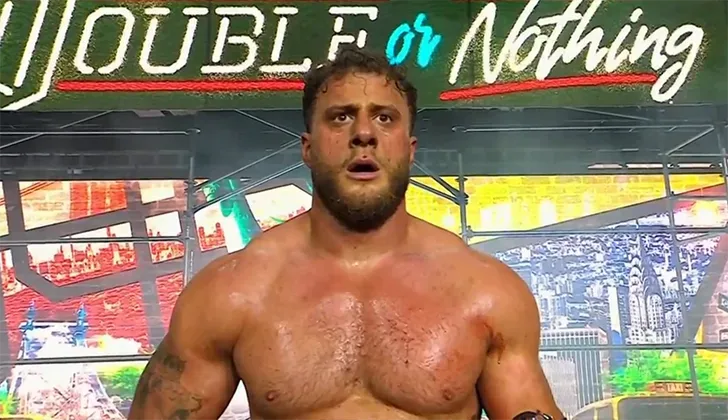
MJF has built much of his career around provoking a reaction, and he has never presented himself as someone likely to shrink from criticism. Whether it comes from fans in an arena, viewers watching at home, or social media users posting in real time, the AEW star has consistently treated negative reactions as part of the job. In his view, though, not every critique deserves the same response.
Speaking in a recent interview, MJF addressed the online conversation surrounding both himself and AEW. His central point was that there is a meaningful distinction between criticism offered by people who care about the promotion and hostility from accounts whose activity appears driven by a desire to attack it at every opportunity.
The former AEW World Champion said he believes it is generally easy to identify the difference. For MJF, context matters. A fan who regularly follows the company, engages with its programming, and wants to see it thrive may have an opinion worth considering, even if he does not necessarily agree with the opinion itself. By contrast, he suggested that a social media account dedicated almost entirely to disparaging AEW is not engaging in the kind of discussion that should carry much weight.
“I think it’s really easy to tell what’s good faith and what’s bad faith criticism,” MJF said. “If somebody’s talking about my company and they have like an avatar of — God bless her, like Alexa Bliss. And like every single tweet from here down, it’s not even about WWE. It’s just them s**ting on AEW, then it’s like, ‘Okay, maybe that’s not the best person to listen to.’”
For more background on this topic, read AEW’s HBO Max Schedule for October 2026 Includes WrestleDream, Dynasty and Grand Slam France.
The comment fits the tone wrestling fans have come to expect from MJF: pointed, confrontational, and willing to use a rival promotion’s fan discourse to make his larger argument. Yet beneath the insult is a fairly direct assessment of how difficult it can be for wrestlers and promotions to navigate online feedback. Social media gives audiences immediate access to performers and brands, but it also creates an environment in which thoughtful analysis, tribal arguments, jokes, rage bait, and personal attacks are frequently mixed together.
For AEW, that dynamic is especially familiar. The promotion has attracted a passionate audience since its launch, while also becoming a constant subject of comparison with WWE. Every major angle, match result, roster decision, television rating, attendance number, signing, absence, or creative direction can rapidly become a point of debate. Some of that debate comes from fans who have invested deeply in AEW and want the product to reach its potential. Some comes from viewers who simply prefer a different style or company. And some is delivered with no apparent aim beyond generating negativity.
MJF indicated that he does see value in listening when the criticism is coming from a sincere place. He described grassroots AEW fans who want the company to succeed as people whose views should be heard.
“But if it’s somebody who’s genuinely a grassroots fan of our company and somebody who wants to see our company succeed, I do believe that it’s important to hear people out,” MJF said. “Now, are these people right? No. I’m always right and most people are always wrong.”
The final line, naturally, preserves the arrogance that has made MJF one of professional wrestling’s most recognizable modern heels. Even while acknowledging that constructive feedback can have merit, he framed the subject through the self-assured character voice that defines him. That balance is a significant part of why MJF’s public comments often stand out. He can address a real subject facing performers while maintaining the persona fans expect to see when he is on television.
His willingness to distinguish between useful feedback and bad-faith attacks is also notable because wrestlers are often encouraged to ignore social media altogether. That can be sensible advice, particularly when criticism becomes personal or obsessive. Still, online platforms remain an important part of how fans experience wrestling. They are where audiences react instantly to live segments, debate stories, praise performances, question booking choices, and create momentum around wrestlers who capture their interest.
There is no simple formula for separating valuable feedback from noise. Fans can disagree sharply while both acting in good faith. A viewer may dislike a storyline, a promo, or a match finish without wanting the promotion to fail. Another may have a favorable view of AEW but believe a specific angle did not connect. MJF’s comments suggest that intent is the key factor for him. Criticism from someone participating honestly in the wrestling conversation can be useful; criticism from someone committed only to tearing the company down is something else entirely.
That does not mean MJF plans to treat negativity as a reason to soften his approach. Quite the opposite. He said hostile posts can become motivation, particularly during training. Rather than allowing disparaging comments to distract him, he said he actively turns them into fuel.
“I’ll read a negative tweet about me while I’m in the gym,” MJF said. “And I’ll just keep reading it over and over again. And I’ll hit PRs, I’ll break records for how long I’m on the treadmill or the Stairmaster, how long I can stay in the sauna. I use negativity and hate as fuel.”
That mindset is consistent with the intensity MJF has projected throughout his AEW career. He has repeatedly positioned himself as a performer who thrives on pressure and confrontation. In wrestling, performers often draw energy from crowd reactions, whether they are cheers or boos. MJF’s comments extend that concept to the digital space. In his telling, the criticism intended to irritate him instead becomes another challenge to overcome in the gym.
He went even further by warning critics that public outrage only encourages him to intensify what they dislike. MJF said fans angered by his behavior on television are effectively giving him more material and more motivation when they post about it online.
“If you find yourself being upset with the way I am on television and you post about it, just know all you’re doing is feeding the monster,” MJF said. “Because I’m going to read what you’re writing about me and then I’m not just going to double down; I’m going to triple down.”
That outlook makes sense for a wrestler whose presentation has long centered on being unapologetically abrasive. MJF’s character does not seek approval, and it does not ask audiences to view his antagonism as an accident. The point is to make people react. When viewers object loudly, the character sees that reaction as proof that the tactic is working.
At the same time, MJF’s broader point about good-faith criticism leaves room for an important distinction. A heel does not need to become likable, and a promotion does not need to make every creative choice based on online opinion. But performers and companies can still benefit from understanding what their committed audience responds to and why. Listening is not the same as surrendering control of the creative process. It can mean recognizing patterns, taking note of audience investment, and evaluating whether the intended story is reaching viewers.
MJF appears comfortable living in both realities. He is willing to acknowledge that invested AEW fans should be heard when they raise sincere concerns. He is also determined not to give the same legitimacy to accounts he views as dedicated to negativity. And when the criticism is directed at him personally, he says he prefers to use it as motivation rather than allowing it to diminish his confidence.
For a performer whose career has been built on turning hostility into heat, that may be the most MJF response possible. Online hate, in his estimation, is not a deterrent. It is fuel for the next workout, the next confrontation, and the next opportunity to become even more of the figure his critics cannot stop talking about.

Darryl Polo
Darryl Polo is a passionate wrestling fan covering WWE, AEW, TNA and beyond. He loves great rivalries, breakout stars and the moments that keep fans talking long after the bell. How we work.