
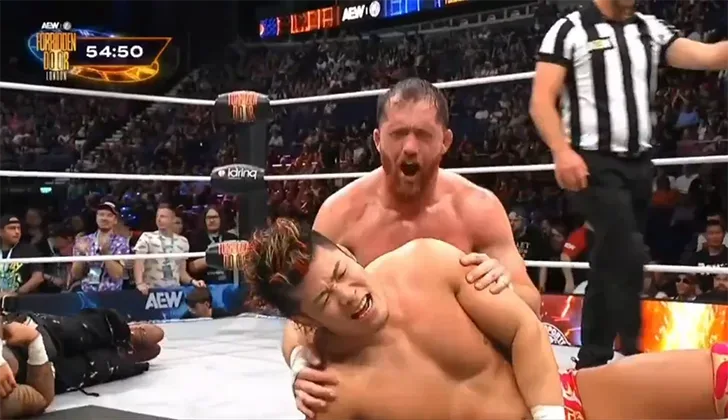
Yuya Uemura is looking at the disappointment of his G1 Climax final defeat as evidence that his vision for himself as a New Japan Pro-Wrestling main-event level wrestler is taking shape.
Uemura came up short against Ryohei Oiwa in the tournament final, missing an opportunity to leave the G1 as its winner and to pursue IWGP Heavyweight Champion Yota Tsuji under the circumstances he had hoped for. But rather than treating the loss as a reason to step back, Uemura has framed it as part of a larger pursuit: establishing what he calls a new standard in professional wrestling while continuing to build every part of his game.
The loss also appears to have sharpened one of the most important rivalries of this generation within NJPW. Uemura spoke highly of Oiwa’s confidence during the tournament and made clear that he expects their paths to remain closely connected going forward.
“Obviously the result was disappointing, but I feel I was able to present my ideal of pro-wrestling,” Uemura said. “I’ve been talking about representing a new standard since last year’s G1, and this year I was finally able to give that form.”
For more background on this topic, read Yuya Uemura Says G1 Climax 36 Final Showcased His Vision for NJPW’s Future.
A G1 final loss, but a clearer statement from Uemura
The G1 Climax is designed to test wrestlers over a demanding tournament schedule, but its final match also carries an extra layer of significance. It can be the point at which a wrestler proves he belongs among the company’s most trusted headline names, even if he does not ultimately win the tournament.
For Uemura, the final against Oiwa was an opportunity to show the identity he wants to bring to the ring. His comments were not centered solely on the frustration of losing. Instead, he emphasized that the tournament allowed him to make his preferred style and his broader ambitions visible.
That distinction matters for a wrestler who is trying to move from being a respected contender to becoming a consistent championship-level force. A G1 victory would have provided an immediate, tangible reward. Uemura did not receive that reward, but he believes the performance itself helped demonstrate the level he is pursuing.
His reference to a “new standard” also shows that Uemura is not simply defining success through rankings or title opportunities. He wants his wrestling to carry a recognizable form and to represent an ideal that audiences can identify when he steps into the ring. The final was disappointing in result, but he sees it as progress in communicating that purpose.
Ryohei Oiwa emerges as a central opponent
Oiwa’s victory was especially meaningful because Uemura views him as more than a one-time obstacle. The two are positioned as rivals with a shared connection to NJPW’s future, and Uemura believes Oiwa’s G1 showed a wrestler who had found an increasingly strong belief in himself as the event moved forward.
“As for Oiwa, he just seemed to be full of confidence right from the midway point of the G1,” Uemura said. “He’s going to be a critical rival for me going forward.”
The word “critical” gives the rivalry added weight. Uemura did not dismiss Oiwa’s win or reduce it to an unfortunate night. He acknowledged the confidence Oiwa carried through the latter stages of the tournament, while also making clear that their competitive relationship will continue to be important to his own journey.
That is the kind of rivalry that can shape a wrestler’s rise over time. A final loss can create a direct competitive target, particularly when both competitors are trying to establish themselves at the top of the promotion. Uemura’s remarks suggest he intends to use the setback as motivation rather than allowing it to become a defining limitation.
For Oiwa, the G1 final victory provides a major accomplishment. For Uemura, it has created another benchmark he wants to overcome. Their respective paths may diverge in the immediate future, but Uemura has already identified Oiwa as a wrestler who will be deeply relevant to his ambitions.
Uemura’s approach: improve in and out of the ring
Uemura’s explanation of how he plans to take the next step was notably broad. He did not point to a single signature victory, a new alliance or a shortcut to contention. His answer centered on making improvement a constant part of his life and carrying that work into every element of his wrestling.
“I think it’s important to live my life constantly thinking about how to get stronger,” Uemura said. “Not just in the ring and in the gym, but in every aspect, I need to bring all of that into my wrestling.”
The philosophy is an exacting one. In Uemura’s view, getting stronger is not confined to training sessions or match preparation. It is a full-time process, and its value is measured by whether it becomes visible in the ring. That perspective fits a wrestler trying to make the leap from a strong tournament performer to a champion.
Uemura also singled out the need to refine every move in his arsenal. The focus is not simply on adding something new; it is on making what he already does more precise, more effective and more dangerous. Among those tools, one hold stands above the rest.
“And I want to develop and refine every single move that I do,” Uemura said. “Especially my wrist lock, I want to be able to submit anyone on the roster with my wrist lock.”
That is an ambitious technical goal. A submission hold becomes more meaningful when opponents and fans recognize it as a potential match-ending threat against anybody, regardless of where they stand on the card. Uemura wants the wrist lock to be that kind of weapon.
It also reinforces his stated interest in presenting his own ideal of professional wrestling. Rather than describing a vague desire to get better, he identified a specific hold he wants to elevate. If Uemura can turn the wrist lock into a feared finishing option, it would give his matches another layer of tension and provide a tangible expression of the refinement he says he is chasing.
Why the win over Yota Tsuji did not settle the title picture
Uemura’s G1 run included a significant semifinal win over Yota Tsuji, the reigning IWGP Heavyweight Champion. Ordinarily, defeating a champion can be a powerful argument for a future title match. Uemura, however, does not believe that win alone gives him sufficient grounds to demand a championship opportunity.
His reasoning is straightforward: he did not win the G1. Uemura wanted to meet Tsuji with the tournament crown in hand and make the contest a direct test between the IWGP champion and the G1 champion. The defeat to Oiwa prevented that scenario from becoming reality.
“Winning the IWGP Heavyweight Championship is a massive goal of mine, but beating Tsuji in the semifinals isn’t enough to justify a shot,” Uemura said. “I lost the G1 in the end after all. I wanted to challenge him as the G1 winner and see whether the IWGP Champion or the G1 Champion was the better man, but I couldn’t make it happen. I’m still constantly aiming for that belt though.”
Uemura’s assessment shows both ambition and restraint. He is not backing away from his pursuit of the IWGP Heavyweight Championship, and the semifinal victory over Tsuji remains an important result. At the same time, he has openly said it was not the full statement he wanted to make.
That leaves Uemura with a clear objective: earn another route back into contention rather than relying solely on the win over Tsuji. He remains focused on the championship, but recognizes that the G1 final loss changed the immediate landscape.
Tokyo Dome and championship goals remain in sight
Uemura said he has reached the final hurdle twice this year, a phrase that reflects the frustration of coming close without capturing the ultimate prize. Still, he has set a concrete target for the months ahead: securing his place on the Tokyo Dome card on January 4 and ending the year as a champion.
“This year, I’ve fallen at the final hurdle twice,” Uemura said. “Before the year is out, I plan to earn my spot in the Tokyo Dome on January 4, and I’ll be doing all I can to become a champion.”
Those goals give Uemura a clear direction after the G1. He is not presenting the final loss as an endpoint. He is treating it as a challenge to sharpen his wrestling, strengthen his position and find the next opportunity that can carry him toward a title.
Uemura’s most recent match took place at NJPW Road To Destruction 2026 Night 11 last month. Teaming with Aaron Wolf and Taisei Nakahara, Uemura was defeated by TMDK’s Hartley Jackson, Kosei Fujita and Oiwa. With Oiwa once again standing across the ring from him in that match, the rivalry Uemura described is already continuing to surface beyond the G1 final.
For now, Uemura’s message is consistent. He remains disappointed by falling short, but he believes he showed the wrestling he wants to represent. His next task is to turn that showing into results: a Tokyo Dome place, championship success and, eventually, another path to the IWGP Heavyweight Championship.

Darryl Polo
Darryl Polo is a passionate wrestling fan covering WWE, AEW, TNA and beyond. He loves great rivalries, breakout stars and the moments that keep fans talking long after the bell. How we work.