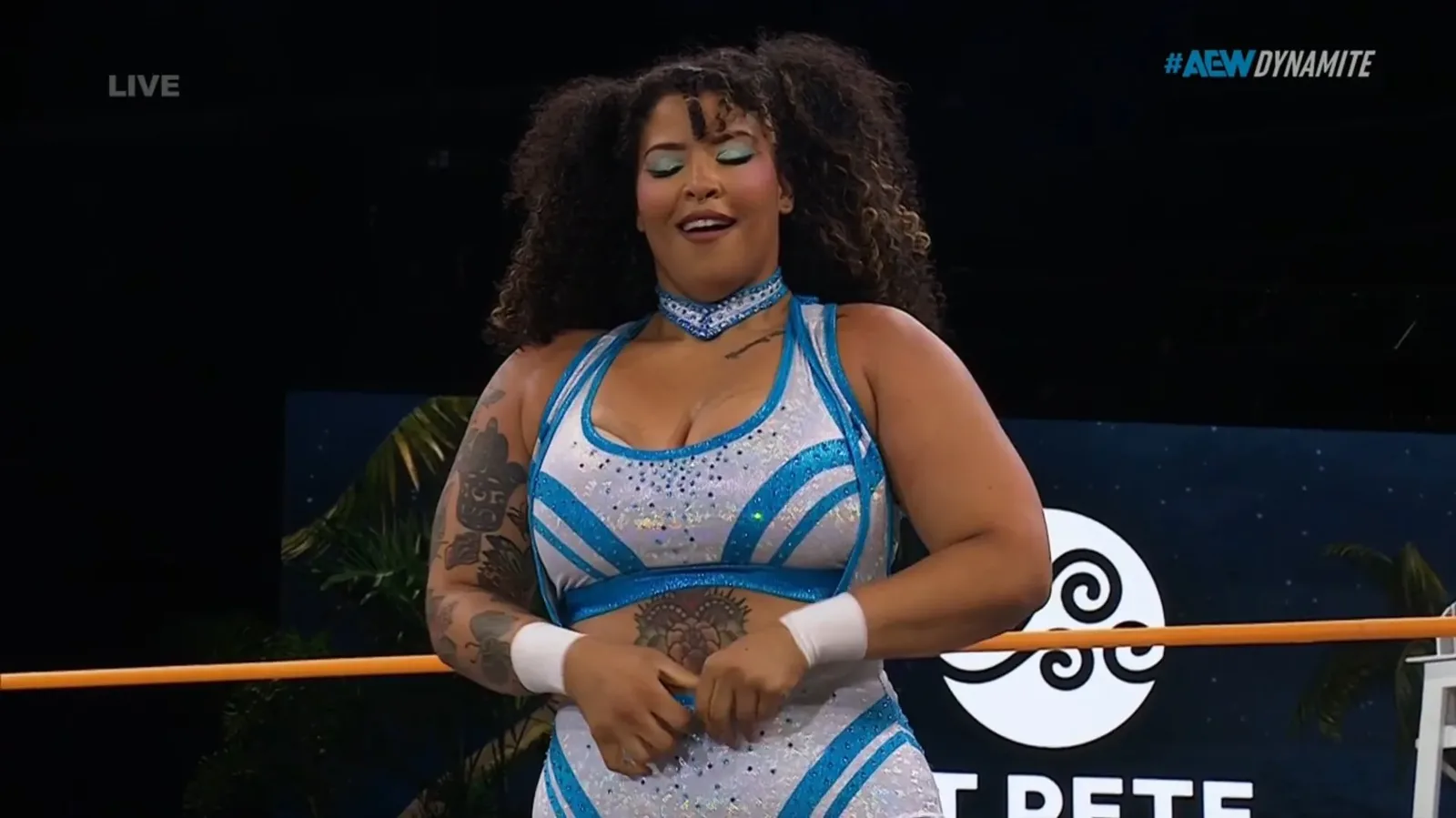
Willow Nightingale has built a reputation as one of the most outwardly positive personalities in All Elite Wrestling, but she does not view herself through the usual black-and-white lens of wrestling alignment.
Speaking with Simon Miller and Under The Mat before AEW All In, Nightingale addressed the idea of a possible heel turn and the hypothetical scenario of fans making her miserable. Her response made clear that she is not especially interested in defining herself as either a traditional fan favorite or a villain.
“I mean, I don’t really think of myself as necessarily a good or a bad guy. I think I’m just a person trying my best and how people perceive me is on them.”
It is a notable perspective from Nightingale, whose smile, energy and frequently optimistic presentation would naturally lead many viewers to place her firmly in the babyface category. In a business built for decades around recognizable heroes and antagonists, Nightingale’s answer does not reject the importance of audience reaction. Instead, it places the responsibility for that reaction with the people watching.
For more background on this topic, read Will Ospreay Reflects on Body Dysmorphia, Gym Insecurities and His Physical Transformation.
Her outlook also leaves room for an interpretation of character that is more personal than a standard alignment label. Nightingale is not presenting herself as someone who exists solely to be cheered, nor is she declaring an intention to become a villain. She is describing a wrestler who acts with her own sense of purpose and accepts that the audience may respond differently depending on the situation.
A Character Built On Authenticity
Nightingale’s statement is especially interesting because professional wrestling audiences are accustomed to reading presentation quickly. Entrance music, body language, interviews, ring tactics and the opponents a wrestler faces can all signal whether fans are expected to cheer or boo. A performer with Nightingale’s vibrant demeanor can appear, at first glance, to be an uncomplicated example of the heroic side of that formula.
But the performer herself is drawing a distinction between being positive and being morally uncomplicated. Her words suggest that optimism does not have to mean being defined as a “good guy,” just as frustration or intensity would not automatically make someone a “bad guy.” The central point is that she sees herself as a person attempting to do her best, with the eventual judgment coming from the audience.
That framing fits an era in which wrestling fans often embrace more layered characters. Modern crowds can cheer wrestlers who are aggressive, blunt or even openly self-interested if they find their motivations understandable. Conversely, audiences can turn against a performer who is technically positioned as a hero if the character’s actions feel dishonest, repetitive or disconnected from the fans.
Nightingale’s comments do not announce a change in direction. She did not say that she plans to turn heel, abandon the traits that have made her popular or alter her approach in AEW. What she did provide was a clear explanation of how she thinks about the question itself: she does not feel the need to apply a fixed label to her identity.
The Audience’s Role In Wrestling Alignment
For Nightingale, the audience is a key part of the equation. “How people perceive me is on them” is a concise acknowledgment of the relationship between a wrestler and the crowd. A performer can make choices, express emotions and compete in a certain way, but the response is never entirely under that performer’s control.
That uncertainty is one of wrestling’s defining strengths. Fans do not merely observe a character from a distance. They react in real time, and those reactions can influence how a match feels, how a rivalry develops and how a wrestler is understood. Some performers actively try to guide that response. Others, like Nightingale in this instance, appear more comfortable allowing the response to develop naturally.
There is also a practical element to resisting rigid labels. A wrestler who defines every decision around being heroic or villainous can become limited by expectations. Nightingale’s description gives her character space to be supportive, competitive, frustrated, determined or forceful without each emotion requiring a full shift from one side of the traditional wrestling divide to the other.
That does not mean alignment no longer matters. Crowds still react strongly to stories built around clear conflict, and promotions continue to use familiar hero-versus-villain structures effectively. Rather, Nightingale’s view speaks to the possibility that those structures can exist alongside performers who approach their personas in more human terms.
No Heel Turn Announced
The question posed to Nightingale involved the prospect of a heel turn after fans make her miserable, but her answer should not be read as confirmation that such a turn is coming. She offered no timetable, no future storyline tease and no indication that she is preparing to take on a more antagonistic role.
Instead, Nightingale pushed back on the premise that her character has to be categorized so cleanly in the first place. The answer is more about self-perception than a declaration of upcoming creative plans. Fans looking for a direct signal about AEW booking will not find one in the quote. What they do have is insight into how Nightingale wants her actions and personality to be considered.
That distinction matters. Wrestling interviews can sometimes be treated as clues to immediate storyline developments, especially when the subject involves whether a popular wrestler could change sides. In this case, Nightingale’s comments are not a promise of a turn. They are a broader reflection on the limits of the “good guy” and “bad guy” language.
Her established public image may make that reflection more surprising to some fans, but it also gives the comment additional weight. Because Nightingale is so commonly associated with joy and encouragement, her refusal to automatically call herself a babyface emphasizes that those visible qualities are only part of how she sees herself.
Why The Answer Fits Willow Nightingale
Nightingale’s wording is grounded rather than confrontational. She did not insist that fans are wrong if they view her as a good guy. She simply said that she does not necessarily think of herself that way. Likewise, she did not try to claim that she is above criticism or that an audience must accept every choice she makes. Her position is that perception belongs to the people receiving the performance.
That approach can make a character feel more accessible. Rather than speaking in absolutes, Nightingale describes an experience many people can recognize: trying to do one’s best while understanding that others may still interpret intentions differently. In wrestling, where emotions are heightened and rivalries are designed to create strong reactions, that simple idea can carry significant character depth.
It also supports the connection Nightingale has developed with viewers without reducing it to a formula. Fans may continue to cheer her because they respond to her attitude, her resilience and the way she carries herself. But those reactions do not have to mean that Nightingale herself accepts a permanent, restrictive label. The connection can remain strong while the character retains room to evolve.
As AEW continues to present wrestlers with distinct personalities and motivations, Nightingale’s stance provides a useful reminder that alignment is not always the entire story. A wrestler can be embraced by the audience while still seeing herself as something more complicated than a designated hero. She can face difficult moments without those moments automatically becoming evidence of a transformation into a villain.
For now, Nightingale’s message is straightforward. She is not interested in deciding whether she is a good guy or a bad guy. She sees herself as a person trying her best, and she is willing to let the fans decide what that means to them.
Darryl Polo
Darryl Polo is a passionate wrestling fan covering WWE, AEW, TNA and beyond. He loves great rivalries, breakout stars and the moments that keep fans talking long after the bell. How we work.