
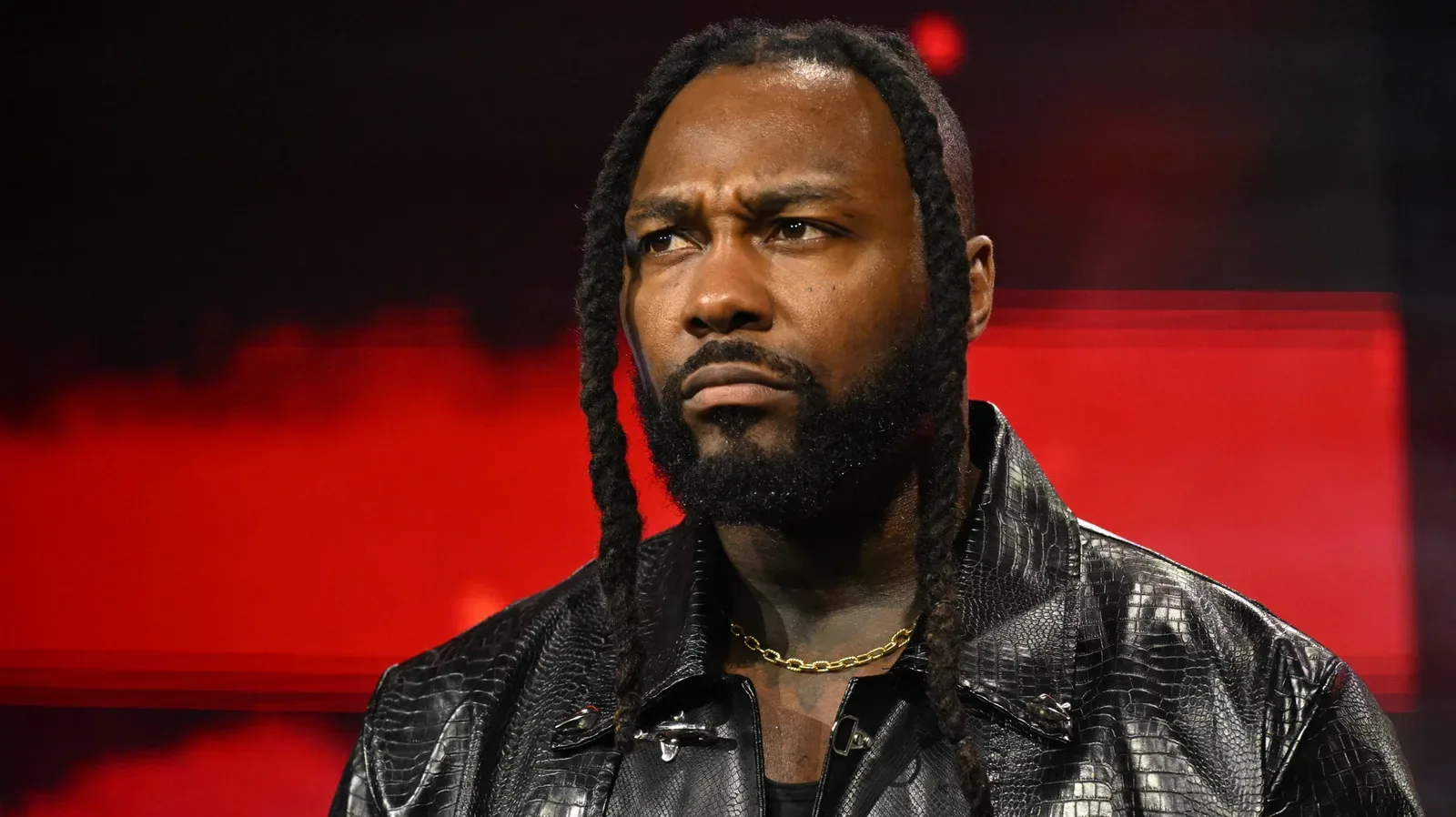
Swerve Strickland has made it clear that he wants his professional wrestling legacy to be judged first by the quality of his work between the ropes.
In comments addressing both his wrestling career and his work as a rapper and hip-hop artist, Strickland said he does not want his accomplishments reduced to a marketable image, a genre association or a simplified idea of representation. Instead, the AEW star believes his rise has come from being himself and from delivering at an elite in-ring level against the best competition available to him.
“Not me being a caricature of hip-hop, and not me being a caricature of a Black wrestler,” Strickland said. “I’m being me. My success in pro-wrestling is genuinely because of my ability in the ring. It’s not because they’re trying to push an agenda, it’s because I perform at a really, really high level — probably the highest level you could see of a Black wrestler in the history of the game.”
It is a forceful assessment, but it also speaks to the standard Strickland has set for himself during a career that has taken him across a wide range of promotions before and after arriving in AEW in 2022. He was already a decorated talent prior to joining the company, having held championships in groups including CZW, wXw, DEFY, MLW and WWE NXT. That background gave Strickland experience in different environments, styles and expectations long before he became one of AEW’s most popular figures.
For more background on this topic, read Jim Ross Home and Recovering After Hospital Stay for Low Oxygen.
For Strickland, the key distinction is not simply visibility. It is standing up as a wrestler whose ability can be measured against anyone on a major show, regardless of background, presentation or promotional narrative. His comments frame that pursuit as a matter of athletic credibility and creative authenticity rather than a desire to be fitted into an existing template.
Being himself rather than a caricature
Professional wrestling has long been a medium where performers are asked to amplify certain traits for the sake of an immediate audience connection. Music, fashion, regional identity, race and personal history can all become part of a character’s presentation. Strickland’s point is not that those parts of him should be ignored. His work as a hip-hop artist remains one aspect of his broader creative identity. Rather, he is drawing a line between bringing those genuine influences into his work and being defined entirely by them.
That distinction is important in the way Strickland describes his path. He does not present himself as someone whose place at the top should be explained away as a symbolic decision. He argues that he belongs in the conversation because he performs at an exceptionally high level in the ring. The statement is both personal and competitive: personal because he wants his identity to be presented honestly, and competitive because he wants his matches evaluated against the strongest wrestlers in AEW.
Strickland’s phrasing also reflects the pressure that can come with being viewed as a representative figure. A wrestler can be celebrated for breaking through while still being judged through a narrower lens than peers who are simply discussed as top workers. Strickland is rejecting that narrower lens. He wants the analysis of his career to begin with his execution, his performances and his ability to succeed against elite opponents.
That is why his comments are less about separating himself from his background than refusing to let any single part of that background limit how his work is understood. He is not asking to be discussed as a special case. He is arguing that he should be discussed in the same performance-based terms as the wrestlers he names.
A standard defined by AEW’s top competition
Strickland specifically placed himself in a group with Kazuchika Okada, Kenny Omega, Will Ospreay and Hangman Adam Page. Those names are significant because each is commonly associated with high-level in-ring competition, major-match expectations and a style of wrestling that places heavy demands on performers.
“Me and Okada. Me and Kenny [Omega]. Me and [Will] Ospreay. Me and Hangman [Adam Page],” Strickland said. “I have to be pure and genuinely me as possible and get there because of actual ability rather than just co-signs.”
The point of that list is not merely that Strickland wants major matches. It is that he sees himself as capable of meeting that level on equal terms. In AEW, where the roster includes wrestlers from varied wrestling traditions and international backgrounds, being considered part of the top in-ring tier requires more than popularity or a memorable persona. It means being able to carry the pace, physicality, storytelling and pressure that come with marquee opposition.
Strickland’s comments suggest that this is the comparison he values most. He does not want external approval to be the basis for his position. He wants his body of work to establish that he can share a ring with performers such as Okada, Omega, Ospreay and Page and belong in the same discussion.
The reference to “co-signs” is especially revealing. Wrestling careers can be changed by endorsements, alliances and the support of influential figures, but Strickland’s stated goal is to build a reputation that stands on its own. In his view, outside validation may bring attention, yet it cannot substitute for the ability to perform when the match begins.
Representation and the history Strickland is addressing
Strickland also put his perspective in a broader historical context, naming Dwayne “The Rock” Johnson and Booker T among the Black wrestlers who became household names. Their impact on wrestling is undeniable, and Strickland acknowledged the level of recognition Black talent achieved in earlier eras.
At the same time, he argued that it was not often said that those stars were the best wrestlers on their respective shows. Strickland attributed that in part to the depth of the competition around them, pointing to figures such as Shawn Michaels and Eddie Guerrero. The comparison was not presented as a dismissal of Johnson or Booker T. Instead, Strickland used it to explain the particular legacy he is chasing.
He wants to be remembered not only as a widely known Black performer, but as someone who could credibly be called one of the best wrestlers in the company at a given time. That is a different kind of benchmark. Household-name status can come through charisma, crossover visibility, championships, storylines or cultural impact. Strickland is emphasizing the technical and performance side of the conversation: the ability to make the strongest case through the matches themselves.
There is an added weight to that ambition. When performers from historically underrepresented groups achieve success, their accomplishments are sometimes treated as exceptions or primarily as milestones. Strickland’s comments insist that excellence must remain central. Representation matters, but he does not want it to become a substitute explanation for why he has reached his position.
A career shaped across multiple wrestling environments
Strickland’s confidence did not emerge overnight in AEW. Before signing with the company in 2022, he had built a résumé across several corners of the wrestling industry. His championship history included CZW, wXw, DEFY, MLW and WWE NXT, reflecting a career developed through diverse promotions and audiences.
That variety matters when considering the emphasis he places on adaptability and actual ability. Different promotions demand different things from wrestlers. Some value a particular pace, some put more emphasis on athletic spectacle, and others require performers to connect with distinct fan bases or work within unique television formats. A career spanning that kind of landscape can provide the tools needed to adjust without losing one’s own identity.
Strickland’s current message is that he has taken those experiences and refined them into something unmistakably his own. The goal is not to be a version of another wrestler, a generic hip-hop character or a performer whose importance is explained by a corporate initiative. His stated goal is to be “pure and genuinely” himself while proving his standing through performance.
That philosophy fits a wrestler who has continued to expand his public identity beyond one medium. Strickland is active as both a wrestler and a hip-hop artist, but he sees those pursuits as complementary parts of a larger creative life rather than labels that should confine him. His wrestling, in particular, remains the foundation of the legacy he wants future audiences to recognize.
The legacy Strickland wants to leave
Strickland’s comments ultimately amount to a declaration of how he wishes to be evaluated years from now. He wants future generations to see a wrestler who earned his place through the ring work, not a performer elevated because he fit a predetermined role.
That standard is ambitious by design. To claim a place among the best requires sustained performances, not just a single major moment or a popular run. It requires being able to face the most accomplished wrestlers in the company and have the audience view the matchup as a genuine test of equals. Strickland has made clear that this is the level he believes he can reach and maintain.
Whether fans frame his legacy through championships, rivalries, crossover creativity or major matches, Strickland wants one conclusion to lead the conversation: he succeeded because he was exceptionally good at professional wrestling. For him, that is not separate from being authentic. It is the clearest expression of it.
In pictures

Darryl Polo
Darryl Polo is a passionate wrestling fan covering WWE, AEW, TNA and beyond. He loves great rivalries, breakout stars and the moments that keep fans talking long after the bell. How we work.