
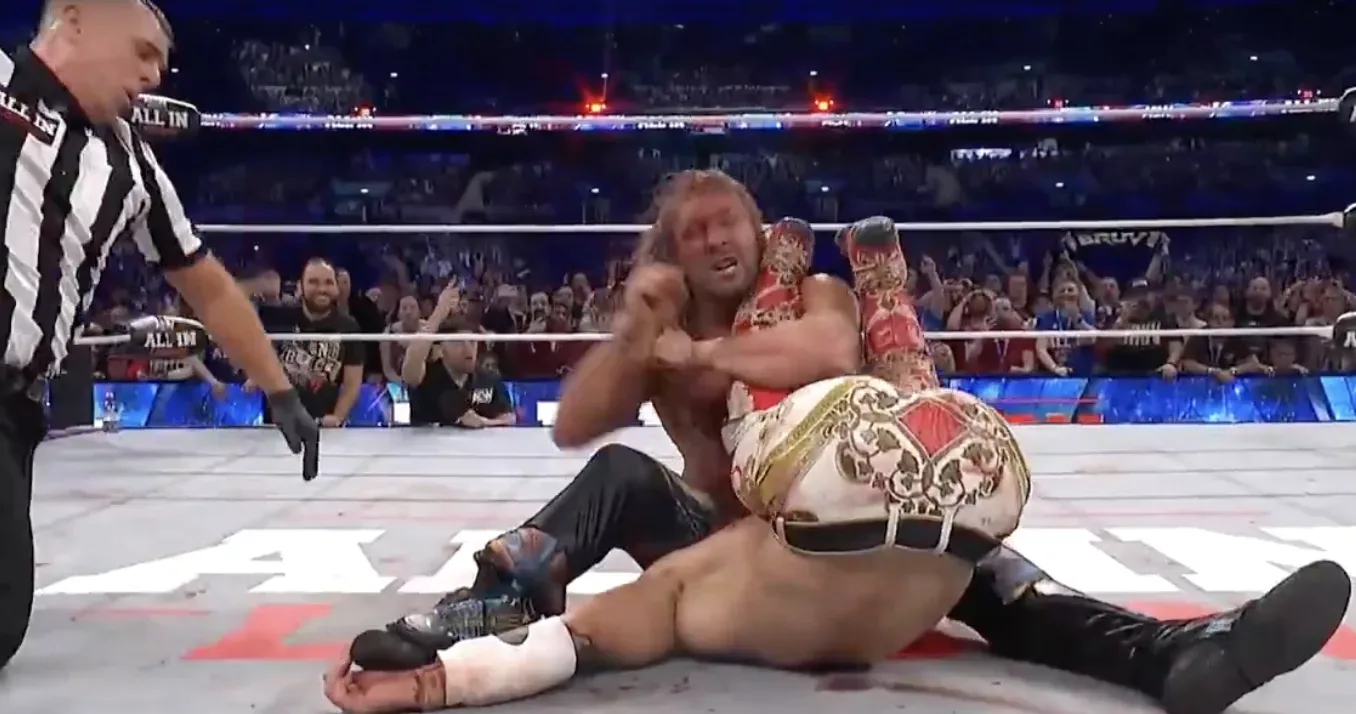
Will Ospreay has opened up about one of the defining moments of AEW All In 2026: his kick-out from Kenny Omega’s One Winged Angel during their AEW World Championship match in England.
The August pay-per-view presented Ospreay with a major opportunity in his home country, as he challenged Omega for the company’s top prize. Yet beyond the championship stakes, the match carried another layer of significance because of the place the One Winged Angel occupies in Omega’s career and in modern professional wrestling.
Omega’s finishing move has long been treated as one of the most protected moves in the sport. While wrestlers routinely survive dramatic finishing sequences in major main events, the One Winged Angel has been presented differently over the years. Its effectiveness is a central part of its identity, and the rare occasions on which someone has escaped it have therefore carried substantial weight.
At All In, Ospreay emphatically kicked out after Omega delivered the move. The moment immediately placed Ospreay in exceptionally select company. Kota Ibushi and Omega himself are among the few names to have previously kicked out of the One Winged Angel, underlining why Ospreay viewed the decision as far more than simply a dramatic near-fall.
For more background on this topic, read Ilja Dragunov Reportedly Signed by AEW as WrestleDream Debut Speculation Builds; Kairi Sane Talks Remain Unresolved.
Ospreay Says The Moment Came Down To Omega’s Trust
Speaking with 1010XL, Ospreay explained that the kick-out represented a deeply personal vote of confidence from Omega. For Ospreay, the significance was not merely in surviving a move associated with a legendary reputation. It was that Omega was willing to allow him to do it.
“That I won Kenny’s trust, because a lot of that comes down to how much he wants to protect it and going forward, like where… Where does that put me?”
That perspective speaks to the collaborative side of a major wrestling match. A protected finishing move is not protected by accident. Its value is built over time through consistent presentation, performer discipline and a shared understanding that every exception must have a reason. When a wrestler is permitted to survive such a move, it can communicate that they are being positioned at a higher level than before.
Ospreay clearly understands that context. He said the All In sequence elevated him to a level that he could scarcely put into words, particularly because Omega is someone he has long admired.
“It just elevates me up to like a legendary status that I will never fully be able to express my gratitude for having that type of moment with someone that I do generally look at as like a hero of mine.”
For Ospreay, being trusted with the moment by a wrestler he regards as a hero made the experience even more meaningful. The emotional importance of the kick-out was tied to both the scale of All In and the identity of the opponent across the ring.
Why The One Winged Angel Matters
Finishers have always been essential to wrestling storytelling. They offer a match its clearest punctuation point: the instant when a wrestler’s signature offense connects and the crowd expects the fight to be over. However, the modern wrestling landscape has seen more frequent near-falls and increasingly elaborate sequences, making a truly protected finishing move especially distinctive.
The One Winged Angel has retained that distinction. Its reputation means that a successful kick-out is not just another escalation in a match. It becomes an event in itself. Fans recognize the move, understand its history and respond to the possibility that a wrestler may be unable to answer the count.
That is why Ospreay’s reaction centers on trust and elevation. The moment did not need additional explanation during the match for its importance to register. The history surrounding Omega’s move did that work. Ospreay’s survival told the audience that this championship challenge had reached a rare threshold, with the challenger demonstrating a level of resolve generally reserved for the most important rivalries and performers.
It also reflects the pressure that comes with using a protected move in a high-profile environment. Once a finisher has been established as nearly unbeatable, every decision involving it becomes meaningful. The wrestler who owns the move has to consider how an exception serves the story, the opponent and the future value of the move itself. Ospreay’s comments make clear that he recognizes the responsibility Omega carried in making that call.
A Home-Country Setting Added To The Scale
All In was already AEW’s biggest pay-per-view of the year when Ospreay stepped into the championship match against Omega. Competing for the AEW World Championship in England added a personal dimension to a contest involving two of the most acclaimed wrestlers of their generation.
A home-country crowd can amplify every element of a major match. The support for the challenger is louder, the stakes feel more immediate and every major turning point has the potential to become a memory that follows the performer for years. In Ospreay’s case, the One Winged Angel kick-out became one of those turning points.
Ospreay did not frame the moment as an entitlement or simply as a reward for his place on a major card. Instead, he repeatedly emphasized gratitude. That distinction is important. His comments suggest he sees the kick-out as something Omega entrusted to him because of their shared work and the meaning it could create, rather than a moment that belonged to Ospreay alone.
“So to have that was just out of this world, mind blowing. Like I’m just super grateful for it.”
The language Ospreay used captures the emotional scale of performing in a match of that magnitude. Wrestling’s biggest moments often live through the feeling they produce in an arena, but they also matter because of what they mean to the people constructing them. For Ospreay, the chance to kick out of the One Winged Angel against Omega at All In was both an unforgettable in-ring moment and a validation from a performer he has admired.
A Rare Benchmark In Ospreay’s AEW Story
Whether viewed through the lens of championship competition, career symbolism or match construction, the kick-out remains a notable marker in Ospreay’s AEW journey. It was a moment rooted in history: the history of Omega’s finishing move, the limited list of wrestlers who had survived it, and Ospreay’s own respect for Omega.
It also illustrates the way AEW can use continuity to deepen the impact of a single sequence. Audiences familiar with the One Winged Angel’s standing did not need to be told why Ospreay’s kick-out was different. The move’s protection had already established the stakes. When Ospreay escaped, the response came from the knowledge that something normally presented as decisive had not ended the match.
That does not lessen the value of the One Winged Angel. On the contrary, Ospreay’s remarks show why the move’s status remains valuable. A protected finish can create a major moment precisely because it is not treated casually. The fewer the exceptions, the more meaningful an exception becomes.
Ospreay’s description of the sequence as a step toward “legendary status” is not a claim he makes lightly. It reflects the particular significance of being connected to a moment involving one of wrestling’s most protected moves and one of the performers he has looked up to. It was a rare instance where match stakes, personal history and long-term storytelling converged on one kick-out.
At AEW All In 2026, Ospreay challenged for the AEW World Championship in front of a crowd in his home country. During that match, he survived the One Winged Angel. Months later, his focus remains on the trust behind the decision and the gratitude he feels toward Omega for sharing that moment with him.
For Ospreay, that is the lasting meaning of the sequence. It was not only about refusing to stay down after one of wrestling’s most feared finishers. It was about being granted the opportunity to make history alongside a hero.

Darryl Polo
Darryl Polo is a passionate wrestling fan covering WWE, AEW, TNA and beyond. He loves great rivalries, breakout stars and the moments that keep fans talking long after the bell. How we work.