
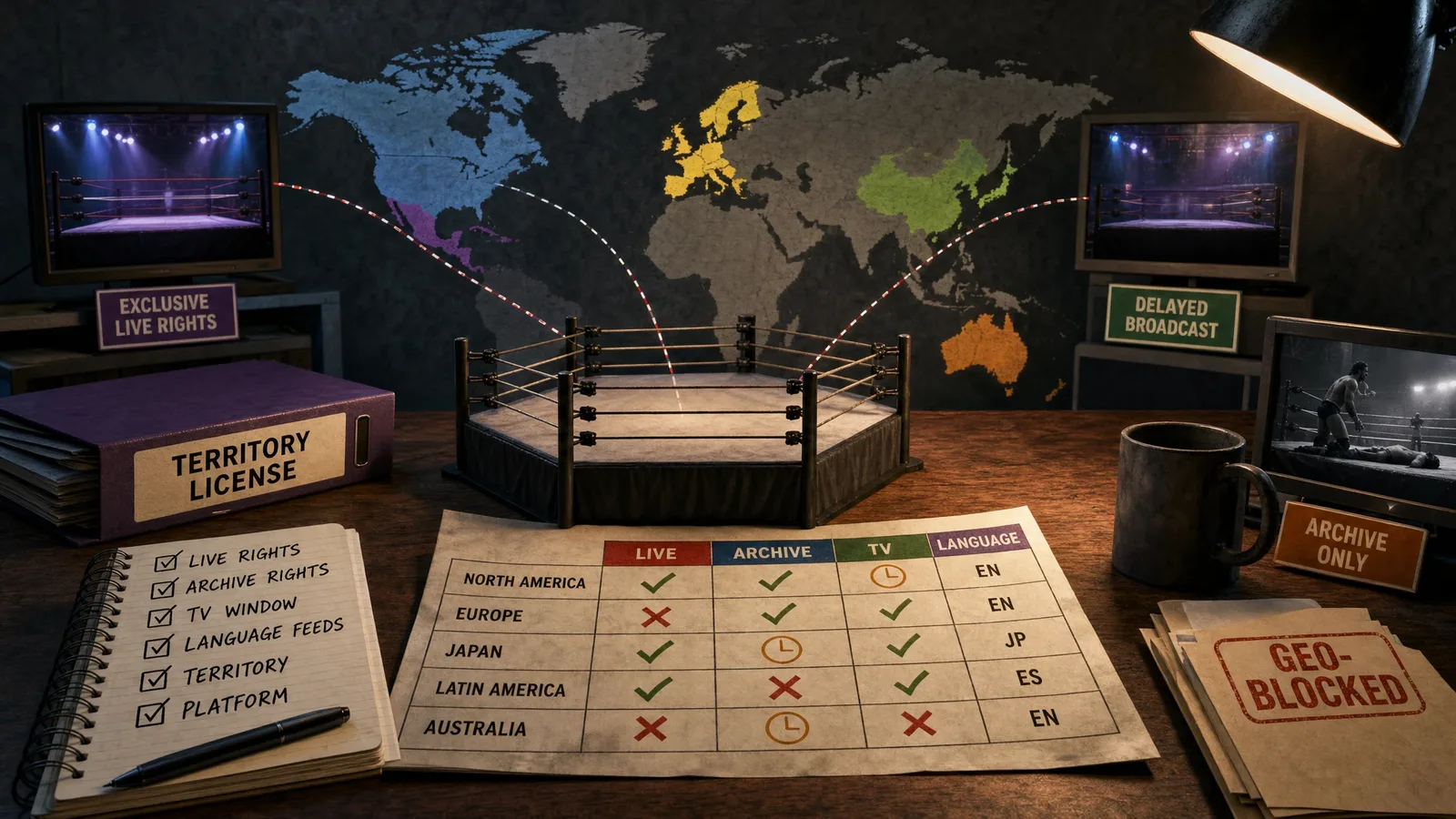
Start with the territory, not the promotion name
Seeing the same promotion available through different services in different places does not necessarily mean that one service has every right everywhere. AEW’s January 2023 announcement with DAZN described exclusive broadcast rights across 42 specified markets in Europe and Asia. The listed territory group stretched from Poland, Portugal, Turkey and Ukraine to Nordic, Balkan, Baltic and Central Asian markets. That is a useful illustration of the basic fan-facing point: a large multi-country agreement can still be regional rather than worldwide. Before asking which service carries a promotion, ask which territory the particular agreement actually names.
The word exclusive also needs to be read carefully. In the DAZN example, AEW attached exclusivity to that distributor’s broadcast deal in its covered markets. The announcement did not present that arrangement as a rule for every country. For viewers, exclusivity is therefore most useful as a description with boundaries: exclusive to whom, for which programming, and in which named territories? A service may be the relevant destination within one defined package while a separate arrangement applies elsewhere. The territory is part of the answer, not a minor technical detail.
A package can cover more than one kind of show
Fans often group a promotion’s output under one label, but a distribution deal may enumerate several distinct kinds of programming. AEW said its 2023 DAZN package added more than 200 events annually and included weekly programs, Battle of the Belts specials, pay-per-views, and the then-current Dark and Dark: Elevation shows. That documented bundle is a reminder to inspect the included program list rather than assume that a deal for a weekly show automatically includes premium events, digital series or older material. A rights package can be broad, but breadth still has to be stated.
The reverse is equally important: one licensed show is not evidence that a whole catalog is included. When Dynamite and Rampage began appearing on NJPW World in Japan in April 2022, the reported arrangement concerned those weekly AEW programs. It was not described as access to every AEW program or every market. A fan comparing two services should separate four questions: Is the desired item a weekly episode, a special, a premium event or library material? Is it offered in the relevant country? Is it live or delayed? And does the listing identify the exact program by name?
A service inside one country can be part of another promotion’s platform
NJPW World’s Japanese availability of Dynamite and Rampage provides a particularly clear example of how a viewer may encounter one promotion’s programming inside another promotion’s subscription service. The episodes were included for NJPW World subscribers in Japan without an additional charge. That arrangement should be understood as a specific historical distribution path, not as a claim that an AEW-branded direct offering and NJPW World always carried the same material. The practical lesson is to distinguish the promotion that made the show from the service that has been licensed to present it in a particular place.
A direct platform and an outside distributor can also coexist without offering an identical menu. CMLL’s official viewing page separates the promotion’s own video offerings from named television outlets. Its YouTube channel lists five live series for members of the Leyenda level, while the same page identifies delayed free programming such as Martes de Glamour, CMLL Informa and Esto Es Lucha CMLL. For a viewer, “official” does not by itself answer whether a specific event is live, delayed, paid, free, or carried by a broadcaster instead.
Time windows can matter as much as access
Availability is not always simultaneous with the original airing. The April 2022 report on NJPW World said the April 6 Dynamite and April 8 Rampage were uploaded after their original U.S. air dates. That creates a different viewing window from a live presentation even though the episodes were made available through a subscription service. When a fan sees a show promoted in one country but cannot yet find it in another setting, the question may not be whether the show is included at all. It may be whether the applicable arrangement uses a later upload window.
Language can add another timing layer. In the Japan-only NJPW World arrangement, English-commentary versions were scheduled a few days after U.S. broadcast, while Japanese-commentary versions were to be uploaded after the commentary had been recorded. The report identified Haruo Murata and Shingo Takagi as the Japanese commentary team for the available Dynamite episode. This does not establish a universal production model, but it demonstrates why a show can appear first with one audio option and later with another. A listing for the show and a listing for a particular language feed need not mean the same thing.
Region locks put the territorial boundary into the viewing experience
A region lock is the visible access boundary a fan may meet after a territorial arrangement has been made. The AEW programming on NJPW World was reported as region-locked to users in Japan. The important point is not that every service uses the same restriction, but that this historical example tied access to the defined territory even though the episodes sat within a subscription product. A subscriber’s access can therefore depend on where the service recognizes the user as being, not only on whether the subscriber pays for the platform.
That distinction helps avoid a common reading error. “Included with a subscription” answered the price question for NJPW World subscribers in Japan; it did not erase the Japan-only condition reported for the AEW material. Likewise, a deal labeled exclusive in a specified group of DAZN markets did not make DAZN a universal destination outside that group. When checking access, treat price, territory and program scope as separate fields. A favorable answer in one field cannot fill in an unanswered field in another.
Scheduled television outlets may carry different versions and repeats
Linear television adds another layer because a broadcaster’s name alone may not reveal whether a viewer can receive the channel. CMLL identifies TUDN/Televisa Deportes as a Saturday outlet and directs viewers to Canal 9.1 over the air along with listed Izzi and Sky channel positions. The listing illustrates that carriage can turn on a local provider as well as a broadcaster brand. A fan who sees a television announcement should check the named channel and any provider detail, rather than assume that every version of the broadcaster is included in every package.
The schedule itself can divide programming into separate windows. CMLL lists El Heraldo TV with a Saturday transmission and a Sunday repeat, and it lists MVS TV with a Saturday broadcast and Sunday repeat. Fox Sports 2 is listed for Viernes Espectaculares, with an exception for special functions, plus Sunday and Wednesday repeats and a separate CMLL Retro slot. These listings show why a program, a repeat and archival content should be treated as different viewing opportunities rather than assumed to be one identical feed.
Multiple outlets can therefore be part of the same promotion’s viewing map without every outlet carrying every event. CMLL’s page names scheduled outlets and channel or platform details, but does not say that each listed outlet carries all CMLL events. It also labels particular series and an exception for special functions. The most reliable viewer habit is to read a schedule at the program level: identify the series, the day or repeat status, the outlet and any qualification. A general promotion listing is useful context, but it is not automatically a complete event-by-event promise.
How to read an availability announcement without overreaching
A concise checklist can prevent most confusion. First, find the territory named by the announcement. Second, identify the exact show types included, since weekly episodes, specials, premium events and digital series can be bundled differently. Third, look for whether the presentation is live, delayed, a repeat or archival programming. Fourth, check whether language versions have separate timing. Finally, determine whether the offer is a promotion membership, a third-party subscription package or a scheduled television outlet. Each of those layers appears in the AEW, NJPW World and CMLL examples.
The examples also support a useful way to interpret an apparent omission. If an archive title is absent while a current weekly episode is available, that does not by itself reveal why; it does show that categories of programming can be separated. If a premium event appears in one package but not another, the DAZN example shows that premium events can be expressly included as part of a larger bundle, while the NJPW World example was reported around specified weekly programs. The sound approach is to seek the stated scope, not to infer a whole catalog from one visible show.
Historical examples are not a current viewing schedule
The dates and limits of these examples matter. AEW’s DAZN announcement documents terms announced in January 2023 and should not alone be treated as proof of a present-day catalog or service availability. The NJPW World report describes an April 2022 arrangement, including its Japanese region lock, upload timing and subscription inclusion, rather than a permanent rule for AEW or NJPW distribution. Wrestling media arrangements can be understood through historical announcements, but a fan looking for a current show still needs a current listing from the relevant promotion or outlet.
CMLL’s viewing page offers a different kind of evidence: it organizes official offerings and scheduled outlets by programming type and window. Even there, the page’s own labels encourage program-specific reading, especially where it identifies live member series, delayed free material, repeats, retro programming and an exception for special functions. The broader lesson is modest but valuable. Access is not one yes-or-no property attached to a promotion. It is a combination of territory, program, timing, presentation and outlet.
For fans, that framework is more durable than any single service recommendation. A promotion’s own membership offering, an exclusive third-party territorial package and a broadcaster’s scheduled linear window are separate access layers documented by these examples. Once those layers are separated, a seemingly contradictory set of announcements becomes easier to read: one country may have a distributor package, another may have a region-locked subscription presentation, and another may have selected live or delayed television and official-channel windows. The key is to match the desired program to the territory and window actually named.
Explore more

Darryl Polo
Darryl Polo is a passionate wrestling fan covering WWE, AEW, TNA and beyond. He loves great rivalries, breakout stars and the moments that keep fans talking long after the bell. How we work.