
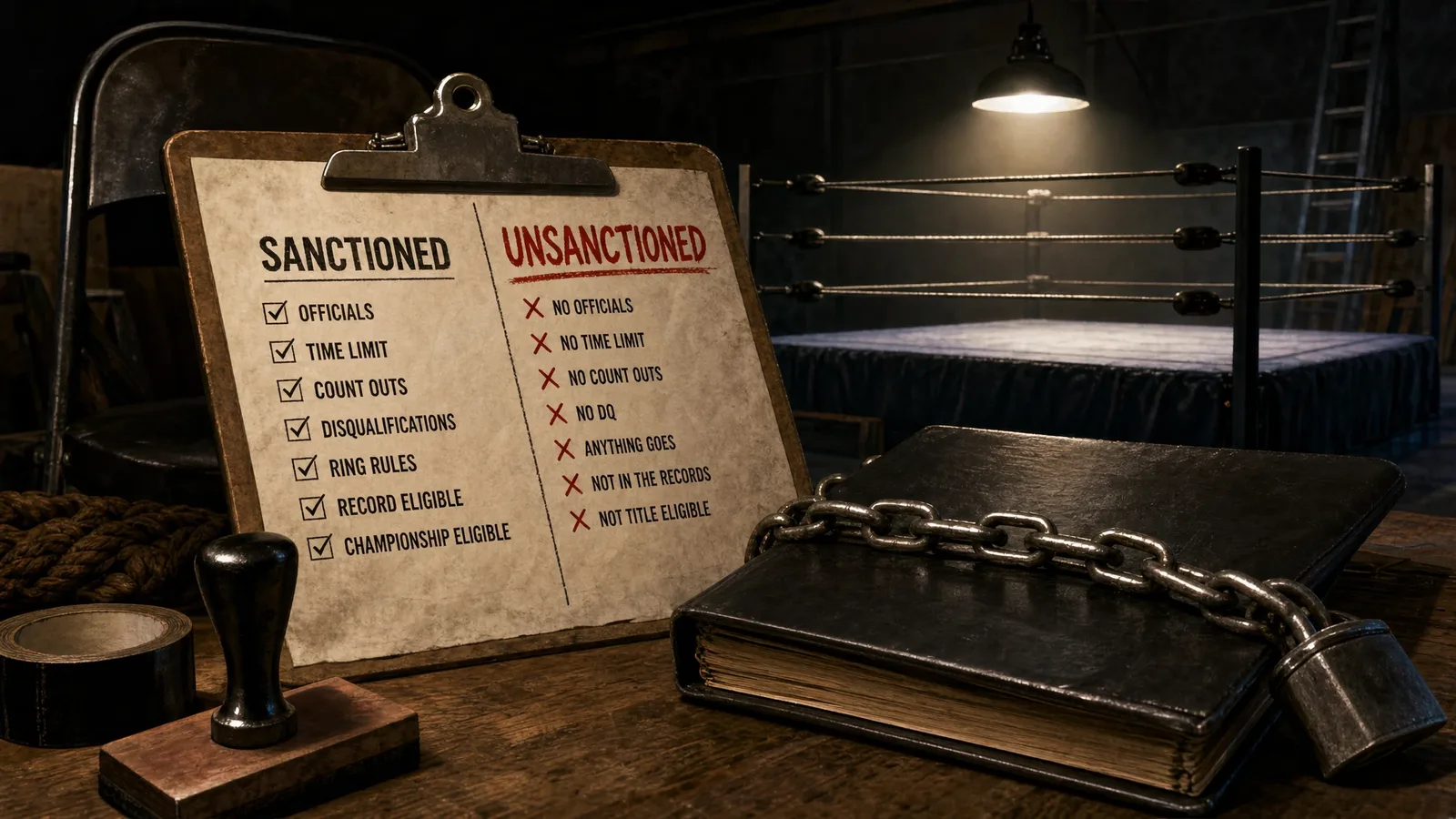
The designation is a promotional frame, not one universal ruleset
When a wrestling promotion calls a match unsanctioned, the most useful first question is not simply what moves are allowed. The label can describe the promotion’s own relationship to the contest: whether it treats the bout as official competition, includes it in formal records, or presents it as outside its normal sporting administration. The available examples do not establish one industry-wide definition. Instead, they show that the same word can sit beside a specific match format, apply to a whole event, or be paired with a decision to leave a result out of a promotion’s standings.
That distinction matters because a match’s rules and its administrative-fiction status answer different viewer questions. Rules tell fans how the contest is presented as being conducted. Sanctioning language tells them how the promotion frames the contest within its own competitive world. AEW’s Light Out example is especially direct: the company described one unsanctioned bout as having no rules, but identified a later no-disqualification, “anything goes” contest as an official World Title Eliminator. Broad freedom in the ring, then, did not by itself decide whether AEW treated a match as official.
AEW’s Light Out example separates feud history from the record book
AEW’s December 2020 preview described a prior Kenny Omega–Joey Janela match on AEW Dark as a Light Out, Unsanctioned Match. The company said their October 15, 2019 contest had no bearing on its record books. That is a concrete example of what an unsanctioned designation can alter: the promotion can present a result without adding it to the formal accounting used for wins and losses. It does not mean the bout disappeared from the promotion’s storytelling or from the wrestlers’ shared history.
In the same account, AEW treated the Light Out outcome as meaningful background. It noted that Omega won and said the earlier match cast a shadow over the wrestlers’ later official meeting. AEW separately described their October 23, 2019 Dynamite match as their only official meeting at that point. Together, those descriptions create two categories a viewer can keep separate: something can be recognized as part of a rivalry while being excluded from the company’s official head-to-head competitive history.
The record treatment was not merely implied. AEW listed Janela’s singles record as seven wins and ten losses while expressly excluding two additional unsanctioned losses. For a fan reading standings, this supplies a practical test: ask whether the promotion includes the result in the named wrestler’s record, rather than assuming that a televised or otherwise acknowledged bout must count. An unsanctioned result may remain central to the narrative while the published tally follows a narrower definition of official competition.
No-disqualification and unsanctioned are not interchangeable
AEW’s later Omega–Janela matchup makes the contrast clearer. The December 2020 World Title Eliminator was promoted as no-disqualification and “anything goes,” yet AEW positioned it as an official competitive opportunity. The company said that a Janela victory could earn a future AEW World Championship match. Its preview also framed the absence of restrictions as a possible tactical advantage for Janela because of his prior experience in matches without restrictions. The rules presentation was permissive, but the championship-related stakes were explicitly official.
This is why “anything goes” should not be treated as a synonym for unsanctioned. A no-disqualification format describes a particular rules environment; an unsanctioned designation can address the promotion’s fictional administrative position and its record keeping. In AEW’s documented comparison, one contest was said to have no rules and no record-book bearing, while another had no-disqualification language and a possible route to a future title match. Fans can therefore examine rules, records, and stakes separately instead of collapsing them into one label.
The comparison also avoids a reverse mistake: an unsanctioned label does not tell viewers every rule without further description. AEW called its Light Out match rule-free, but that description belongs to that particular contest rather than every unsanctioned match across wrestling. A reliable reading begins with the promotion’s exact language. Is the bout also called a Street Fight, a Light Out match, no-disqualification, or something else? Then ask whether the company says the winner receives a formal reward or whether the result enters the standings.
Special and violent stipulations existed within official settings
The historical record supplied by WWE cautions against treating unusual, violent, or elaborate match structures as inherently outside promotion approval. WWE dates the first reported Steel Cage Match to Atlanta on June 25, 1937. It also identifies a 1960 NWA Florida Brass Knuckles Championship defended in wild brawls, followed by Brass Knuckles titles in other territories. These examples place special-match structures well before modern uses of “unsanctioned” branding and show that distinctive stipulations have had their own long history.
WWE’s account of a No-Disqualification Bull Rope Match at Madison Square Garden offers an even more pointed contrast. The New York State Commission approved that match in August 1978. In other words, an unusual and violent-sounding stipulation could be officially approved rather than presented as an unsanctioned contest. The lesson is limited but useful: the intensity of a match format does not establish its administrative label. Fans should look for how the promotion and, where relevant, an actual regulator describe the event instead of inferring status from the stipulation alone.
WWE’s historical overview places “extreme” prominently in wrestling by the mid-1990s alongside ECW’s rise and early Attitude Era developments, while also stressing that violent or unusual stipulations came earlier. That framing helps put later unsanctioned branding in perspective. A promotion can use administrative language to give a bout a particular narrative identity, but the existence of weapons, cages, brawling, or nontraditional settings is not new evidence by itself that the promotion has disowned the match from its competitive structure.
The label can attach to a match or to an event presentation
The 1995 WCW UnCensored event illustrates an event-level use of the framing. WWE describes UnCensored as billed both “unsanctioned” and “unauthorized.” Its card consisted mostly of stipulation matches and opened with Dustin Rhodes versus Bunkhouse Buck on a moving 18-wheeler. The event is useful not because it supplies a universal definition, but because it shows the terminology operating as a broad promotional atmosphere for an entire card, rather than solely as a classification applied to one bout.
That example encourages a simple viewing distinction. If “unsanctioned” appears in an event name or overall billing, it may be setting the tone for the show as a whole. If it appears in the name of a specific match, it may instead frame that individual contest’s place in the promotion’s fictional sporting order. Either way, the accompanying language still matters. WCW’s event billing existed alongside a card made up largely of stipulation matches, underscoring that the unsanctioned frame and the concrete match formats can operate together.
A specific format may remain visible alongside the unsanctioned label
WWE’s presentation of Shawn Michaels versus Triple H on August 25, 2002 provides another clear pairing. WWE calls the match an Unsanctioned Street Fight, and its account notes the use of a chair, ladder, and Michaels’ leather belt. The designation did not replace the Street Fight description. Instead, the two labels conveyed different parts of the presentation: “Street Fight” named the recognizable match format, while “Unsanctioned” supplied an additional frame around it. A viewer should preserve both terms rather than treating one as a complete substitute for the other.
This pairing supplies a useful way to read match graphics and commentary. First identify the stated format, because that is the clearest starting point for understanding the contest’s presented conditions. Then identify whether the promotion adds an unsanctioned or unauthorized label, and finally see whether it says anything about standings, title eligibility, officials, or formal recognition. The WWE example establishes the first two parts of that method; AEW’s Light Out material establishes how record-book treatment can become an additional and separate question.
Storyline sanctioning is different from public regulation
An unsanctioned label inside a wrestling story should not be confused with a real athletic commission’s authority. Ontario provides a documented example of the latter. According to commissioner Ken Hayashi, as reported by Slam Wrestling, Ontario deregulated professional wrestling effective May 10, 2006. Hayashi described professional wrestling as choreographed and pre-arranged and said the commission’s main health-and-safety function did not involve real health-and-safety regulation for wrestling. That is a discussion of government oversight, not a promotion’s storyline classification for a match.
Before deregulation in Ontario, promotions had to carry liability insurance, post a C$1,000 security deposit, and pay licensing fees that varied by community population. Wrestlers were required to pay an annual C$75 licence fee to wrestle legally. After deregulation, promotions still owed a two-percent gate tax based on live-event revenue even though the commission no longer regulated professional wrestling. Those are concrete legal and financial conditions, fundamentally different from a company announcing within its own fictional world that it does not recognize a particular bout.
Slam Wrestling also reported that deregulation did not resolve every practical concern. An independent wrestler warned that promoters might operate without insurance and that untrained talent or substandard shows could create safety and business problems. That warning reinforces why fans should keep the two topics distinct. A storyline declaration of “unsanctioned” is not evidence about insurance, licensing, public safety requirements, or whether an event has been approved by an actual regulator. Those questions require information about the relevant jurisdiction and event, not just a match label.
Questions that clarify what an unsanctioned match changes
For viewers, the most revealing question is often: what does the promotion say will count afterward? AEW explicitly excluded unsanctioned losses from Janela’s singles record and said the earlier Omega–Janela Light Out contest had no bearing on record books. Yet it also used that result as meaningful history before an official meeting. When a promotion gives comparable information, fans can distinguish narrative consequence from formal accounting: a rivalry may advance even when the match does not alter the published win-loss record.
Next, ask whether the match carries an official competitive reward. AEW described its no-disqualification World Title Eliminator as a contest in which a Janela victory could earn a future AEW World Championship match. That is notably different from the company’s handling of the earlier Light Out bout. Finally, read the exact format instead of assuming the administrative label supplies all conditions. AEW’s Light Out match was described as having no rules, while WWE’s 2002 example retained the Street Fight name alongside “Unsanctioned.” Those details are what make the designation intelligible in each promotion’s own presentation.
Explore more

Darryl Polo
Darryl Polo is a passionate wrestling fan covering WWE, AEW, TNA and beyond. He loves great rivalries, breakout stars and the moments that keep fans talking long after the bell. How we work.