
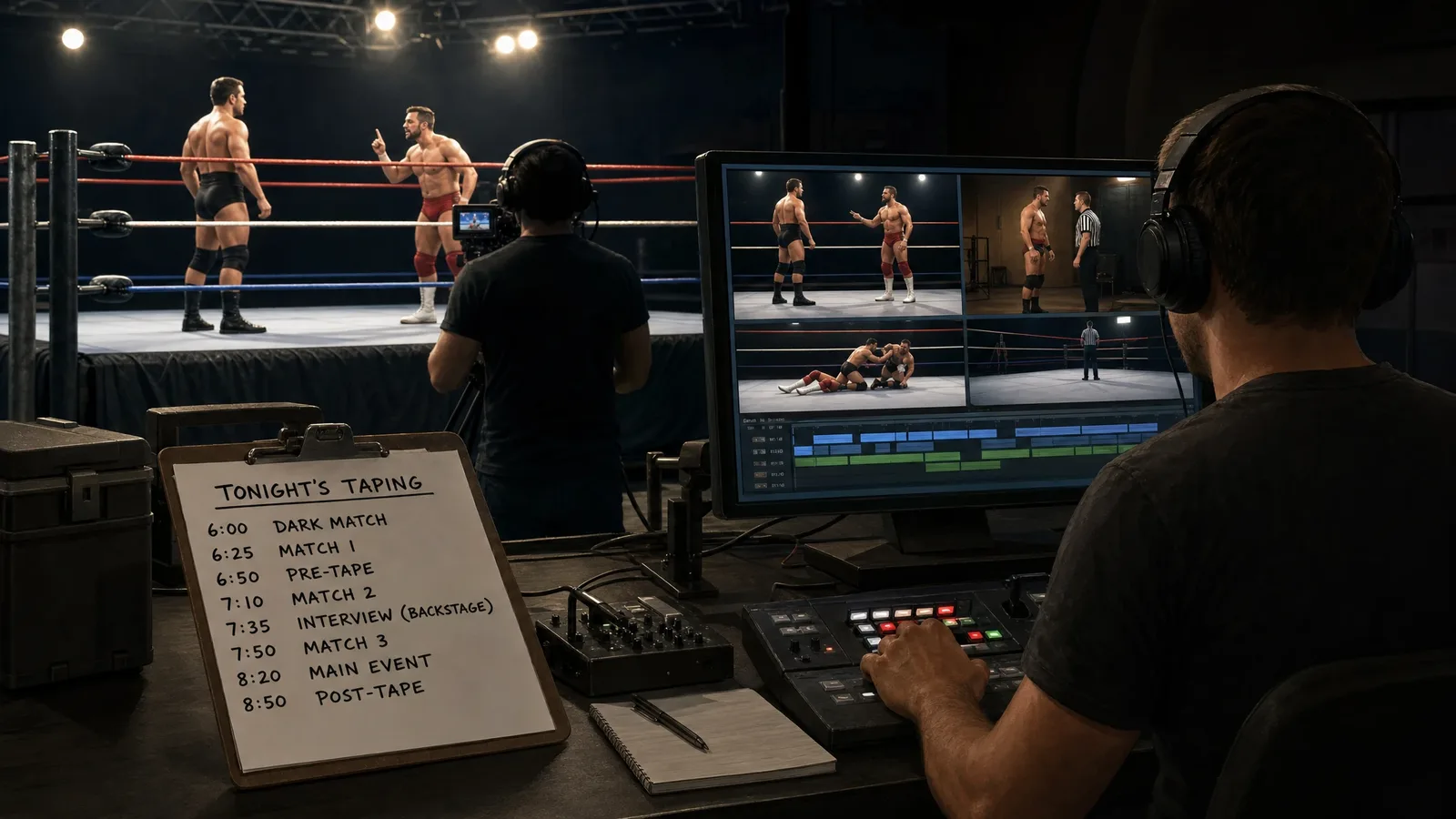
A taping is a production setting, not one fixed format
“Television taping” can sound like a single, clear category, but wrestling history shows several arrangements under that broad label. Territory programs could be filmed at regular live events or in a studio, while promotions can also record matches for later weekly episodes. The useful first question is not simply whether cameras are present. It is what material is intended for release, when that release is planned, and whether the version in the building is the same version viewers at home will receive. A crowd can be attending a live event that also supplies material for television without watching a complete, ready-to-air episode unfold in sequence.
That distinction matters because “live” describes more than one thing. An event can happen live before an audience, yet be shown later through tape delay. Portland’s Saturday program was broadcast live from its arena until roughly 1979, when a timeslot change brought a shift to tape delay. The wrestlers and ticket-buying audience were still sharing the event as it happened; the home audience’s relationship to it had changed. For viewers, then, a live crowd and a live television broadcast should be treated as separate questions rather than interchangeable labels.
Territory television connected local broadcasts and live events
By the end of the 1950s, reliable local television had become an important part of a successful territorial promotion’s business. Promoters commonly used the broadcasts to draw attention toward paid live events, rather than regarding television as a wholly separate product. This historical framing helps explain why an older wrestling program may feel closely tied to particular towns, venues and upcoming cards. The broadcast did not have to function as a self-contained national program to have value within the promotion’s local circuit.
The territory-era account describes a broader practice in which weekly broadcasts could first air in a promotion’s home city and then circulate elsewhere. Interview material could be inserted or replaced for different towns on a touring circuit, allowing shared wrestling footage to carry promotion aimed at the market where an episode would air. Portland is specifically documented as having aired a Saturday program on KPTV from the early 1950s and as having been syndicated across the Pacific Northwest during the period discussed. Those Portland facts should not be confused with proof that every territory-wide localization practice was used there.
Physical tapes shaped what audiences received—and what survived
The historical practice known as bicycling involved sending physical television tapes from market to market and eventually back to the home city. That circulation could make a show feel directed at a local audience even when its match footage had previously played in another market. For modern viewers accustomed to immediate digital access, the system is a useful reminder that the broadcast path once depended on a traveling physical object. A program’s local presentation and the age of its match footage were not necessarily the same thing.
Those tapes were also reused in part to save money, and old episodes were often recorded over after their circulation ended. The resulting historical loss is significant: surviving footage should not be mistaken for a complete account of what original audiences watched. The Portland history estimates that a weekly territory could erase roughly 20 to 30 programs in a year after reruns and weeks off, while only a small fraction of live wrestling shows held from 1950 to 1970 were filmed at all. Later, more accessible home video recorders allowed some fans to preserve broadcasts that promotions had not kept.
A live event can supply material for future episodes
A contemporary announcement from TNA makes the overlap especially plain. For its April 14–15, 2026 Syracuse dates, TNA called the shows back-to-back live events and said matches from both nights would be taped for future episodes of Thursday Night iMPACT! on AMC in the United States. Neither description cancels the other. Attendees could see live events in person, while the promotion could record material from them for later television use. “Live event” and “television taping” can therefore describe different aspects of the same night.
The wording “future episodes” carries an important limit for fans trying to place what they saw on a calendar. It means an attendee was not necessarily seeing an episode set to air that evening or even the immediately following week. TNA’s announcement did not say exactly how many episodes the two Syracuse nights would produce. That missing detail is worth respecting. A multi-night or bulk-taping setting can establish that a promotion has material for later broadcasts, but it does not by itself reveal the eventual episode-by-episode arrangement.
Being taped does not guarantee release
The clearest caution around dark matches comes from a documented AEW case. Richard King wrestled Ortiz during bulk tapings at Universal Studios on June 11, 2022, but the match did not appear in AEW’s YouTube output. That makes the bout a useful illustration of a match performed at a taping that did not become part of the eventual released program. It does not establish one universal definition for every promotion or every use of the term “dark match,” but it does establish the central viewer point: cameras, a crowd and a match can all be present without a public release following.
King said he had been told beforehand that the match might not air and was unsure whether cameras had been running. That uncertainty is itself instructive. Fans in the building may be able to report that a match happened, but they may not know its precise production status or intended destination. It is safer to distinguish between “seen in the arena,” “recorded,” and “released” than to treat them as automatic stages of a single process. Each term describes something different, and the King–Ortiz account shows that the chain can stop before publication.
Continuity can affect whether material is used
The reported reason King’s match was unlikely to air was continuity. Ortiz was scheduled to appear with a shaved head on the following televised Dynamite after a Hair vs. Hair stipulation. Releasing an earlier-recorded match that showed a conflicting appearance could disrupt the visual chronology of the program’s release plan. The point is not that every withheld bout has the same explanation. Rather, this example shows why the order in which material was filmed may not be the order in which a promotion can comfortably present it to viewers.
For a fan, continuity is best understood as a question of what the released sequence asks the audience to accept. If a visible change is scheduled to appear in one broadcast before footage shot earlier is released, the earlier footage may no longer fit that sequence. This is a release-planning issue demonstrated by the AEW example, not proof that a match failed creatively or was unimportant to those involved. Indeed, King and Ortiz received backstage feedback from Christopher Daniels after their match, showing that an unaired or unreleased bout could still have an internal performance-review role.
The practical lesson is to avoid reading too much into an omission. A match that does not air may have been filmed, may have been discussed as a possible release, or may have been performed under uncertain camera circumstances. In the documented case, King knew in advance that release was not assured. That is enough to show why an arena report cannot always predict the final program. A missing match is evidence of a difference between the event and the release, but not automatically evidence of a single broader conclusion about the performers or the promotion.
How to watch the broadcast without confusing it with the building
When a program comes from a taping, viewers can ask a few grounded questions: Was the event described as live, taped for future episodes, or both? Did the promotion identify a particular airdate? Does the announcement specify how many episodes the session will supply? These questions separate confirmed scheduling language from assumptions. TNA’s Syracuse announcement, for example, confirmed future television use and live-event status, but did not assign every match to a precise future episode or state the total number of episodes created by the two nights.
It is also useful to separate match footage from other elements of a television program. The territory-era account describes interview inserts that could be changed for different towns, meaning a broadcast could combine shared wrestling footage with locally tailored promotional material. Portland’s documented history establishes its home-city broadcast and later Pacific Northwest syndication, but not that this particular interview-insert practice was part of its own production model. More broadly, the example demonstrates that a version reaching a television market can be shaped for its intended audience even when parts of the program originated earlier or elsewhere.
Spoilers require modesty about the final version
The gap between a live performance and later release creates the basic spoiler issue. An attendee may know that a match or segment occurred before television viewers do. At the same time, the eventual broadcast may omit material or present a planned sequence that does not mirror every moment experienced in the building. The responsible approach is to describe advance information clearly as taping information, rather than treating it as a complete substitute for the released episode. This respects both fans avoiding spoilers and the possibility that the final program will differ.
A careful report from a taping can distinguish what was witnessed from what is confirmed for release. Saying that a bout took place in front of the crowd is different from saying it will air, and saying that material was recorded is different from saying when it will appear. The King–Ortiz match illustrates the first two distinctions, while TNA’s Syracuse announcement illustrates the third: future television use was announced, but the exact episode allocation was not. Precision keeps a fan account useful without promising more certainty than the available information provides.
Ultimately, the arena show and the television program are connected but not identical experiences. Portland’s documented example includes a live arena broadcast that later moved to tape delay. Separately, territory-era television could use physical tape circulation and locally tailored interview material across markets. TNA’s announced Syracuse model joined live events with future television taping, while the AEW example shows that even a bout held during bulk tapings may never be released. Keeping those distinctions in view makes unseen matches, delayed episodes and differing reports easier to interpret according to the evidence available for each event.
Explore more

Darryl Polo
Darryl Polo is a passionate wrestling fan covering WWE, AEW, TNA and beyond. He loves great rivalries, breakout stars and the moments that keep fans talking long after the bell. How we work.