
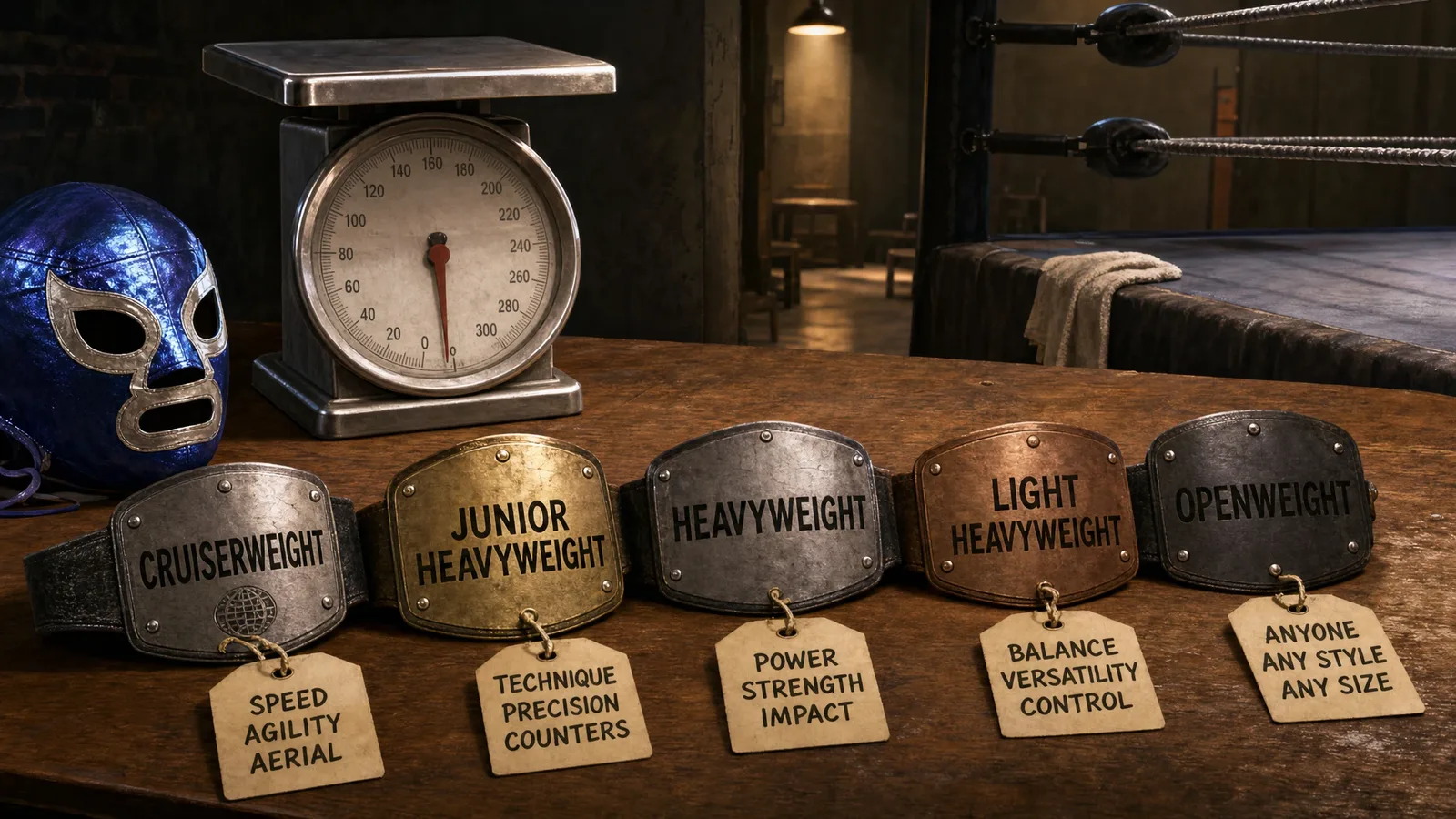
A division name is not one universal system
Terms such as junior heavyweight, cruiserweight and heavyweight can look like straightforward measurements, but the available history shows that they have operated differently in different wrestling settings. In the NWA territorial context, junior heavyweight was a meaningful championship category. In WCW and later WWE, cruiserweight identified a recurring division associated with a particular group of performers and a recognizable television role. In TNA, the X-Division began as a cruiserweight-like attraction despite having no weight limit to speak of. CMLL’s long anniversary record, meanwhile, contains several weight-named championships. The common language does not establish a single shared rulebook.
That distinction gives viewers a practical starting point. A weight word may describe title eligibility, a promotion’s favored attraction, an inherited championship lineage, or a presentation built around expected match styles. It may do more than one of those things at once. It should not automatically be read as proof that every wrestler was weighed under a consistently stated numerical threshold. The sources here identify historical labels and their uses, but do not set out a universal junior-heavyweight or cruiserweight cutoff, nor do they document a common weigh-in procedure across these promotions and periods.
Junior heavyweight as an established championship category
The NWA example makes clear that junior heavyweight was not merely a retrospective label for fast-moving wrestlers. It was a championship category with durable top-level identity. Danny Hodge was presented as an NWA World Junior Heavyweight champion from 1960 through 1976, and the account identifies his first of seven title wins as a victory over Angelo Savoldi in Oklahoma City on July 22, 1960. Whatever a viewer expects from the modern sound of “junior heavyweight,” this history places the term within a long-running title structure rather than treating it as a synonym for one style.
Hodge also complicates a simple small-versus-large reading of the name. The profile lists him at 220 pounds while identifying him as a junior heavyweight. That does not establish a division limit or tell us how every participant was classified. It does, however, show that one prominent historical junior-heavyweight example does not fit an assumption that the label always meant physically small by ordinary standards. The most careful reading is narrow: the title category and everyday impressions of a wrestler’s size are not necessarily identical measures.
The same profile foregrounds Hodge’s high-school wrestling, three NCAA national titles, Olympic freestyle appearances and amateur boxing. Those credentials show one way a weight-class championship could be presented with combat-sport legitimacy. The source specifically connects his credibility in the division in part to his Olympic and collegiate résumé, rather than to a stated scale measurement or formal weigh-in process. For a fan, that is a useful reminder that the significance of a division can be built through championship history and presentation as well as a publicly visible number.
Territories could make a division part of their identity
A division’s meaning also depended on where it was being emphasized. Leroy McGuirk’s NWA-affiliated Oklahoma-and-Arkansas office is described as placing an emphasis on junior heavyweights, while the New York and Los Angeles territories featured more heavyweights. This is evidence of a promotional contrast, not evidence that every territory used the same classification standards. Still, it shows that a division could help give a regional office its own wrestling identity: one market could put junior-heavyweight championship competition near its center while other markets foregrounded larger wrestlers.
The label did not necessarily function as a sealed competitive boundary. Hodge is described as wrestling larger stars outside his weight class even while being identified with the junior-heavyweight championship. That history matters when viewers encounter a weight-named championship and assume it prohibits all crossover. A division can provide a distinct championship lane without dictating every match a wrestler may have. The available account supports crossover in this example; it does not supply a general rule that all junior-heavyweight structures always worked that way.
Cruiserweight became linked to an American television attraction
By the mid-to-late 1990s, lucha libre’s visibility to many U.S. viewers helped make a faster, aerial-oriented style more prominent in major American wrestling. WCW was a major employer of lucha talent including Eddie Guerrero, Rey Mysterio and Juventud Guerrera, linking its cruiserweight scene to cross-border stylistic exchange. This does not mean every cruiserweight match was lucha libre or that lucha libre can be reduced to one division. It does identify a historical setting in which a cruiserweight label became closely associated with performers and pacing shaped by that exchange.
Style association did not eliminate adjustment between opponents. The account says that WCW performers associated with the cruiserweights were expected to adapt when facing non-luchador opponents, while those opponents adapted to lucha-influenced pacing and techniques. This frames a division less as a rigid list of identical wrestlers than as a place where different approaches met. When watching a cruiserweight-era match, a useful question is not simply whether both wrestlers fit a presumed size bracket. It is also how the match is negotiating the division’s established stylistic expectations.
The source characterizes WCW cruiserweights as frequent producers of standout matches while saying they struggled to rise above the mid-card. That separation is important. A division may have a strong in-ring reputation without occupying the top card position. The account also connects heavyweight and super-heavyweight presentation with the industry’s top spots, even while praising cruiserweight and X-Division matches. Together, those observations show that division names can help organize perceived status on a card as well as identify a title or a match category.
WWE reused cruiserweight and light-heavyweight ideas
After WWE purchased WCW in 2001, it established a cruiserweight division using several former WCW-associated wrestlers, including Billy Kidman, Chavo Guerrero, Shannon Moore, Gregory Helms, Último Dragon and Rey Mysterio. The source describes this post-2001 cruiserweight division as a SmackDown highlight. In this setting, cruiserweight functioned as a recurring television attraction, with familiar personnel helping carry the label into a new promotional home. That is a different emphasis from the territorial junior-heavyweight example, where the available evidence centers on a championship category and regional office identity.
WWE had also experimented earlier with a Japanese WWF Junior Heavyweight Championship from 1967 to 1985 and with a Mexican-influenced light-heavyweight division. The source assesses WCW’s cruiserweight division as more successful than those earlier WWE experiments. That is a historical evaluation from the account, not a universal ranking of all weight-based divisions or a measurement of every match’s quality. The broader lesson is continuity of experimentation: junior heavyweight, light heavyweight and cruiserweight have all been used within related but distinct promotion-specific frameworks.
The X-Division shows why style and size should not be conflated
TNA’s early X-Division provides the clearest counterexample to the assumption that a cruiserweight-like division must be regulated by weight. It was initially framed as a cruiserweight-like attraction, but the account explicitly says it began without weight limits to speak of. The label therefore did not establish a conventional size ceiling. Calling the X-Division “cruiserweight-like” describes its place in presentation, not a hidden numerical rule that the source does not provide.
Because that early competition had no stated weight limit, high flyers could regularly be matched with wrestlers of different sizes and styles. The source presents it as a clear instance of a division functioning more as a brand than a regulated class. This does not make “brand” an empty term. It means the division could signal an attraction and a kind of matchup without making weight the stated eligibility gate. For viewers, it is a useful caution against using aerial offense alone as proof that a division has formal weight restrictions.
Lucha title history keeps weight names in a larger stakes system
CMLL’s official anniversary record documents championships named for welterweight, middleweight, light-heavyweight or semicompleto, and heavyweight or completo categories. Its listings include a National Welterweight Championship match as early as September 14, 1939. The record therefore establishes that weight terminology has been embedded in this major-event history for decades. It does not, in the entries summarized here, provide a set of numerical limits or a weigh-in account. What it clearly preserves is the long-term presence of multiple named weight-title categories.
The continuity is visible even as the title affiliations named in the record vary. World Middleweight Championship matches appear in 1947 and 1948 before numerous later NWA-branded middleweight bouts. NWA-version welterweight title matches are listed in 1952, 1953, 1964, 1965, 1968 and 1972. NWA-version semicompleto bouts appear in 1960, 1961, 1972 and 1975, while national heavyweight matches appear in 1946, 1976, 1980 and 1982. The enduring weight words do not, by themselves, mean an unchanged governing brand or one uninterrupted title lineage.
CMLL’s anniversary cards also place weight-title matches alongside mask-versus-mask, hair-versus-hair, tag, trios and cage stipulations. That mix indicates that weight championships are one organizing device within a broader lucha libre stakes system, not the sole measure of a match’s importance on a card. Another entry lists a UWA-version World Heavyweight Championship, while other entries name CMLL, NWA-version, national and arena-associated titles. A word such as heavyweight can thus recur across distinct brands and lineages without identifying one single championship structure.
Questions that make a division label easier to read
When a promotion uses a weight-based name, start with the concrete context. Is the term attached to a particular championship, as junior heavyweight was in the NWA example and as several weight categories are in CMLL’s record? Is it a recurring television attraction, as WWE’s post-2001 cruiserweights were described? Is it a style-facing brand without a stated weight limit, as the early X-Division was? Then ask whether the available presentation actually states an eligibility threshold or a weigh-in practice. Without that information, it is safer to describe the label’s documented role than to assume a uniform rule behind it.
Explore more

Darryl Polo
Darryl Polo is a passionate wrestling fan covering WWE, AEW, TNA and beyond. He loves great rivalries, breakout stars and the moments that keep fans talking long after the bell. How we work.