
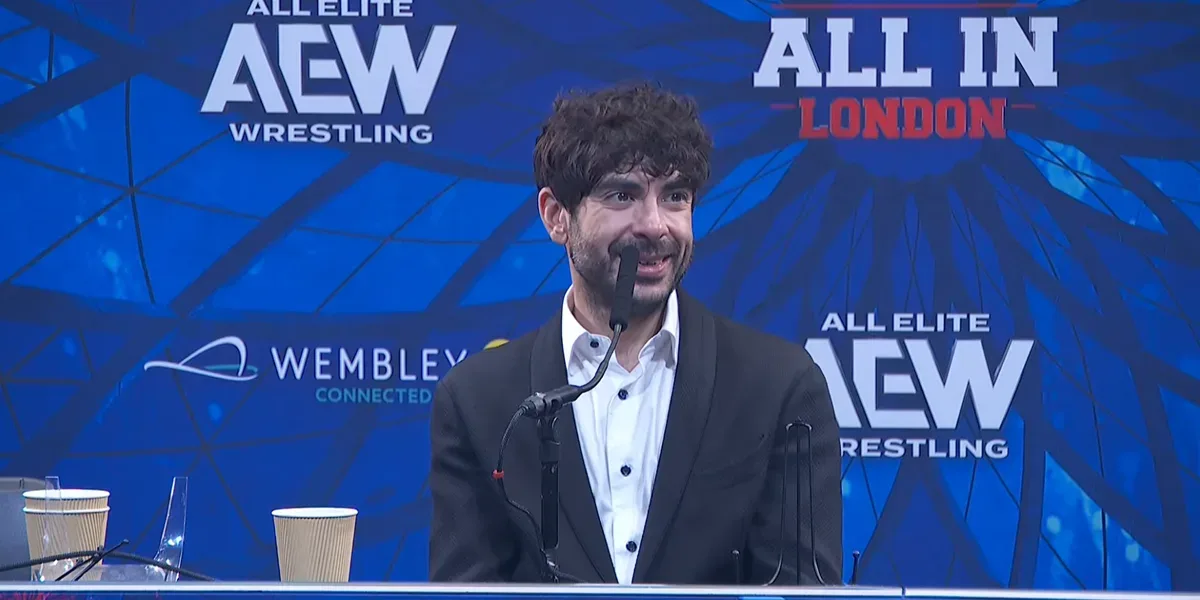
AEW President Tony Khan has addressed the significant travel complications that affected the company’s November 11 dual taping of Dynamite and Collision in Salt Lake City, Utah, explaining that several planned participants were delayed while the live event was already underway.
Speaking during the AEW Full Gear media call on November 12, Khan said the circumstances required quick revisions to the night’s running order. He nevertheless came away pleased with the finished product, describing a strong feeling of relief after a three-and-a-half-hour broadcast that had to be adjusted around arriving talent.
The situation offered a reminder of the logistical challenges behind a weekly live wrestling production. A travel issue can affect far more than one match: it can reshape entrances, interviews, timing, pre-taped material, match placement and the overall pacing of a card. For a combined Dynamite and Collision event, where the company had a lengthy program to fill and numerous wrestlers scheduled to appear, Khan’s ability to move pieces around became especially important.
Khan said there were “numerous flight issues” affecting talent headed to Utah. Rather than treating the problem as an insurmountable obstacle, he emphasized the value of backup plans and of being able to alter a lineup in real time. He also praised the network for accommodating the changes and allowing parts of the broadcast to be moved later in the night.
For more background on this topic, read John Skyler Set for TNA Immersed as AEW, WWE and Independent Wrestling Updates Fill Busy November Day.
Hyan Reached the Building as the Show Began
The most notable example involved Hyan, who was booked for the TBS Championship main event alongside Queen Aminata and Maya World. Khan revealed that Hyan arrived at the arena as the event was starting, making the eventual placement of the title match at the end of the broadcast a practical solution as well as a showcase opportunity.
Putting the bout in the main-event position gave Hyan time to get to the building and prepare while ensuring the advertised championship match could still take place. It also allowed AEW to preserve the match rather than replacing a participant or substantially changing the planned contest.
Khan stressed that he viewed the main event as worthy of its position on the card independent of the travel delay. He pointed to Hyan’s recent work in both AEW and Ring of Honor, saying he wanted to give her a meaningful opportunity on a major show. Queen Aminata, Hyan and Maya World were therefore able to complete the planned TBS Championship match despite the difficult route to getting everyone in the same arena.
“In the case of the main event, Hyan arrived at the arena as the show was starting,” Khan said. “By putting that match in the main event, first of all, it’s a great championship match in the main event.”
The decision illustrates how match order can become a valuable tool when travel plans break down. Wrestlers who are delayed do not necessarily need to be removed from a card if the promotion has enough flexibility to shift their segment later. In this case, a championship match had the stature to close the broadcast while also solving a pressing operational problem.
Several Collision Participants Were Also Delayed
Hyan was not the only performer affected. Khan said that a number of wrestlers scheduled for the Collision portion of the dual taping reached Salt Lake City later in the evening, after the live event had begun. He did not identify every person impacted or detail the individual flights involved, but he said the company was ultimately able to get those wrestlers on the program.
That included talent who had been held up at the airport but still made it to the arena in time to wrestle or participate in interviews. Khan credited the performers for arriving and delivering once they were able to get through the travel disruptions, while also highlighting the importance of the production team making the necessary adjustments.
In a live wrestling environment, those changes can require coordination across nearly every department. Producers must revise timing, talent relations must track arrivals, the announce team may need updated information, and technical personnel have to be ready for segments appearing in a different position than originally expected. A network accommodating a delayed item can also make a crucial difference when a show is designed to air live.
Khan said he enjoys the challenge of pivoting when plans change. He compared the need to adapt on November 11 to the type of rapid problem-solving AEW regularly faced during the pandemic era, when restrictions and shifting conditions often demanded rewritten lineups and alternative production approaches.
“That’s the energy of the pandemic that I really loved,” Khan said of the process of making changes and seeing a reworked event come together successfully.
Nick Wayne Was Featured After a Late Arrival
Nick Wayne was another wrestler Khan specifically named when discussing the travel issues. Khan said he had wanted to make sure Wayne was featured on the show despite his later arrival, and AEW was able to do so.
Khan connected Wayne’s delayed travel to the Jericho Cruise, saying the young wrestler had gotten in later that night because of the cruise. While Khan did not provide further details on Wayne’s exact travel itinerary, he made clear that the delay did not keep him from appearing once AEW restructured the show.
The effort to include Wayne was notable because Khan framed it as part of a broader commitment to providing opportunities for emerging talent. Hyan, Maya World and Wayne represent performers whose roles can benefit from being placed in visible positions, whether through a championship match, a wrestling appearance or a storyline interview. With travel disruption threatening those plans, Khan said he was happy to make changes that still allowed those wrestlers to be featured.
“I really wanted to get Nick Wayne on the show,” Khan said, adding that he was pleased AEW could accomplish what it had planned for him after he reached the building.
Contingency Planning Takes Center Stage Before Full Gear
The Salt Lake City taping came just days before AEW Full Gear on Saturday, November 14. Khan said completing the disrupted broadcast successfully gave him confidence and excitement heading into the pay-per-view, even after a day in which travel difficulties had forced several decisions to be made on the fly.
That timing added pressure to the situation. The lead-in episode to a pay-per-view often serves as a final opportunity to build major matches, advance rivalries and put key names in front of the audience. Unexpected absences or late arrivals can complicate that objective, particularly when the promotion has already announced important Full Gear developments. AEW’s ability to keep the show moving and still use its delayed talent meant the company did not have to abandon the affected appearances outright.
Khan’s comments did not suggest that the travel problems changed the Full Gear lineup. Instead, his focus was on the November 11 broadcast and the satisfaction of getting the scheduled talent involved despite the disruptions. He said the night ended with the feeling that everything had come together well.
For viewers, many of the alterations may not have been obvious without Khan’s explanation. That is generally the goal of a successful last-minute rewrite: the audience sees a cohesive show, while the behind-the-scenes adjustments remain largely invisible. In Salt Lake City, AEW had the benefit of a long combined program and the willingness to move segments, but it also needed talent to arrive with enough time to be safely integrated into the event.
The TBS Championship main event became the clearest visible product of that flexibility. Hyan’s late arrival could have threatened a planned title bout, but the match was repositioned and ultimately served as the closing attraction. Elsewhere, delayed wrestlers were still able to work matches or conduct interviews after reaching the arena.
A Successful Pivot in a Difficult Situation
Khan’s assessment was straightforward: the November 11 show presented real logistical problems, but AEW’s contingency plans held up. He said he was proud of the three-and-a-half-hour presentation and of the people who made it work after dealing with airport delays and altered schedules.
Unexpected travel trouble remains one of the most persistent variables in professional wrestling, where a single live event can require talent to arrive from multiple cities and, at times, from international commitments. The challenge becomes even sharper when a company is producing television on a fixed schedule. There is no guarantee that a delayed flight will recover in time, and every lost hour reduces the options available to the creative and production teams.
In this instance, AEW avoided the worst-case scenario. Hyan made it in time for the TBS Championship main event. Nick Wayne was incorporated into the broadcast. Other delayed performers were able to wrestle or appear in interviews. And Khan believed the finished Dynamite and Collision presentation came off well despite a day that demanded considerable improvisation.
With Full Gear next on AEW’s calendar for November 14, the company now moves forward from a hectic Salt Lake City taping having navigated one of the less glamorous but essential aspects of running a major wrestling promotion: making sure the show can go on when the travel schedule does not cooperate.

Darryl Polo
Darryl Polo is a passionate wrestling fan covering WWE, AEW, TNA and beyond. He loves great rivalries, breakout stars and the moments that keep fans talking long after the bell. How we work.