
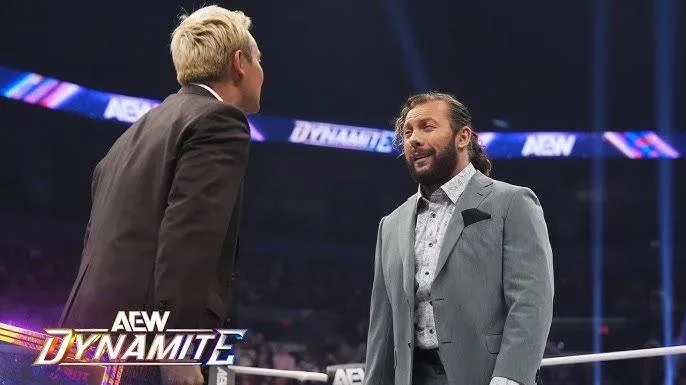
Swerve Strickland has added his voice to one of professional wrestling’s longest-running debates: which match deserves to be called the greatest of all time?
There may never be a universal answer. Wrestling’s history is too broad, its audiences too varied, and its greatest matches too dependent on what each viewer values most. Some prioritize athletic innovation, others emotional investment, historical importance, crowd reaction, presentation, or the ability to bring new viewers into the fold. But when Strickland was asked to identify the pinnacle of in-ring wrestling, he pointed toward one of the defining rivalries of the modern era: Kenny Omega against Kazuchika Okada in New Japan Pro-Wrestling.
Specifically, Strickland named Omega and Okada’s bout at NJPW Dominion 6.9 in 2018, the celebrated two-out-of-three falls encounter that concluded their extraordinary series. The match took place in Osaka-jo Hall on June 9, 2018, with Omega finally defeating Okada to win the IWGP Heavyweight Championship after a rivalry that had already altered the conversation around modern main-event wrestling.
“I would say the greatest wrestling match of all time – it would be Kenny and Okada at Dominion,” Strickland said.
For more background on this topic, read Wrestle Kingdom 21’s AEW-NJPW Balance Could Shape Tokyo Dome’s Biggest Outcomes.
The answer places Strickland alongside countless fans and wrestlers who regard the Omega-Okada saga as a defining body of work for the 2010s. Their four major singles matches were not simply acclaimed in isolation. Together, they created a continuing athletic and emotional narrative built around endurance, escalating stakes, and Omega’s pursuit of the championship held by New Japan’s ace.
The Dominion meeting was the decisive chapter. Omega and Okada had wrestled to a 60-minute time-limit draw at Dominion in 2017, following earlier classics at Wrestle Kingdom 11 and Dominion that same year. By 2018, the rivalry had grown into something that felt larger than a single title program. The question was no longer whether the two could deliver another elite match. It was whether Omega could finally overcome Okada when the championship and their shared legacy were both on the line.
They did so under a two-out-of-three falls stipulation, giving the contest a different rhythm and scale from their previous encounters. Omega’s eventual victory brought an end to Okada’s historic IWGP Heavyweight Championship reign and completed a major turning point for both men. For Omega, it was the culmination of years of work in New Japan and the realization of the championship ambition that had defined much of his singles rise. For Okada, it represented a rare moment of vulnerability after standing at the top of the company for an extended period.
Strickland’s selection is particularly notable because he did not frame greatness as a simple, objective formula. In the same discussion, he acknowledged that great matches can reach that level for very different reasons. He also referenced a far different kind of landmark spectacle when considering the broadest possible answer to the question.
“The greatest match of all time is probably Rock and Hogan,” Strickland said.
The Rock vs. Hulk Hogan at WrestleMania X8 remains one of wrestling’s most iconic examples of audience connection and generational storytelling. It did not require the extended match length or technical escalation associated with Omega and Okada’s Dominion epic to leave a permanent mark. Instead, it became historic because of the atmosphere inside the building, the collision of two enormous eras, and a crowd response that changed the tone of the match in real time.
By mentioning both bouts, Strickland illustrated why debates around wrestling’s greatest match can be so difficult to settle. Omega vs. Okada at Dominion can be viewed as an apex of sustained in-ring performance, long-term rivalry development, and championship drama. Rock vs. Hogan can be viewed as an unmatched cultural and emotional event. Neither comparison needs to diminish the other. They represent distinct paths to greatness within the same industry.
Why Omega and Okada’s Dominion Match Still Stands Apart
The impact of Omega and Okada’s 2018 Dominion main event continues to be felt because it arrived at a time when international audiences were increasingly able to follow Japanese wrestling closely and react to it in real time. New Japan had become a major destination for viewers seeking high-level wrestling, and the Omega-Okada rivalry became a key entry point for many fans.
The series also helped reinforce the value of patient, serialized storytelling. Each match had consequences for the next. The competitors remembered previous holds, previous near-falls, and previous failures. Their history was not treated as background information; it was an essential part of the action. The Dominion finale was therefore not just a lengthy championship match. It was the payoff to years of rivalry, partnership history, faction dynamics, and repeated attempts by Omega to dethrone a champion who seemed nearly impossible to beat.
That context is important in any assessment of the bout. A match can have spectacular offense and extraordinary conditioning, but the most enduring contests are usually those where every major moment carries a clear emotional meaning. Omega and Okada’s final chapter had that foundation. The audience knew what a win meant to both men, and the result felt monumental because the road to it had been so demanding.
For Strickland, whose own career has featured major matches across multiple promotions and a rise to the AEW World Championship, the choice speaks to the influence Omega and Okada have had on the current generation. Their work expanded expectations for what a major-event match could look like, both in terms of structure and the commitment required to make a rivalry feel truly definitive.
Strickland’s Choice for Wrestling’s Most Underrated Great Match
Strickland also offered a different answer when asked about the most underrated match of all time. Rather than choosing a hidden gem from decades ago, he looked to a match featuring wrestlers who have become central figures in AEW: Hangman Page and Kenny Omega against The Young Bucks.
“I’m always good at doing the most underrated great matches,” Strickland said. “The greatest is tough because it’s like they’re great for so many different reasons. I still don’t think to this day with everything that has culminated – it’s Hangman and Omega against The Bucks.”
Page and Omega’s match against Matt and Nick Jackson is remembered as much for its character-driven tension as for its athletic execution. At the time, the relationships within The Elite had become increasingly strained, with friendships, loyalty, and championship aspirations all pulling the group in different directions. The tag team match used that instability as a central strength rather than a distraction.
That is likely part of why Strickland sees it as underrated. The match did not exist merely as a showcase for four acclaimed performers. It carried the weight of an evolving story involving Page’s insecurity, Omega’s attempts to hold relationships together, and the complicated bond between the Bucks and their longtime allies. The action mattered because the emotional fractures mattered.
Tag team wrestling has often produced some of the industry’s most inventive and exhilarating matches, but it can sometimes receive less attention than the biggest singles main events when fans assemble all-time lists. Strickland’s answer is a reminder that the format can provide storytelling opportunities unavailable in one-on-one competition. Partners can communicate without words, make split-second choices that reveal their loyalties, and create moments where victory and personal betrayal seem uncomfortably close together.
The Page and Omega versus Young Bucks match also occupies an interesting place beside Strickland’s Omega-Okada selection. In one case, Omega was chasing a career-defining singles championship through a rivalry constructed over several New Japan events. In the other, he was working within a tag team story shaped by friendship and dysfunction. The styles, settings, and emotional objectives were different, yet both matches demonstrate Omega’s ability to make major wrestling moments feel consequential.
Greatness Has More Than One Definition
Strickland’s comments do not settle the debate over professional wrestling’s greatest match, nor could any single answer do that. Instead, they underline the many standards fans use when evaluating all-time classics.
There is the technical and athletic standard represented by Omega and Okada’s Dominion encounter. There is the historic crowd-driven phenomenon of Rock vs. Hogan. There is also the layered team storytelling Strickland identified in Page and Omega against The Young Bucks. Each match has supporters for good reason, and each demonstrates a different strength of the medium.
What connects them is the ability to make viewers feel that they are watching something bigger than a routine match. Omega and Okada produced that feeling through a years-long battle for supremacy. Rock and Hogan achieved it through the collision of icons. Page, Omega, and the Bucks did it through personal conflict and a deeply invested audience.
For Strickland, the Dominion 2018 clash between Omega and Okada remains at the very top of that conversation. More than eight years later, its reputation has endured as a benchmark for championship wrestling, a landmark New Japan main event, and a match that continues to shape how wrestlers and fans discuss excellence in the ring.

Darryl Polo
Darryl Polo is a passionate wrestling fan covering WWE, AEW, TNA and beyond. He loves great rivalries, breakout stars and the moments that keep fans talking long after the bell. How we work.