
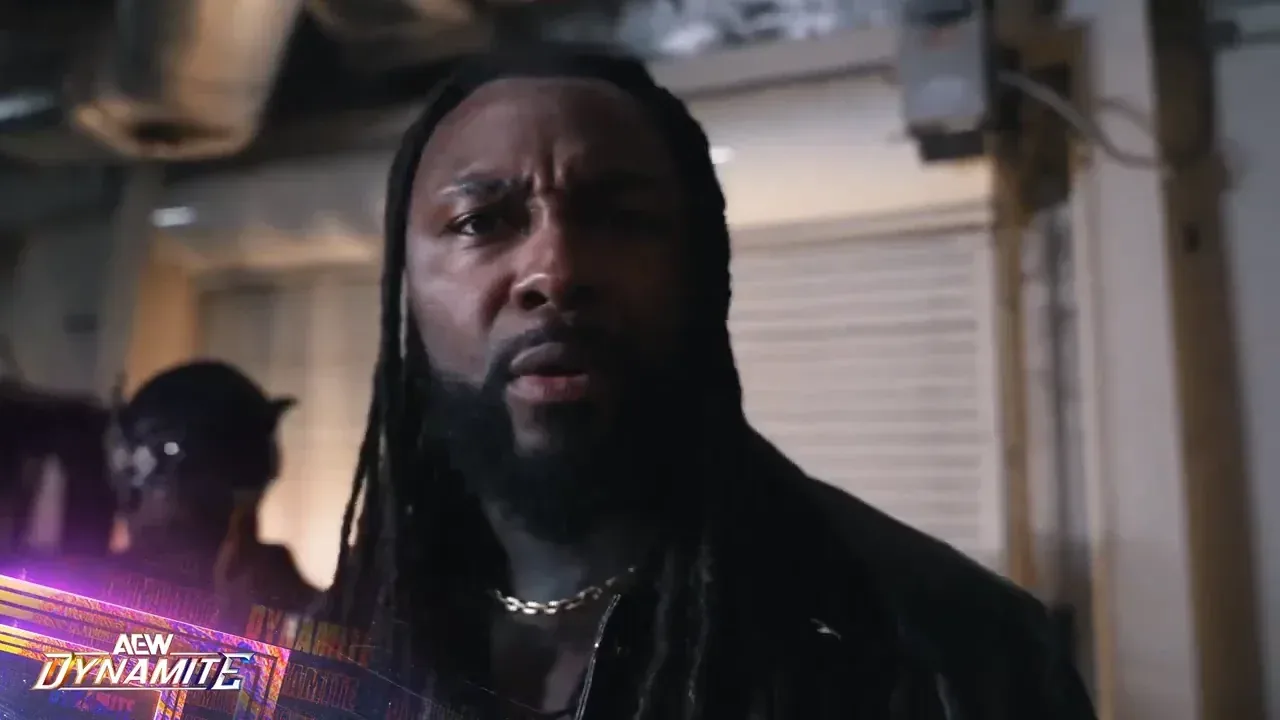
Swerve Strickland has built his presentation around confidence, composure and a clear sense of control. Whether he is walking to the ring, standing across from an opponent, or taking the stage as a rap performer, Strickland sees the same core principle at work: the ability to command attention without immediately giving the audience more movement, noise or explanation.
Discussing the overlap between his wrestling career and his music performances, Strickland described his approach with a concise phrase: “Stillness is power.” It is a philosophy that speaks to much more than simply pausing during an entrance. In Strickland’s view, knowing when not to move can create anticipation, guide a crowd’s emotional response and give the performer greater ownership over the atmosphere.
“The less I do, the more I stand there, the more people crave the attention, to want to move,” Strickland said.
That idea is central to performance in professional wrestling, where even a small glance, posture change or delayed reaction can alter how a crowd reads a moment. Wrestlers are constantly communicating, even when they are not speaking. A stare can challenge an opponent. A pause can make an audience wait for a strike. A measured walk rather than a sprint can establish status before the first lockup happens.
For more background on this topic, read Swerve Strickland Details How Adam Copeland’s Advice Helps Shape His AEW Performances.
For Strickland, the effect is not limited to the ring. He compared that controlled restraint to the kind of anticipation created by major music performers, invoking Michael Jackson’s famous ability to draw an enormous reaction while standing on stage without immediately launching into the next action. The audience wants the release, and the longer the performer confidently withholds it, the louder and more invested that audience can become.
“Michael Jackson stands on stage for five minutes straight. People are going crazier and crazier and crazier,” Strickland said. “I’m like, ‘Do something! Come on! Do something!’ … Then boom! They go louder. So stillness is power.”
Control Starts Before the Bell
In wrestling, an entrance is often treated as a piece of spectacle attached to the match. Strickland’s comments underline why it can also be a vital part of the match’s storytelling. The walk to the ring establishes tone. It tells viewers how a wrestler wants to be perceived and what emotional response they are trying to draw out of the building.
A performer who charges to the ring sends one message. A wrestler who stops, looks around and appears completely unhurried sends another. Neither is automatically better, but the choice has to serve the character and the moment. Strickland’s philosophy is built around understanding that the audience fills in the silence. When a performer is comfortable enough to remain still, the crowd begins to project its own anticipation, excitement or tension onto that pause.
Strickland said he applies that concept to his entrances and to his work between the ropes. The longer he can remain still, he believes, the more he can influence the audience.
“The longer I stand still, the more I can control the people,” Strickland said.
That is a particularly revealing way to describe wrestling psychology. Crowd control is not only about louder reactions or direct gestures. It can also come from withholding. If the audience expects an explosive movement, a taunt or a verbal response, delaying that beat can make the eventual action feel larger. A sudden burst of speed carries more impact after a period of calm. A look toward an opponent can become more dramatic when it follows a long silence.
In that sense, stillness is not the absence of performance. It is performance with purpose.
Using the Camera as Part of the Performance
Strickland also addressed the relationship between a wrestler and the camera. Professional wrestling is experienced by two audiences at once: the fans inside the arena and the viewers watching through the broadcast. The strongest performers have an awareness of both, understanding how their movements play to a live crowd while also giving cameras images that advance the story.
Strickland said even moving his eyes can influence how a moment is presented on screen.
“I notice when I move my eyes, the camera tells the story of where I want them to shoot,” Strickland said. “So I’m directing at all times in the ring. I’m directing the people. I’m directing the cameras.”
The word “directing” is important. Wrestling performers do not control a production in the same literal way as a television director, but elite ring work often involves offering production teams the clearest possible visual cues. A wrestler’s line of sight, body position and pacing can all help frame a dramatic reaction, an opponent’s vulnerability or an impending shift in momentum.
A deliberate glance toward the stage can alert the audience that something has changed. Looking down at an opponent after a major move can emphasize dominance. Turning toward the hard camera at the proper time can ensure that a facial expression reaches viewers at home. Those details may last only a second, but they can make a sequence more understandable and memorable.
Strickland’s description presents those choices as active storytelling rather than incidental habits. His stillness gives him space to make the next signal matter. Instead of constantly moving through the moment, he can choose the exact movement that tells the audience where to focus.
Comfort in Silence
One of the more broadly applicable points in Strickland’s comments was his focus on silence. He connected wrestling and music with stand-up comedy, another performance medium in which timing and the ability to sit in an uncomfortable pause can determine whether a moment lands.
Silence can be difficult for performers because it creates uncertainty. There is no music covering the gap, no immediate chant to lean on and no guarantee that the crowd will react in the desired way. But Strickland believes that discomfort is precisely why a performer must learn to embrace it.
“When the quiet goes down, it feels uncomfortable to people,” Strickland said. “But if you are able to find comfort in the quiet and the comfort in the stillness, that’s where you can control the people and control the atmosphere.”
That observation applies naturally to wrestling. The loudest moments in a match are often made possible by the quieter ones that came before them. Fans need time to recognize a turning point, process a dangerous situation or wonder what a wrestler will do next. If every second is played at maximum volume and maximum speed, there is little room for escalation.
The same principle applies to promo delivery and character work. A pause before a key line can make the words hit harder. Remaining expressionless after an insult can make an eventual response more threatening. Taking a breath before a major decision can invite an arena full of fans to lean forward together. Timing is frequently discussed as a matter of when to speak or when to execute a move. Strickland’s comments emphasize the other side of that equation: knowing when to wait.
Parallels Between Rap and Wrestling
Strickland’s experience across rap and professional wrestling has given him a perspective that treats both as connected forms of live performance. The settings differ, but both demand an understanding of rhythm, crowd energy, persona and visual presentation. A musician has to read whether an audience is ready for a beat to drop. A wrestler has to read whether the building is ready for a comeback, confrontation or finishing sequence.
Strickland said he began watching and understanding these common elements before applying them across his work in the ring, during his entrance and on stage. Rather than viewing his creative outlets as separate, he sees them as parallel disciplines that sharpen the same instincts.
That approach helps explain why presence can be as valuable as action. In both music and wrestling, a performer does not always need to fill every moment. The audience’s imagination and expectation are part of the experience. The performer’s job is to recognize when anticipation has reached the right point, then deliver the movement, lyric, expression or physical sequence that gives that anticipation a payoff.
Strickland’s “stillness is power” philosophy ultimately comes down to intentionality. Every movement means more when it is chosen carefully. Every pause can become part of the story. And when a performer is capable of standing calmly in a moment that others might rush to escape, that composure can become its own statement of power.
Darryl Polo
Darryl Polo is a passionate wrestling fan covering WWE, AEW, TNA and beyond. He loves great rivalries, breakout stars and the moments that keep fans talking long after the bell. How we work.