
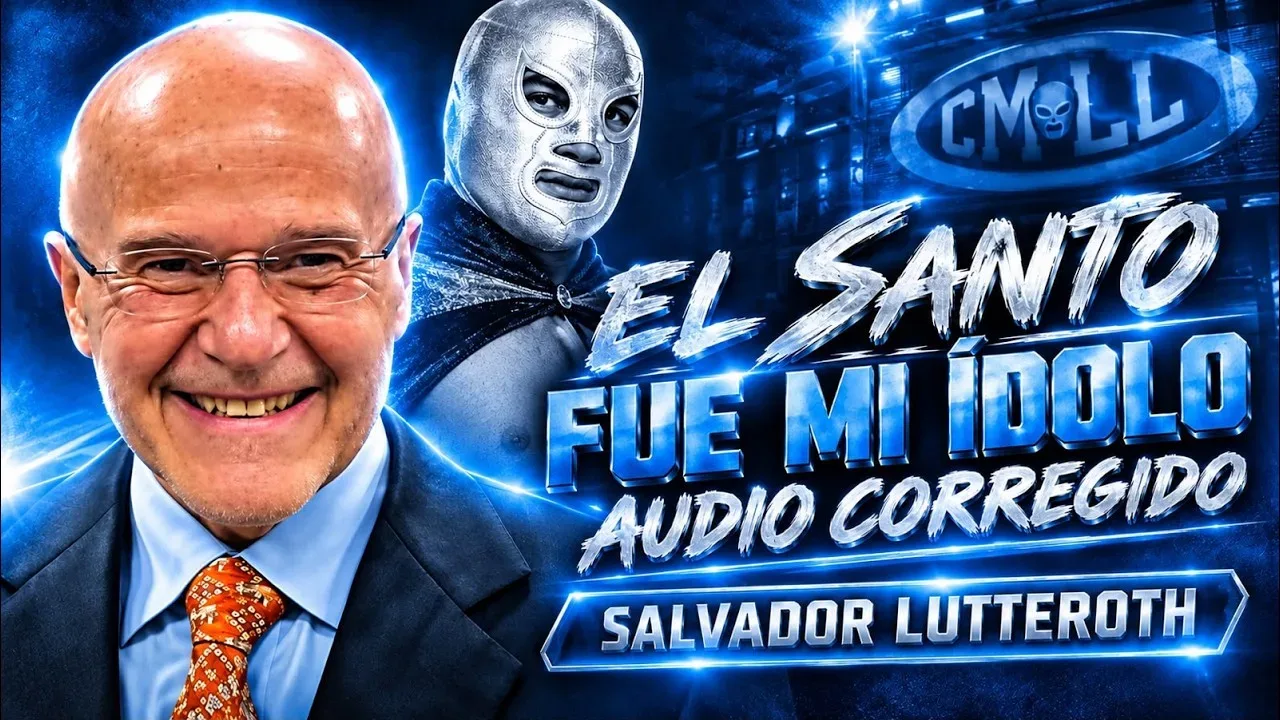
Salvador Lutteroth has offered a measured reflection on El Hijo del Santo’s decision to leave Consejo Mundial de Lucha Libre in 2006, making clear that he holds no resentment toward one of lucha libre’s most recognizable masked stars.
El Hijo del Santo had been a regular presence in CMLL beginning in 1995 before departing the promotion 11 years later. He ultimately did not return to CMLL before retiring in December 2025, ending an in-ring career that carried the enormous legacy of his father, El Santo, while establishing its own place in Mexican wrestling history.
Speaking on Máscara y Cabellera – El Podcast, Lutteroth discussed the circumstances surrounding the departure and framed it as an individual choice rather than an issue that has created lasting animosity between the sides.
“I think these are decisions each person makes for themselves,” Lutteroth said. “You choose the path you’re going to follow. They didn’t seek an option with us, nor did we want him to say goodbye here, but there’s no hard feelings toward El Hijo del Santo.”
For more background on this topic, read Candela Reflects on Mr. Niebla, Héctor Garza and Hijo del Perro Aguayo as Defining Influences.
The comments offer a notable perspective on a separation involving a figure whose name has always carried unique weight in lucha libre. El Hijo del Santo was not merely another masked wrestler on a CMLL roster. As the successor to El Santo, he represented a continuation of perhaps the most celebrated identity in the history of Mexican professional wrestling.
That status naturally made every professional decision surrounding him significant. A departure from a major promotion can be remembered through the lens of business, creative direction, booking opportunities, or personal ambition. Lutteroth, however, did not present the 2006 situation as a public conflict. Instead, he emphasized the agency of the performer involved and expressed respect for the career El Hijo del Santo built under one of wrestling’s most famous names.
A Long CMLL Run Before the Split
El Hijo del Santo’s regular association with CMLL began in 1995. The promotion is one of the defining institutions of lucha libre, and a sustained run there places a performer in the center of a tradition shaped by generations of stars, masks, rivalries, and championship-level competition.
His departure in 2006 therefore brought an end to a substantial chapter. The fact that he never came back to CMLL gives that decision additional historical finality, particularly now that his retirement is part of the record. There was no eventual homecoming match for the promotion, no later farewell presented under its banner, and no return that revised the outcome of the split.
Lutteroth acknowledged that neither side pursued a CMLL goodbye at the time. That detail stands out because farewells in professional wrestling can carry considerable symbolic importance, especially when they concern a legacy performer. In this case, the conclusion of El Hijo del Santo’s regular run was not marked by the kind of formal sendoff that might have been expected for a wrestler bearing such a legendary surname.
Still, Lutteroth’s remarks reject the idea that the lack of a goodbye should automatically be interpreted as hostility. His assessment is that El Hijo del Santo made his own choice and followed his own path. That distinction is central to how he views the 2006 departure.
Respect for a Successor to El Santo
Lutteroth went beyond discussing the exit itself and praised El Hijo del Santo as a steward of the tradition associated with El Santo. In doing so, he spoke not only about the individual wrestler but also about the values he believes the original Santo represented.
“I think he’s also been a great successor to El Santo’s tradition,” Lutteroth said. “I say ‘El Santo’ not just because I knew him and had this brief friendship with him, but because of everything El Santo stood for: everything he came to embody through his persona, his career, the prominence his name achieved, and, above all, his immense commitment to the sport, the integrity upheld as an athlete, and the respect he showed toward the fans, his colleagues, and professional wrestling.”
That is significant praise given the standard attached to the Santo name. El Santo’s importance reaches far beyond a single promotion or even the wrestling ring itself. The mask, character, career, and public image became foundational parts of lucha libre culture. Any wrestler presented as his successor faces expectations that are unusually high, with audiences measuring not just athletic ability but the handling of a historic identity.
Lutteroth’s comments suggest he sees El Hijo del Santo as having honored that responsibility. He specifically pointed to El Santo’s commitment to the sport, personal integrity, and respect for fans and colleagues as defining qualities. By calling El Hijo del Santo a great successor to that tradition, Lutteroth placed the son’s career in the context of those same standards.
The distinction matters. Legacy names can create immediate recognition, but they also invite constant comparisons. The successor is expected to preserve what made the original act meaningful while navigating a changing industry and building an individual career. Lutteroth’s remarks credit El Hijo del Santo with meeting that challenge in a way that respected the name he carried.
No Return Before Retirement
El Hijo del Santo’s post-CMLL history did not include a return to the promotion. That remained the case until his retirement in December 2025. As a result, the 2006 departure was not a temporary interruption in an otherwise continuing CMLL relationship; it was the final point of his regular tenure there.
In wrestling, separations between talent and promotions are often revisited years later. Reunions, one-night appearances, anniversary events, and farewell attractions can all change the way a departure is remembered. El Hijo del Santo’s case took a different course. His career concluded without a CMLL return, making Lutteroth’s present-day statement one of the clearer acknowledgements of how the promotion views the relationship.
The important takeaway is not that the two sides necessarily agreed on every aspect of the decision in 2006. Lutteroth plainly said that an option was not sought with CMLL and that the promotion did not seek to stage his goodbye there. Those facts establish that the exit did not unfold as a jointly planned farewell.
But Lutteroth also made an equally direct point: there are no hard feelings. That wording leaves room for the reality that professional paths can diverge without erasing mutual regard. It also recognizes El Hijo del Santo’s right to determine the direction of his own career.
The Lasting Meaning of the Departure
Viewed in retrospect, the 2006 CMLL departure is one moment within a much larger story. El Hijo del Santo had already spent years as a regular in the promotion, and his retirement in 2025 closed the active portion of a career connected to one of lucha libre’s most enduring lineages.
Lutteroth’s comments do not rewrite the fact that El Hijo del Santo never returned to CMLL. They also do not suggest that a farewell was held when he left. Instead, they provide a respectful interpretation of an unresolved-looking chapter: a major performer took a different path, CMLL did not host his departure, and the relationship was not defined by bitterness.
For Lutteroth, the greater legacy appears to be the way El Hijo del Santo carried forward the ideals associated with El Santo. His remarks focus on commitment, integrity, respect, and the stature achieved by the original Santo’s persona. Those are qualities that extend beyond any one company or any single stage of a career.
El Hijo del Santo’s CMLL years remain an important part of his body of work, even though they did not end with a return or a formal final appearance. And as the wrestling world continues to assess his legacy following his retirement, Lutteroth’s perspective underscores a simple conclusion: whatever business decisions separated the parties in 2006, the respect for El Hijo del Santo and the Santo tradition remains intact.

Darryl Polo
Darryl Polo is a passionate wrestling fan covering WWE, AEW, TNA and beyond. He loves great rivalries, breakout stars and the moments that keep fans talking long after the bell. How we work.