
Start with CMLL’s own frame for the terms
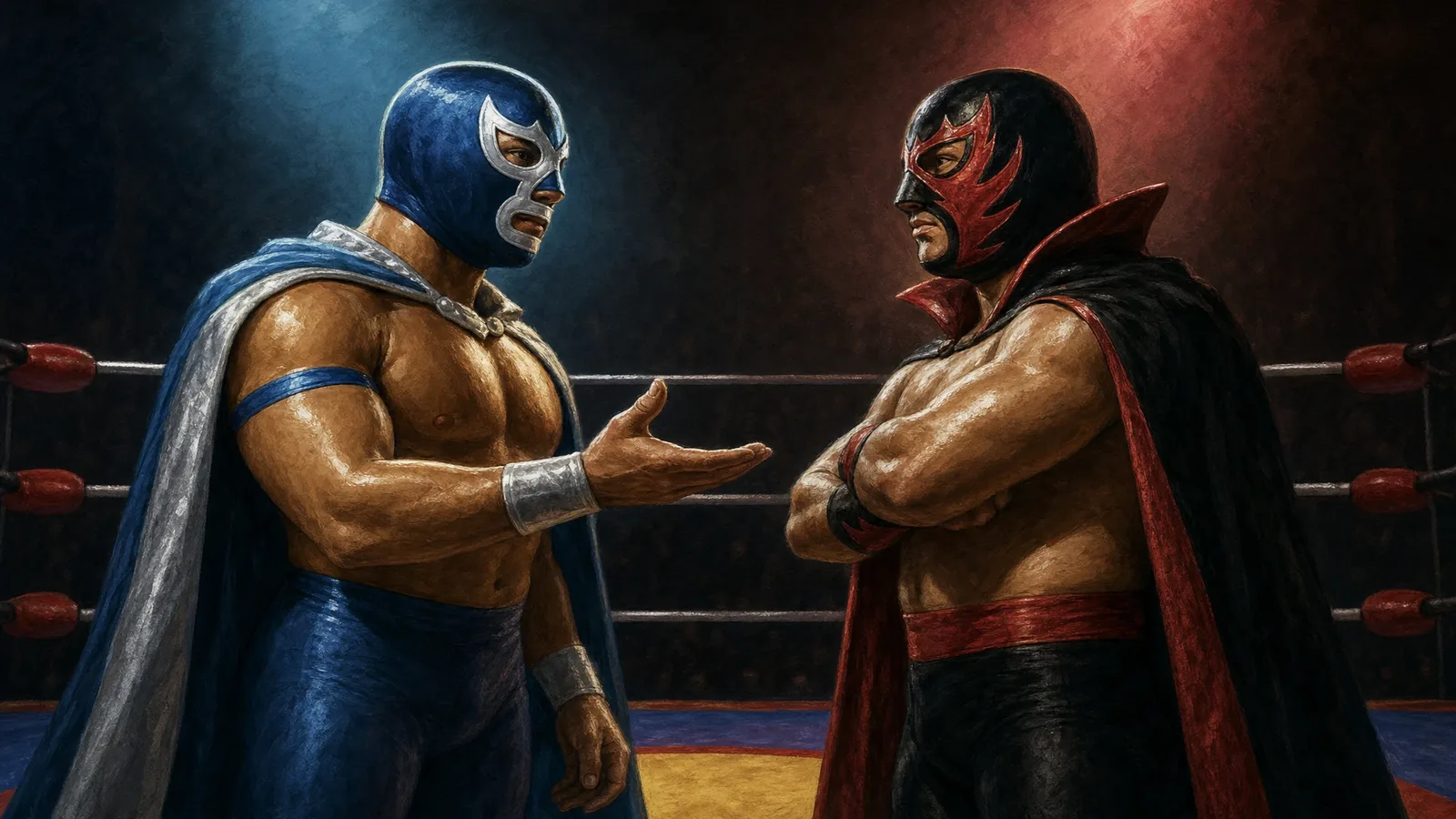
Rudo and técnico are useful labels for reading character roles in CMLL, but CMLL’s official presentation gives them a wider symbolic setting than a simple list of wrestling archetypes. Its Arena México mural places rudos versus técnicos among several dualities: day and night, good and evil, victory and defeat, and life and death. That arrangement makes the opposition legible as part of lucha libre’s dramatic vocabulary. For a viewer, the key starting point is that the labels describe sides within a presentation, not a complete explanation of every wrestler, match, partnership or audience response.
English-language fans can use heel and face as a loose point of comparison. Each pairing helps identify an opposition between character sides, and that shorthand can make a CMLL card easier to approach. Still, CMLL’s mural situates rudo and técnico in Mexican lucha libre symbolism rather than offering them as direct translations. Treating the words as identical can erase that setting. A more careful reading uses the comparison to orient oneself, then returns to the specific CMLL labels, imagery, wrestler presentation and crowd reaction visible in the material at hand.
The source behind this framing also has clear limits. The mural, titled A dos de tres caídas sin límite de tiempo and credited by CMLL to Miguel Valverde, was made for the 80th anniversary of lucha libre in Mexico, dated 2013 and installed at Arena México. It is a cultural and historical presentation, not a current rulebook. It can therefore help a fan understand how CMLL presents the duality and its traditions, but it should not be used to impose a rigid rule on every later performer or bout.
See alignment as one signal among many
CMLL’s mural presents masks and hair as foundational elements of lucha libre. It also connects lucha libre with Mexican folklore, cinema, science fiction, masks and imagined heroes. These are important reminders that character alignment is one prominent element within a larger visual and dramatic world. When watching, a fan can ask what signals are in play beyond the stated side: is the presentation emphasizing a mask, a hair stake, a larger symbolic image or an imagined-hero quality? The answer need not be “rudo” or “técnico” alone.
The same presentation describes three falls within its wrestling representation and names both mat-based lucha and aerial lucha. It also identifies an evolution toward aerial wrestling from the 1990s. Together, those details keep style and alignment distinct: the historical presentation does not make a wrestler’s side a substitute for how a match is worked. A viewer should resist reading a mat sequence, an aerial exchange or a three-fall structure as automatic proof of character alignment. Those are separate features that can be noticed alongside the designated side.
CMLL also describes a bond between wrestlers and the respetable público, its respectful name for the audience, and connects the public with catharsis and expressions. This makes the crowd more than background noise in the promotion’s historical imagery. Yet audience participation should be read as response in a particular moment, not as a mechanical confirmation that every fan holds the same view. Listen for the response, but keep the stated alignment, the match circumstances and the individual performer’s presentation in view at the same time.
Use the roster designation before guessing
A practical CMLL-specific method begins with the promotion’s own roster language when it is available. El Terrible’s CMLL profile labels him “Luchador/Rudo” and lists his bando as rudo. The use of bando gives fans a direct term for a wrestler’s side or alignment. Rather than inferring that side from a costume, a sequence in the ring or a loud reaction, the profile supplies an explicit designation. This does not resolve every storytelling question, but it establishes a firmer starting point than assumption.
El Terrible’s profile also separates alignment from a featured technique. It identifies the Volantín as his named hold while listing rudo in the distinct bando field. That layout is a small but useful reading lesson: a rudo designation and a named move are different kinds of information. A fan does not need to turn a hold into evidence of a side, or treat a side as a prediction of every hold. CMLL’s own profile structure allows those details to coexist without collapsing one into the other.
The profile records other elements that likewise should not be mistaken for alignment by themselves. Before the CMLL period described there, El Terrible wrestled masked in Monterrey as El Engendro, and CMLL says he removed the mask upon joining its ranks. The same page credits him with championships and tournament victories. Those facts can help identify stages of a documented career and accomplishments, but they do not replace the page’s explicit bando label. The useful distinction is between a wrestler’s stated side and the many other facts attached to a wrestling identity.
A team need not be alignment-pure
El Terrible provides a concrete warning against assuming that teams must contain only one side. CMLL describes him as adaptable to different styles and cites an alliance with Ángel de Oro and Niebla Roja. On that same profile, El Terrible remains designated a rudo while Ángel de Oro and Niebla Roja are identified as técnicos. The documented alliance is therefore more useful than an abstract rule: it shows that a partnership can cross stated alignment categories. Teaming information deserves its own reading rather than being treated as a permanent rewrite of every member’s listed side.
This distinction also makes older profile details easier to place. CMLL says El Terrible joined the first generation of the Universidad de los Guapos and later formed a trio with Shocker and Máscara Mágica. It records a 2003 cage-related hair-stakes result involving Bestia Salvaje, followed by a partnership with Hijo del Perro Aguayo that left Cien Caras and Máscara Año 2000 without their hair. These are documented associations and stakes results. They offer context for his career record, while the bando field remains the direct evidence for the rudo designation.
For viewers, the practical question is not “does this team prove everyone is the same kind of character?” It is “what does the promotion say about each wrestler’s side, and what does this particular alliance add?” CMLL’s El Terrible profile supports keeping both answers in view. That approach avoids a false choice between roster designation and team history. It also leaves room for a performer’s adaptability, which CMLL specifically attributes to El Terrible, without turning adaptability into a general rule for all rudos or técnicos.
El Satánico shows one rudo persona, not every rudo
Sports Illustrated México describes El Satánico as a long-running model of rudo antagonism: provocative toward técnicos, willing to break rules and designed to draw a strong crowd reaction. That account gives a vivid example of how a rudo persona can function in a particular career. It should be kept at that scale. The article presents the description as El Satánico’s persona and career, not as a technical definition that every rudo must follow across every era or promotion. An example can sharpen a category without exhausting it.
El Satánico’s own description of his approach adds another boundary. He characterized his wrestling as rough and violent, contrasting it with elegant technical wrestling and contemporary acrobatic spectacle. This tells fans something meaningful about his presentation and the contrast he drew. It does not establish that roughness belongs to every rudo, that elegance belongs only to técnicos or that acrobatics reveal a wrestler’s alignment. CMLL’s broader historical presentation already separates mat-based and aerial lucha from the rudo/técnico duality, making that caution especially important.
Not every character signal is a move. Sports Illustrated México recounts that El Satánico repeatedly raised an index finger while claiming to be number one, and that the gesture intensified reactions. For viewers, it is a useful example of how a small recurring action can help establish a persona. The interpretive lesson is narrow: watch for repeated signals that frame an individual performer’s role. Do not assume that one gesture carries the same meaning for every wrestler, or that it creates a universal checklist for rudo behavior.
Read crowd response as active but changeable
In the account of El Satánico, fans complaining, becoming angry and responding audibly were part of the desired reaction to his antagonist presentation. He also said that attention, including hostile attention, helped the show, the performer and fellow wrestlers. Those comments make crowd response central to this specific account of rudo work. They do not mean that one volume level supplies a complete reading of a match. The more grounded question is what a particular response is doing within the presentation: reacting to a recurring signal, a provocation, a rivalry or another moment in the spectacle.
Crowd feeling can change over time. Sports Illustrated México says that after years of boos and insults, the audience supported El Satánico’s farewell. The same account links the ability to make a large arena react or split with the gift of being a rudo, while stopping short of claiming that every crowd reacts alike. Taken together, these details caution against treating cheers as a final verdict that erases a stated role, or boos as the only possible response to one. A crowd response is meaningful, but it is also situated and changeable.
Do not force every match into a moral binary
The El Satánico account explicitly notes an era with rudo-versus-rudo matches as well as técnicos who fought intensely. That is direct reason not to flatten every CMLL bout into an uncomplicated good-side-versus-bad-side formula. It also recalls memorable rivals including Sangre Chicana, El Dandy, La Fiera and Último Guerrero, without requiring an assumption that each rivalry had the same alignment pattern. When reading a match, begin with the named sides, then ask what the pairing actually is and how the performers are behaving in that documented setting.
A final distinction concerns rivalry itself. Sports Illustrated México recounts that El Satánico later described intense rivalry as part of the spectacle and differentiated it from work outside the ring. Fans can therefore discuss character conflict as presentation without inventing claims about personal hostility beyond it. The most reliable viewing habit is to combine CMLL’s stated bando, the individual character signals on display, the particular team or opponent arrangement and the audience’s response. Rudo and técnico remain valuable guides when they are treated as guides rather than total explanations.
Explore more
- CMLL
- How CMLL Apuesta Stakes Take Shape Before the Deciding Match
- CMLL Officials Reportedly Surprised by Split Crowd Response to Místico vs. Averno

Darryl Polo
Darryl Polo is a passionate wrestling fan covering WWE, AEW, TNA and beyond. He loves great rivalries, breakout stars and the moments that keep fans talking long after the bell. How we work.