
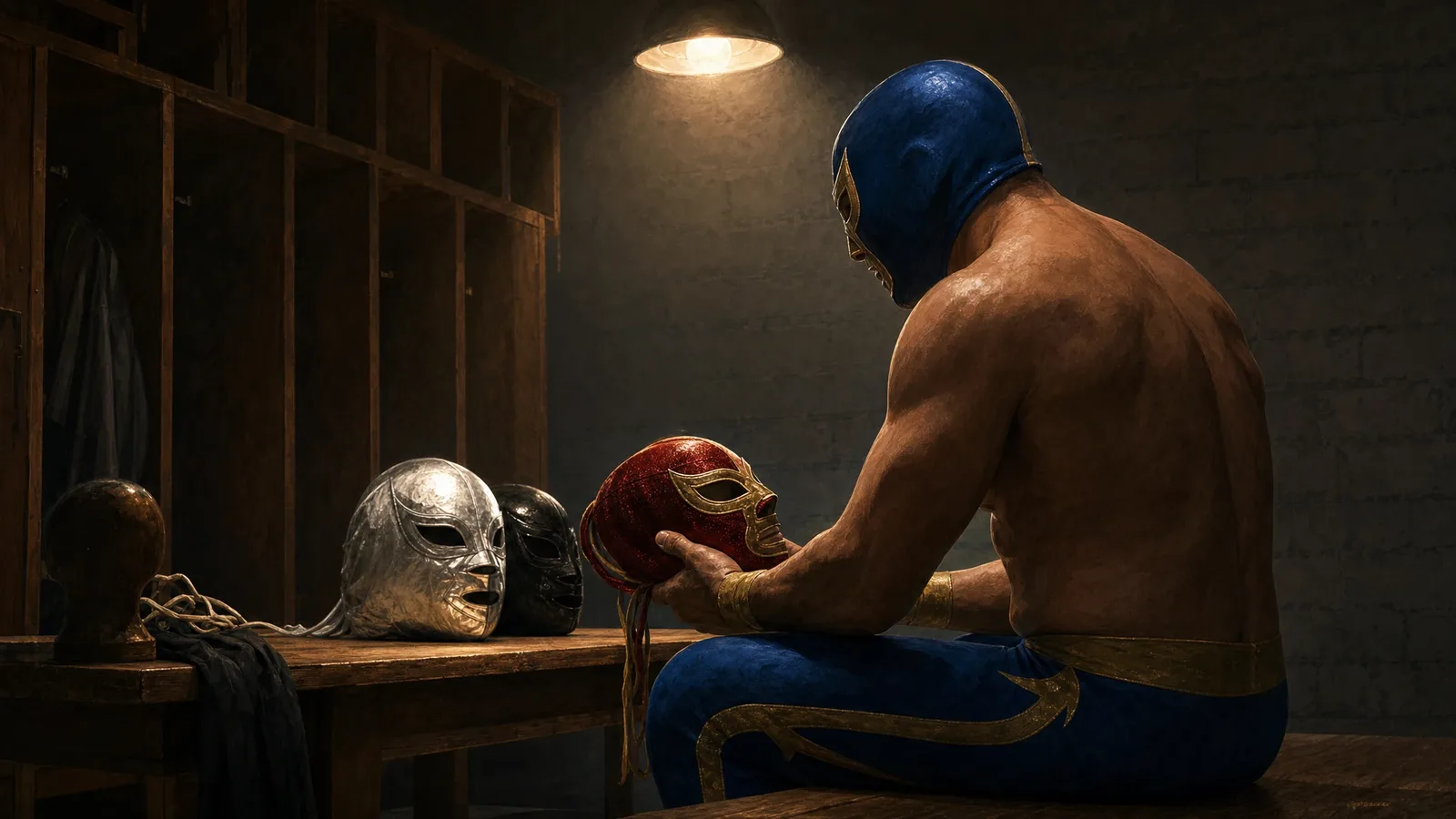
Start with the stake, not a broad label
An apuesta is best read first as a declared wager within a match, rather than as a synonym for any high-pressure bout. Slam Wrestling describes it generally as a bet match in which the loser commonly risks a mask or hair. CMLL’s Homenaje a Dos Leyendas history supplies the useful practical detail: the wagers recorded there include hair versus hair, mask versus mask and mask versus hair. Those labels tell a viewer what each side has placed at risk. They also prevent a familiar shorthand such as “mask match” from erasing an opponent’s different stake or the exact terms documented for the contest.
The visible result depends on that stated stake. In the examples summarized by Slam Wrestling, the masked loser is unmasked, while the wrestler who loses a hair wager has their head shaved. That is why a mask should not be treated in coverage as an interchangeable entrance accessory or a generic costume detail once it has been named as the wager. The match description identifies it as the losing side’s recorded consequence. Hair carries its own stated consequence, so calling all apuestas the same without naming the stake leaves out the central information a viewer needs to follow the finish.
Read Homenaje a Dos Leyendas as a format record
CMLL describes Homenaje a Dos Leyendas as its second-most-important annual event. It is held in March to commemorate Salvador Lutteroth González’s birthday while honoring another wrestling legend, and CMLL says it gathers wrestlers who have performed best in the preceding months. Its event history also says the card normally includes one or two apuestas involving masks or hair. That background makes the series a particularly clear record for studying how labels work, but it does not turn every entry into the same type of wager or establish one fixed route to a conclusion.
A useful viewing habit is to separate a listed stake from the size of the field. CMLL’s history contains singles results, but also records team wagers. The 1999 Homenaje record, for example, lists Negro Casas and El Hijo del Santo defeating Scorpio Jr. and Bestia Salvaje in a mask-and-hair versus mask-and-hair wager. The important reading point is not simply that masks and hair appeared on the line. Four wrestlers were arranged into sides whose combined stakes were explicitly described. A headline that reduces such a result to an ordinary singles mask or hair match would change the documented format.
Identical stakes and mixed stakes are different propositions
Mask versus mask and hair versus hair give both sides matching terms, but CMLL’s record shows that symmetry is not required. CMLL records Atlantis defeating Villano III in a mask-versus-mask wager at the 2000 Homenaje event. Its 2001 entry instead lists mask versus hair, making the contrast visible in consecutive historical examples. The latter wording means the two competitors were not risking the same thing. For viewers, the simple question before the bell is therefore: does each wrestler face the same consequence, or does the advertised wording set masks against hair? The answer belongs in any accurate description of the deciding match.
The same care applies when two-person sides are involved. CMLL’s 2013 history lists Stuka Jr. and Rey Cometa against Namajague and Okumura in a mask-and-hair versus mask-and-hair wager. Its 2019 record lists Ángel de Oro and Niebla Roja defeating El Terrible and La Bestia del Ring in a hair-versus-hair team match. These are not interchangeable formulations: one combines mask and hair stakes on each team, while the other places hair at stake across the teams. Naming both the participants’ arrangement and the exact wager preserves what CMLL’s result table actually distinguishes.
A deciding contest may be reached through a larger field
A multi-person structure needs its own name in a recap. CMLL labels its 2010 La Sombra versus El Felino entry a Cuadrangular de Máscaras and also identifies Místico and Volador Jr. as participants. The record therefore should not be recast as a conventional one-on-one mask match simply because La Sombra and El Felino are prominent in the listing. The format signals that the wager was organized around more than the eventual featured pairing. Before drawing conclusions from a result, viewers can ask who entered the wager field and whether the promotion’s label identifies a four-person structure rather than a direct singles challenge.
CMLL’s 2023 entry offers a parallel hair-stakes example. It calls Volador Jr.’s win over Rocky Romero a Cuadrangular de Cabelleras and names Ángel de Oro and Oráculo as additional participants. The qualifier matters because it defines what fans were watching: not merely a hair-versus-hair meeting detached from the rest of the field, but a format CMLL itself identified as a cuadrangular. Retaining that wording is more informative than treating every final-looking confrontation as if it began as a straightforward one-on-one wager. It keeps the path and the declared stakes visible at the same time.
Follow the route that creates the final
Some CMLL listings use a team-format label alongside the names connected to a stakes program, so the label itself deserves to remain in any recap. The 2022 Homenaje entry is described as Relevos Increíbles con Final Suicida and identifies Marcela and Metálica in that entry. That establishes that the record is not presenting a simple, unqualified singles wager. It is more accurate to retain the full format name and report only the participants and outcome that the result record clearly specifies than to convert every mention within a larger-format listing into a separately established final. The format and the result should be read as distinct pieces of information.
The 2025 Homenaje history makes a route to a deciding contest more explicit. CMLL lists a Relevos Increíbles con Final Suicida in which Zandokan Jr. defeated Star Jr., with Esfinge and El Valiente also involved in the route to the deciding contest. For a fan watching an apuesta program, this supplies a practical checklist: identify the initial group, identify the named format, and then identify the wrestlers who reached the deciding match. That sequence describes the documented arrangement without inventing motivations for the pairings or assuming every multi-person contest works under identical terms.
CMLL’s 2026 report places two distinct routes on one card, making format-specific reading especially valuable. Its Octagonal Infernal was a field of seven masks and one head of hair at stake, while a Triangular de Amazonas sent Marcela and Princesa Sugehit to a final hair-versus-hair contest after La Magnífica won the triangular. The two structures share the broad apuesta label but are plainly different on the page: one is an uneven eight-person mask-and-hair field, and the other uses a triangular result to establish a two-wrestler hair final. The advertised path is part of the stakes story.
Report outcomes without overstating what they prove
A historical listing can confirm that an apuesta was completed, but an announced wager and a completed result are not automatically the same thing. CMLL’s 2020 Homenaje entry says its listed apuesta was postponed because of the COVID-19 pandemic. Its table thereby distinguishes disruption from a finished contest with a winner and a stated consequence. CMLL also records Bárbaro Cavernario defeating El Felino in a hair-versus-hair match on September 17, 2021, rather than in the event’s usual March slot. Together, those entries encourage precise wording: say whether a wager was postponed, moved, or completed, rather than letting an original announcement stand in for an outcome.
Once a deciding match has happened, report the result at the level the source establishes. CMLL says Max Star defeated Pólvora in the mask-stakes outcome of the 2026 Octagonal Infernal. In the same report, CMLL says Marcela won the final hair-versus-hair match against Princesa Sugehit, leaving Princesa Sugehit without her hair. Those are concrete match consequences tied to named stakes. They do not require a writer to publish the defeated masked wrestler’s private identity, and they do not establish that every mask or hair loss carries the same longer-term meaning beyond the match record.
Rivalries can develop in more than one match type
The Slam Wrestling account of Negro Casas and El Hijo del Santo provides a documented example of a rivalry appearing across ensemble matches before a major singles confrontation. It says the two frequently opposed one another in tag matches and six-man trios. The same account reports that Casas defeated El Hijo del Santo in two straight falls on June 27, 1987, including damage to Santo’s mask, before a rematch at Los Angeles’s Olympic Auditorium on July 18. This sequence is useful as an example of how a fan can trace recorded encounters without assuming that every rivalry follows this exact progression or produces an identical kind of wager.
Slam reports that El Hijo del Santo defeated Casas in their July 18, 1987 match. It also says they later changed alignment, became a team, won tag titles and defeated Scorpio Jr. and Bestia Salvaje in the March 1999 double mask-and-hair wager. CMLL’s Homenaje history likewise records that 1999 victory. For readers, the lesson is modest but useful: an apuesta-related history can include opponents, partners and team-based stakes at different points. The documented winner and the stated wager are firmer ground than a sweeping claim that an apuesta always settles a relationship in one permanent way.
Questions that keep an apuesta recap precise
Before describing an apuesta, ask four direct questions. What exactly is at risk: mask, hair, or one of each? Is the listed match singles, team-based, or part of a larger field? Does the promotion call it a cuadrangular, a Relevos Increíbles con Final Suicida, a triangular, or another specified structure? Finally, has the source recorded a completed winner, or only an announced contest? These questions are grounded in the range of forms CMLL documents, from mixed team wagers to multi-person formats and postponed entries. They help a recap remain descriptive instead of forcing unlike contests into one template.
After the outcome, a second set of questions keeps the aftermath proportionate. Which wrestler won? What was the recorded mask or hair consequence? Did the result come directly from the deciding match, or did earlier team or triangular action determine who reached it? CMLL’s 2026 report answers those questions differently for its Octagonal Infernal and its women’s triangular-to-final route. That contrast is the point: personal stakes can be clear while the route to the deciding contest remains structurally complex. Accurate fan education names both elements and avoids treating the broad word apuesta as sufficient explanation by itself.
The strongest account of a CMLL apuesta is therefore specific rather than inflated. State the named stake, retain the format label, identify the participants who actually entered the relevant field, and distinguish a qualifier from its final. Then report the recorded result and visible consequence without adding a universal theory about what it must mean afterward. CMLL’s Homenaje history spans mask, hair, mixed-stake, team and multi-person arrangements; Slam Wrestling’s general explanation supplies the basic wager concept and visible consequences. Together, those records support close reading of each contest on its own documented terms.
Explore more

Darryl Polo
Darryl Polo is a passionate wrestling fan covering WWE, AEW, TNA and beyond. He loves great rivalries, breakout stars and the moments that keep fans talking long after the bell. How we work.