
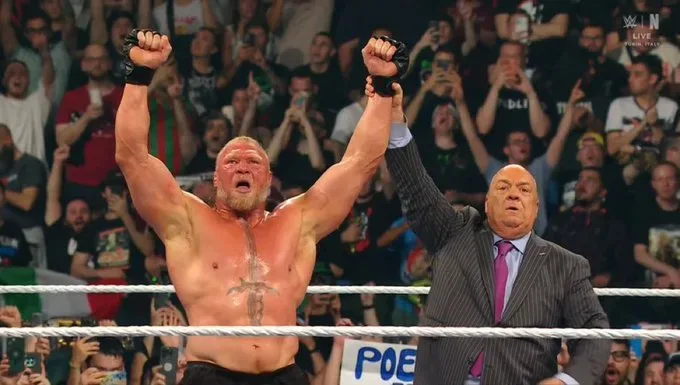
Paul Heyman has offered an emphatic assessment of Brock Lesnar’s mixed martial arts career, arguing that the former UFC Heavyweight Champion would have remained unbeaten had diverticulitis not derailed a significant portion of his time in the sport.
Lesnar’s UFC run remains one of the most unusual and consequential second acts in combat-sports history. After leaving WWE in 2004, Lesnar briefly pursued the NFL before moving into MMA. He entered UFC with immense mainstream recognition but very limited professional fighting experience, then rapidly developed into one of the organization’s biggest attractions and its heavyweight champion.
In a conversation with Graham Bensinger, Heyman reflected on Lesnar’s rare combination of physical gifts, commercial appeal and competitive drive. While acknowledging the immediate impact Lesnar made after switching from professional wrestling to a legitimate combat sport, Heyman placed the greatest emphasis on the illness that affected the latter stages of Lesnar’s championship tenure.
View the referenced post on Instagram
“It’s one of those things, it’s just magic. It’s lightning in a bottle,” Heyman said. “He is the greatest athlete on the face of the planet and the only reason why he doesn’t get the credit he deserves is number one, there is a preconceived notion of what a professional wrestler is. Number two, because diverticulitis robbed him of so much more great athletic accomplishment.”
For more background on this topic, read Kayla Becker Says Paul Heyman ‘Paved The Way’ for Wrestling Microphone Holders.
Heyman then made his central claim without qualification, saying Lesnar’s UFC defeats would not have happened if his health had not been compromised.
“If he didn’t have diverticulitis, he would’ve never been defeated in UFC. Never. He’d still be champion today at 49. There’s nobody on this planet that could hang with him, no one. No one would get out of the first round with him, there’s no way.”
Lesnar’s Fast Rise to UFC Gold
Lesnar arrived in UFC carrying the expectations and skepticism that come with crossing over from WWE. His amateur wrestling credentials were unquestioned, including an NCAA Division I heavyweight championship at the University of Minnesota, but MMA presented a very different challenge. A loss to Frank Mir in his UFC debut at UFC 81 in February 2008 immediately showed the gaps that could exist between elite wrestling and the broader demands of professional fighting.
What followed was a remarkably quick adjustment. Lesnar rebounded with wins over Heath Herring and Randy Couture, defeating Couture in November 2008 to capture the UFC Heavyweight Championship in just his fourth professional bout. He then defeated Mir in their rematch at UFC 100 in July 2009, a result that gave Lesnar a measure of revenge for his lone early defeat and further solidified his status as the central attraction of UFC’s heavyweight division.
Lesnar next stopped Shane Carwin at UFC 116 in July 2010. The fight was particularly notable because Lesnar survived a punishing first round before rallying to submit Carwin in the second. It was a performance that underscored both his toughness and his ability to adapt under extreme pressure. By that stage, Lesnar had held the championship for nearly two years and had become one of the most recognizable names in the entire sport.
His reign ended in October 2010, when Cain Velasquez defeated him for the title. Lesnar returned once more against Alistair Overeem in December 2011, losing by TKO before announcing his retirement from MMA. The final record does not reflect an unbeaten career, but Heyman’s argument is that the medical adversity surrounding Lesnar’s later UFC fights fundamentally changed what he was capable of accomplishing.
The Impact of Diverticulitis
Diverticulitis is an inflammatory digestive condition, and Lesnar’s battle with it was serious enough to interrupt his career. His illness became a major point of discussion during his UFC championship run, not merely because it forced him away from competition, but because it raised concerns about whether he would be able to continue fighting at all.
Lesnar returned to action after the condition had already affected his preparation and career momentum. That context has long shaped discussion around the defeats to Velasquez and Overeem, particularly among those close to Lesnar who believe fans never saw the fighter at full strength again after his health issues emerged.
Heyman’s comments represent the strongest possible version of that viewpoint. Rather than suggesting diverticulitis shortened Lesnar’s title reign or reduced his opportunities, he maintained that it was the deciding factor separating Lesnar from an undefeated legacy. It is an opinion rooted in Heyman’s longtime association with Lesnar and in his belief that Lesnar possessed a level of athleticism few competitors could match.
That belief has been a constant throughout their association. Heyman has served as Lesnar’s on-screen advocate during multiple WWE runs, helping present him as an extraordinary attraction who stood apart from conventional sports-entertainment performers. The pairing worked because it drew from truths about Lesnar’s background: a champion amateur wrestler, a former NFL hopeful, a UFC heavyweight champion and a WWE headliner with uncommon physical presence.
Heyman Revisits Lesnar’s NFL Attempt
Heyman also discussed another frequently cited example of Lesnar’s athletic ability: his effort to make the Minnesota Vikings after leaving WWE. Lesnar participated in the Vikings’ training camp in 2004 despite having been away from football for years. His pursuit did not lead to an NFL roster spot, but it became an enduring part of the narrative around the breadth of his physical talent.
According to Heyman, Minnesota was cautious about publicizing Lesnar’s testing numbers because of concern over how they would be received given his WWE background.
“He went out for the Minnesota Vikings training camp, they were reluctant to release to the media his combine numbers because he came out of WWE,” Heyman said. “The Minnesota Vikings were concerned that the media would think this is a WWE stunt with these numbers, because whether it was the 40 yard dash or the 100 yard dash or the quarter mile or the standing jump or whatever it was, his combine numbers were of Olympic qualifying time.”
Heyman added that Lesnar entered that camp while dealing with the consequences of a serious motorcycle accident. He said Lesnar had flipped his motorcycle at high speed in Minnesota approximately six weeks before camp, suffering a fractured pelvis, torn groin, extensive damage to his lower body and a broken jaw that required wiring.
“He showed up at training camp recovering from a fractured pelvis, a torn groin, and everything else,” Heyman said. “He was beyond black and purple from the stomach down to the knees.”
The account fits the broader case Heyman was making: that Lesnar repeatedly pursued elite-level challenges in different fields while overcoming circumstances that would have stopped many athletes before they could even compete. The NFL attempt did not culminate in a professional football career, just as the UFC run did not end with an undefeated record, but both experiences remain significant when measuring the range of Lesnar’s accomplishments.
A Career Defined by Exceptional Expectations
Lesnar’s career has always invited counterfactual questions because his path has been so unconventional. He entered WWE and became a top star at a young age, walked away to chase football, became UFC heavyweight champion with remarkable speed, returned to WWE as an even larger attraction, and remained one of the most protected and imposing figures in the industry for years.
Heyman’s comments do not change the official results of Lesnar’s UFC career. Velasquez and Overeem remain the men who defeated Lesnar in his final two Octagon appearances, while Mir owns the first victory over him. But the remarks reinforce the lasting debate about how much Lesnar’s illness altered the trajectory of a fighter who had already captured the division’s top prize after only a handful of bouts.
Lesnar retired from in-ring competition at WWE SummerSlam in August, where he lost to Oba Femi in his final match. That development adds a sense of closure to a career spanning multiple generations and several sports, even as Heyman’s reflections make clear that the questions around Lesnar’s athletic potential are unlikely to disappear.
For Heyman, the conclusion is simple: Lesnar was not merely a successful crossover athlete, but a uniquely gifted competitor whose greatest achievements were limited by circumstances beyond the cage. Whether that assessment is accepted as fact or viewed as the passionate defense of a longtime ally, it speaks to the enormous standard Lesnar set whenever he entered a new arena.

Darryl Polo
Darryl Polo is a passionate wrestling fan covering WWE, AEW, TNA and beyond. He loves great rivalries, breakout stars and the moments that keep fans talking long after the bell. How we work.