
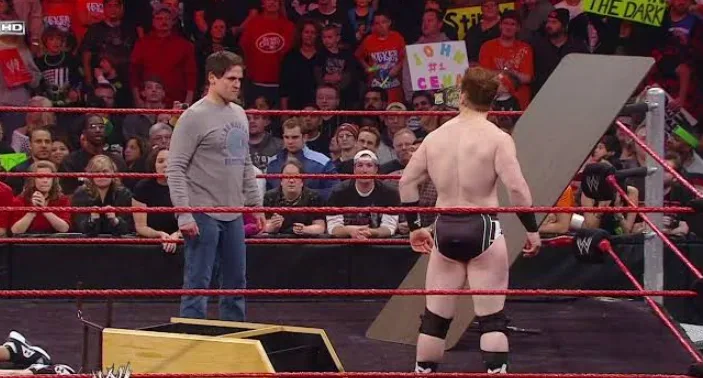
Mark Cuban’s WWE guest appearances may have been built around celebrity spectacle, but he says the physical consequences were very real.
Speaking on Build Or Break, Cuban reflected on his involvement with WWE in 2003 and 2009. He said he enjoyed both experiences and entered them with two non-negotiable requests: he wanted to take a move, and he wanted the chance to dish one out as well. The second appearance, which included John Cena and then-rising WWE star Sheamus, left a particularly lasting impression.
Cuban recalled that Sheamus drove him through an actual table during the 2009 Raw segment. While the planned spot went as intended, Cuban said the aftermath was severe enough that he dealt with back pain and soreness for roughly two weeks.
“It was a real table,” Cuban said. “They told me, ‘He’s gonna put you right in the center of the table, it’ll just crack in half. Keep your head down because if your head is up when you hit, you’ll break your neck.’”
For more background on this topic, read Jimmy House Credits Gabe Sapolsky With Helping Him Earn WWE Tryout Opportunity.
Cuban said he had no hesitation about protecting himself once he heard those instructions. The landing broke the table, and he stayed down to sell the damage for the cameras. Once the segment was over, though, he found out just how demanding a seemingly brief wrestling moment could be.
“I did my whole pretend I’m dead thing and I was sore for two weeks,” Cuban said. “My back hurt so bad. Those guys deserve so much respect. It may be orchestrated, but it’s still athletic and it’s still painful.”
Cuban’s rules for appearing in WWE
Cuban’s WWE history began at Survivor Series in November 2003, shortly after he had purchased the Dallas Mavericks. WWE contacted him when the company was coming to Dallas and asked whether he was interested in making a celebrity cameo. Cuban was interested, but he did not want to simply stand at ringside or participate in a purely verbal segment.
He explained that he gave WWE two rules for his involvement.
“One, I get hit. Two, I get to hit somebody,” Cuban said.
That first appearance fulfilled the first half of the request in memorable fashion. Cuban took an RKO from Randy Orton, a move that requires cooperation, timing, and trust even in a carefully rehearsed setting. Cuban said WWE personnel had him practice the sequence beforehand, but the preparation did not remove the impact of taking the bump.
“We had to practice it and do this stuff, it was still hard,” Cuban said. “It still hurt.”
The point is notable because celebrity involvement in wrestling can often be discussed only in terms of surprise value or mainstream attention. Cuban’s account instead stresses the practical side of the performance. Even when the action is mapped out, a person is still falling, landing, absorbing force and following precise safety instructions in front of a live crowd and television audience.
Professional wrestlers train for those demands over years. They learn how to fall, how to protect their heads and necks, how to position themselves for their opponents, and how to maintain character while working through the physical effects of a move. Cuban’s recollection does not suggest his appearances were equivalent to the day-to-day demands placed on full-time WWE talent. Rather, it illustrates why a single major spot can quickly give an outsider a greater appreciation for the profession.
The 2009 Raw segment with John Cena and Sheamus
Cuban returned to WWE in 2009 for a segment involving John Cena. The appearance also gave Sheamus an opportunity to work with a high-profile celebrity early in his WWE run. Cuban remembered being told that Sheamus had never hit the canvas in that particular setup and that the planned sequence would allow Cuban to put him down before the table bump shifted momentum back in Sheamus’ favor.
That arrangement directly matched Cuban’s requirements. He would get a moment of offense, and he would also take the major physical payoff. The result was a table break that looked dramatic on television and proved more punishing than Cuban anticipated.
Table spots are among the most familiar visuals in modern pro wrestling, but Cuban’s recollection is a useful reminder that the props are not harmless. A table is designed to break under the right amount of force and in the right location, but it still has to be struck. The difference between a successful planned break and a dangerous landing can come down to positioning, timing, and body control.
Cuban specifically recalled the instruction to keep his head down. That detail underlines the level of care involved in even a short celebrity angle. Wrestlers and producers can plan the broad outcome, but the person taking the move must still execute the safety measures at the exact moment the impact happens. Cuban said he understood the stakes immediately.
“I’m like, ‘My head will be down,’” Cuban said.
He also made clear that the soreness was not limited to the immediate aftermath in the ring. The back pain continued long after the cameras moved on, lasting approximately two weeks. For Cuban, that experience reinforced that the controlled nature of wrestling does not make it painless or easy.
Respect for the performers
Cuban’s strongest takeaway from both WWE appearances was respect for the athletes who perform week after week. His comments draw an important distinction that longtime wrestling fans often make: matches and segments are planned, but the physical exertion and impact are genuine.
Wrestling’s presentation depends on performers making difficult actions appear as spontaneous as possible. That includes strikes, throws, falls, dives, ring movement, and weapon or furniture spots. Planning helps minimize risk, but it does not erase it. The performers must repeatedly execute demanding physical sequences while communicating with one another, responding to crowd reactions, and maintaining the pace of a televised program.
For Cuban, taking an RKO and later going through a table offered a limited but memorable firsthand perspective. He was not merely brought in for a quick cameo; he wanted to be physically involved, and WWE gave him opportunities that carried real impact.
His comments also reflect why celebrity appearances can work when the guest is willing to meet the environment on its own terms. Cuban did not describe wanting a protected role in which he would be separated from the action. He wanted to contribute to the physical story being told, even if that meant taking a move from Orton or enduring a table bump from Sheamus.
In 2025, Sheamus stated that he did not know who Cuban was before their 2009 Raw segment. Cuban’s new comments add the other side of that unusual pairing: a major sports and business figure who was eager to participate, took the safety directions seriously, and came away with a much deeper appreciation for the punishment wrestlers absorb.
A celebrity moment that still resonates
Cuban’s two WWE appearances came years apart, yet both remain tied to prominent names from their respective periods. The 2003 Survivor Series moment put him in the path of Randy Orton’s RKO. The 2009 Raw angle brought him into a scene with Cena and Sheamus, ending with Cuban being put through a table.
For WWE, moments like those can create a memorable collision between sports, entertainment, and celebrity. For Cuban, they created stories that still stand out decades later—not simply because he got to share a ring with famous wrestlers, but because he experienced a small portion of what the work feels like.
His assessment was straightforward: professional wrestling may be structured and choreographed, but the athleticism is real, the technique matters, and the pain does not disappear once the show ends. After two weeks of soreness from the Sheamus table spot, Cuban had little doubt about that.

Darryl Polo
Darryl Polo is a passionate wrestling fan covering WWE, AEW, TNA and beyond. He loves great rivalries, breakout stars and the moments that keep fans talking long after the bell. How we work.