
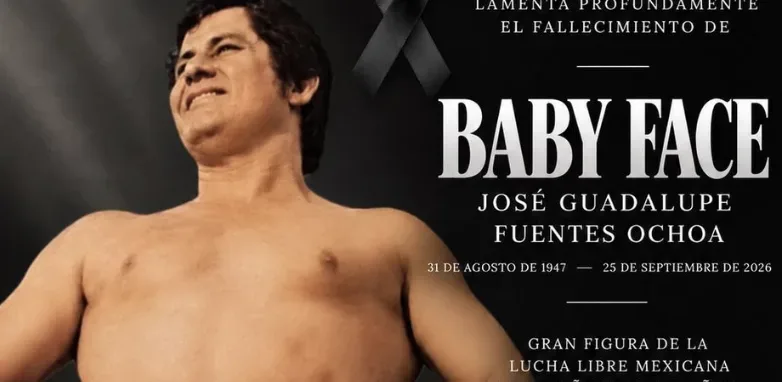
José Guadalupe Fuentes Ochoa, the veteran Mexican wrestler widely known as Babe Face, has died at the age of 79. His passing was announced on September 25, 2026. Born on August 31, 1947, Fuentes Ochoa spent decades as part of the lucha libre landscape, building a career that started in 1970 and took him through major promotions in Mexico and Japan.
Although his ring name suggested a classic fan favorite, Babe Face was known for working largely as a rudo, embracing the confrontational side of lucha libre that calls for a wrestler to antagonize the crowd and stand opposite the heroes of the ring. That contrast between name and presentation gave the veteran a distinct identity over the course of his long tenure in professional wrestling.
El Hijo del Santo paid tribute to Fuentes Ochoa in a message mourning the loss of a respected peer and Mexican wrestling figure.
View the referenced post on X
“I deeply regret the passing of my dear ‘Baby Face’ José Guadalupe Fuentes Ochoa. August 31, 1947 — September 25, 2026. Great figure of Mexican Wrestling and beloved professional companion. Rest in peace. Our deepest condolences to his family, friends and to the entire Wrestling family.”
For more background on this topic, read Kevin Knight to Lead NJPW Academy Seminars in October.
A Career That Began In 1970
Babe Face entered the wrestling business in 1970, beginning a journey that would span multiple eras of Mexican lucha libre. His career placed him among performers who worked in an industry defined by its deeply rooted local traditions, its passionate crowds, and the ongoing importance of established titles as markers of standing within the sport.
The period in which Babe Face debuted was a significant one for Mexican wrestling. Lucha libre had already developed its own identity through masks, colorful ring personas, fast-paced exchanges, and a clear cultural distinction between the técnicos and rudos. A wrestler’s ability to draw a reaction—whether cheers or boos—was fundamental. Babe Face’s work as a rudo meant that he was asked to help create the emotional conflict that made those matches matter to the audience.
His name may have carried the language of a clean-cut hero, but the role he occupied in the ring was often the opposite. Rudos are central to the rhythm of lucha libre cards. They can use attitude, rule-breaking tactics, intimidation, and crowd provocation to establish the stakes before the técnicos mount their response. In that environment, an effective villain is not merely an opponent; he is an essential part of the story being told between the ropes.
Over time, Babe Face worked for organizations including CMLL, AAA, and NJPW. Appearing under the banners of those promotions reflects a career that extended beyond one setting and one generation of fans. CMLL remains one of the foundational institutions of Mexican wrestling, while AAA became another major force in the country. His work with New Japan Pro-Wrestling also connected his career to Japan, a market with its own influential wrestling history and a long relationship with Mexican talent.
Mexican National Light Heavyweight Championship Reign
The most notable championship accomplishment of Babe Face’s career came in 1981, when he won the Mexican National Light Heavyweight Championship. He held the title for 570 days, a substantial reign that stands as a defining achievement in his professional record.
Championship reigns offer a clear measure of the faith placed in a wrestler at a particular point in time. Holding a nationally recognized championship for more than a year and a half establishes Babe Face as a meaningful presence in the light heavyweight division during that period. The 570-day run remains one of the clearest indicators of his place within Mexican wrestling history.
In lucha libre, weight-class championships carry particular importance. They help define the competitors associated with a division while giving promoters a championship around which to build rivalries, defenses, and major cards. A long title run requires consistency, availability, and the ability to remain credible as a champion against a changing group of challengers. Babe Face’s reign in 1981 and beyond ensured that his name would remain connected to the lineage of the Mexican National Light Heavyweight Championship.
That achievement also speaks to the durability of a performer who had only been wrestling for roughly a decade when he captured the title. Rather than being remembered solely for a single tour or a brief stretch in one promotion, Babe Face’s record includes a championship tenure that lasted 570 days and a career that continued across different companies.
Remembering A Lucha Libre Figure
The death of Babe Face is a loss for the community of wrestlers, families, promoters, and fans who share in the history of Mexican lucha libre. For wrestlers of his generation, the profession demanded a constant commitment to travel, conditioning, performance, and the preservation of a persona capable of connecting with live audiences. Those contributions can stretch well beyond the most easily available records of wins and title changes.
Veterans such as Fuentes Ochoa helped carry wrestling from card to card and city to city, creating the depth that allows a promotion’s stars and championships to thrive. A rudo’s responsibility in particular is often rooted in making the conflict feel urgent. The boos, arguments with fans, and willingness to play the antagonist are not secondary details; they are part of the foundation on which lucha libre’s enduring técnico-versus-rudo dynamic is built.
Babe Face’s career also crossed promotions that represent different chapters and styles within professional wrestling. CMLL and AAA are among Mexico’s most recognizable wrestling organizations, while NJPW is one of the leading names in Japanese professional wrestling. Working across those environments underscores the broad reach of his time in the industry without changing the central legacy of his career: he was a Mexican wrestler whose identity was forged in lucha libre.
His passing has prompted condolences for those closest to him, as well as recognition of his professional legacy. The message from El Hijo del Santo described Babe Face as both a “great figure of Mexican Wrestling” and a “beloved professional companion,” words that capture the dual impact of a longtime wrestler. The public sees the character and the matches; fellow workers also remember the person they shared locker rooms, travel, and the demands of the profession with.
Legacy Of José Guadalupe Fuentes Ochoa
José Guadalupe Fuentes Ochoa will be remembered under the Babe Face name, as a largely rudo performer, as a former Mexican National Light Heavyweight Champion, and as a veteran whose career began in 1970. His 570-day championship reign remains a lasting part of his legacy, while his work for CMLL, AAA, NJPW, and other stops illustrates the length and range of his time in wrestling.
Professional wrestling is built on names that remain alive through championship histories, the memories of audiences, and the respect of fellow performers. Babe Face’s name now takes its place among the veteran figures whose contributions helped shape the long-running story of lucha libre. His career covered decades of change, but the essentials of his role stayed clear: he was a wrestler who performed before demanding crowds, embraced the rudo side of the sport, and earned a place in Mexican wrestling history.
Condolences go out to the family, friends, colleagues, and fans of José Guadalupe Fuentes Ochoa during this difficult time.

Darryl Polo
Darryl Polo is a passionate wrestling fan covering WWE, AEW, TNA and beyond. He loves great rivalries, breakout stars and the moments that keep fans talking long after the bell. How we work.