
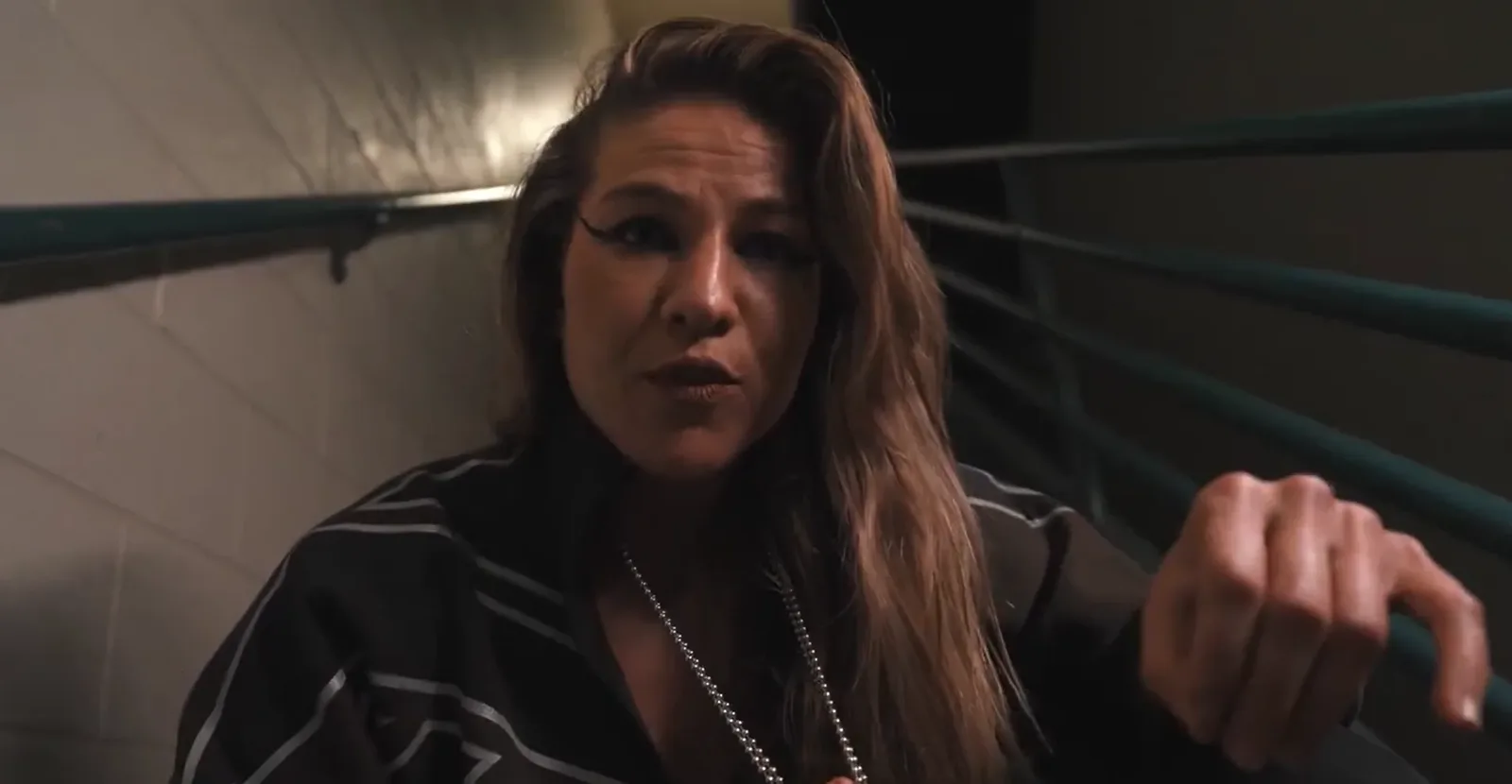
Marina Shafir has made it clear that she does not view herself as a supporting character in the Death Riders.
Heading into her AEW Full Gear match with Mercedes Moné, Shafir addressed the language being used around her role in the group. Moné has repeatedly taken aim at Shafir in the build to their encounter, including referring to her as “Jon Moxley’s little bitch.” For Shafir, the broader suggestion that she is merely a sidekick is just as insulting.
Speaking about the Death Riders, Shafir emphatically rejected that framing. She described the group as a collective built on mutual loyalty rather than a hierarchy in which she exists to serve someone else’s agenda.
“I fucking hate the word sidekick. I fucking hate the word sidekick,” Shafir said. “We are teammates. They are my brothers, I am their sister. There is no sidekick mentality here. This isn’t a fucking Batman and Batboy type situation and I feel like whenever someone tries to lessen it, it’s because they see how fucking big it is really is.”
For more background on this topic, read AEW Collision Viewership Rises To 376,000 For November 7 Episode.
That perspective goes directly to the heart of Shafir’s current AEW presentation. Her association with Jon Moxley and the Death Riders has placed her alongside some of the most imposing personalities in the company, but Shafir insists the connection should not be read as evidence that she is subordinate to anybody. In her view, the alliance is rooted in the kind of sibling-like trust that is rarely represented in wrestling stables.
Shafir argued that outsiders who attempt to minimize the group are missing the larger point. Rather than measuring its members through conventional ideas of leaders and followers, she sees the Death Riders as a unit with a different internal foundation.
“They don’t see this type of sisterhood and brotherhood in this business,” Shafir said. “This group in itself is so special because whatever assumptions people had about groups in professional wrestling, we have revolutionized that for like future professional wrestling. We have opened the doors to so many new possibilities that it’s invigorating.”
Shafir’s comments arrive at an especially important moment, with Full Gear set to feature her clash with Moné. The verbal conflict between the two has given the bout an intensely personal edge. Moné’s dismissive characterization of Shafir has not simply been another insult in a competitive rivalry; it has challenged the way Shafir sees herself, her work and the role she holds beside her Death Riders teammates.
For Shafir, the answer is not to detach herself from the group in order to prove her worth. Instead, she presented her identity as a wrestler and her place among the Death Riders as connected ideas. She believes being a dependable teammate is a statement of strength, not an admission that she lacks independence.
Shafir Sees The Death Riders As A Constant Learning Environment
While discussing why the group matters to her, Shafir also spoke about the creative and personal motivation she finds in being part of it. She described arriving at work with an eagerness to discover what she can improve and what the group can develop together.
“I feel like every week I go to work, I’m just kind of like, ‘What am I going to learn this week, what are we going to try and master?’” Shafir said. “That’s how it is. It’s not a sidekick.”
That mindset is consistent with the blunt intensity that has long shaped Shafir’s public persona. She did not frame success solely around individual acclaim, championship status or the ability to dominate every opponent. Instead, she emphasized discipline, evolution and the value of being reliable when her teammates need her.
It also adds another layer to the Full Gear match. Moné has sought to reduce Shafir to a label, while Shafir is answering with a far wider definition of who she is. She is not trying to deny the importance of her affiliations. She is arguing that a wrestler can be deeply committed to a group and still stand on equal ground with the people around her.
In professional wrestling, factions often produce questions about influence and status. Fans naturally evaluate which member drives a group’s direction, who receives the biggest spotlight and who is positioned as the central figure. Shafir’s remarks do not deny that audiences make those comparisons. Rather, she is pushing back on the idea that such comparisons accurately explain the Death Riders’ dynamic.
Her use of the word “teammates” is central to that argument. It conveys shared responsibility, shared investment and a shared willingness to endure difficult moments. Shafir said she regards the men in the group as brothers and sees herself as their sister, language that underlines the personal bond she believes exists within the unit.
Resilience Is At The Center Of Shafir’s Desired Legacy
Beyond the immediate dispute with Moné, Shafir also discussed what she hopes her career will represent. Her answer was not centered on a single match, rivalry or achievement. She wants to be remembered as someone who could be trusted, someone who kept moving forward, and someone who added something meaningful to professional wrestling.
“As far as me coming out and establishing myself, I’ve established myself as a fucking solid teammate,” Shafir said. “I’ve established that I’m dependable, I’m resilient, I’m like the fucking company’s cockroach. I will never fucking die.”
Shafir acknowledged that defeat is part of her experience, but she made a distinction between losing a contest and being broken by a loss. She said she has learned how to lose, and she considers that an ability many people have not developed for themselves.
“You can beat me, I might lose but I don’t really fucking lose,” Shafir said. “I don’t. I have learned to lose, I’ve learned how to lose and that is a skill that a lot of people haven’t learned for themselves.”
Her comments draw on experiences beyond wrestling. Shafir said she has lost in judo, fighting, motherhood, marriage and “being fucking everything.” In describing those setbacks, she did not present herself as untouched by failure. The opposite is true: she portrayed adversity as the force that has shaped her outlook and built the resilience she wants audiences to recognize.
That is why Shafir believes she differs from many of her peers. Her self-assessment is not that she is impossible to defeat in a literal sense. It is that every setback creates another challenge for whoever believes they have figured her out.
“You solve me once and you get ten more problems,” Shafir said. “That’s just poetically what I’ve always wanted to be.”
The statement offers a concise summary of Shafir’s current message. Moné may be preparing to face her at Full Gear with a firm opinion of who Shafir is, but Shafir is presenting herself as a competitor who cannot be fully defined by an insult, an affiliation or even a loss. Her answer to being called a sidekick is not merely verbal defiance. It is a declaration that she intends to remain difficult to dismiss and even harder to erase.
A Goal Bigger Than Individual Recognition
Shafir ultimately framed her ambitions in terms of contribution rather than self-interest. She said her primary objective is to make professional wrestling better and to bring more to it. That goal, she explained, requires discipline and an effort to avoid becoming selfish.
“My objective is to make professional wrestling better,” Shafir said. “I just want to bring more to it. That’s always been my goal. I really don’t want to be selfish, I want to be more disciplined, I’ve said that time and time again.”
She added that this is the legacy she wants to leave behind. Whether that legacy is ultimately measured through her work in the ring, her role with the Death Riders or the way she responds to adversity, Shafir wants it to reflect a willingness to contribute to something beyond herself.
At AEW Full Gear, Shafir will have the chance to answer Moné in the ring. The tension between them has already made clear that Shafir has no interest in accepting the role Moné has assigned to her. As far as Shafir is concerned, she is not anybody’s sidekick. She is a teammate, a resilient competitor and a wrestler determined to make her own impact.

Darryl Polo
Darryl Polo is a passionate wrestling fan covering WWE, AEW, TNA and beyond. He loves great rivalries, breakout stars and the moments that keep fans talking long after the bell. How we work.