
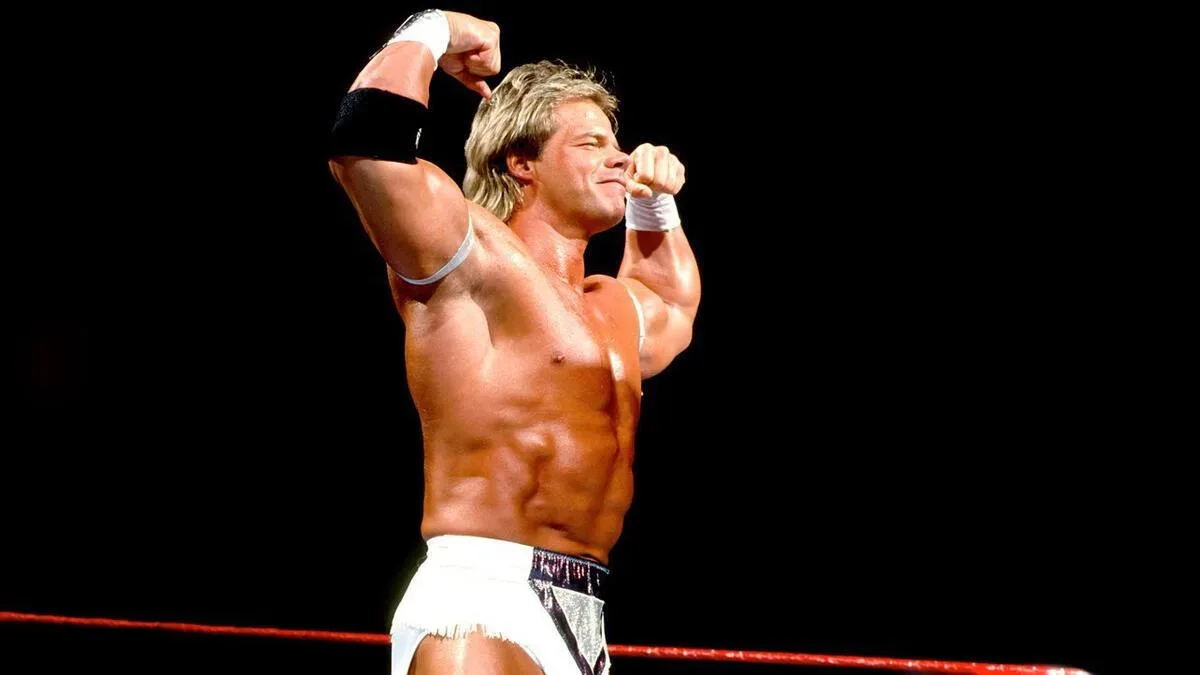
Lex Luger believes one of the more intriguing chapters of his WWE career ended before it had a real opportunity to develop.
Before becoming a central babyface figure in the company, Luger arrived with a markedly different presentation: The Narcissist. The persona leaned into Luger’s famed physique, his self-assurance, and an intentionally vain attitude. It also came with a built-in in-ring advantage that could have given the character a distinct identity for years: a surgically implanted metal plate in his arm.
Speaking during a recent appearance on Going Ringside, Luger reflected on his initial WWE run and said he would have welcomed a substantially longer stint as a heel. In his view, the character had the ingredients for an extended program, particularly because the plate could be used as a believable foreign-object advantage without relying on a weapon that could simply be confiscated at ringside.
“I came in as a heel, as a narcissist. It was great. I mean, Dr. James Anders, the world-renowned guy they interviewed, he put it in there. It’s still in there, and a titanium plate from here wrapped around your elbow. So I would have loved to have stayed heel longer when I first came in.”
For more background on this topic, read Nick Khan Highlights WWE’s Expanding Media Reach and AAA’s ‘Significant Audience Growth’.
Luger’s comments underline why the angle was so useful from a storytelling perspective. Wrestling villains have long looked for creative ways to gain a physical edge, whether through illegal objects, loaded equipment, interference, or rule-bending tactics. Luger’s character had a more unusual situation: the advantage was presented as a legitimate medical reality. The plate was surgically implanted, meaning opponents or officials could not realistically remove it to neutralize the threat.
That premise allowed Luger to use the elbow as a source of controversy. He could expose the protected area by lowering an elbow pad and turn a routine strike into something more dangerous. It was a simple visual cue for audiences and a practical way to establish the character’s willingness to exploit every available advantage.
A Heel Turned Babyface Quickly
Luger said the move away from The Narcissist was not because he lacked enthusiasm for the role. Instead, he explained that changing circumstances on the babyface side of the roster accelerated his transition. Luger pointed to major departures at the time, including Hulk Hogan, as part of the reason he was shifted more quickly than initially planned.
“I got switched really quick because things were happening in the baby face side of the company. When I came in, the guys were leaving. Hogan was one of them. So I got switched way quicker than they wanted to.”
That context is important to Luger’s recollection. The direction of a wrestling character is often shaped by broader roster needs rather than by the long-term potential of a particular gimmick. A promotion may enter a period where it needs a new top heroic act, a fresh challenger, or a recognizable name to occupy a changing position on the card. In those circumstances, even a villainous persona with plenty of room to grow can be altered quickly.
For Luger, the early change meant audiences did not get to see how far the company could have taken the combination of The Narcissist’s personality and the implanted plate. He remains convinced that the material was sustainable, not merely a short introductory device.
“I would have loved to have done The Narcissist thing because that was a great thing that they can’t take it out. It’s a foreign object, but you can’t take it out because it’s surgically implanted and it won’t cover an elbow pad. But as a heel, you love the way you can just kind of just pull that elbow pad down.”
The key detail was not simply that Luger possessed an apparent weapon. It was the contradiction at the heart of the angle. The plate could be framed as a foreign object in effect, while remaining something officials could not remove because it was medically necessary and part of his body. That gray area offered the kind of loophole that can make a heel character especially frustrating for opponents and fans.
In wrestling terms, it also provided an easy foundation for repeatable stories. A rival could protest the legality or danger of the elbow strikes. Officials could warn Luger about exposing the plate. Luger could insist that he had done nothing wrong while continuing to use the injury-related protection to his benefit. The issue could be revisited across feuds without requiring the same finish every time.
Luger Sees Years of Potential in the Character
Luger did not place a modest ceiling on the concept. He said he believes the heel presentation and the metal plate could have supported approximately three years of stories. That is a significant assessment from someone looking back at a character that ultimately gave way to a very different role in WWE.
“I mean, I could have got three years out of that run with that steel plate. That’s a great question. I would have loved to have had like a real run with The Narcissist with that steel plate in here. That would have been a great heel thing.”
His description also highlights a familiar truth about memorable wrestling personas: the strongest concepts often have both an immediate hook and a flexible mechanism for future conflict. The Narcissist had the immediate hook of Luger’s arrogance and physical presentation. The plate supplied an in-ring feature that could be brought into matches, interviews, confrontations, and rivalries whenever the character needed an extra layer of heat.
Had the role continued, Luger’s own assessment suggests the elbow pad could have become an increasingly recognizable signal. A crowd knows what it means when a villain deliberately reveals the part of the body tied to a controversial advantage. The anticipation can be as useful as the strike itself, because it gives the opponent a clear danger to avoid and gives the audience a reason to react before the move lands.
Instead, Luger’s WWE path soon changed course. That shift made him a prominent babyface at a consequential time for the company, but it also left The Narcissist as a relatively brief glimpse at a different version of Luger. His recent comments do not dismiss what followed; rather, they reveal the creative avenue he feels remained unexplored.
The Yokozuna Feud Remains Part of the Conversation
Elsewhere in the same interview, Luger discussed another notable aspect of that period: his feud with Yokozuna. Luger said there were discussions about him using the Torture Rack on Yokozuna during their rivalry. The possibility is notable because the Torture Rack was closely associated with Luger and represented one of the most dramatic displays of strength within his arsenal.
The Yokozuna program was a major part of Luger’s babyface positioning, making it especially interesting to compare with his thoughts on The Narcissist. One path involved Luger as an arrogant antagonist with a concealed-or-exposed physical advantage. The other centered on Luger as a heroic challenger confronting one of the era’s most imposing opponents. Both directions drew from Luger’s athletic presence, but they asked the audience to view that presence in entirely different ways.
Luger’s reflection ultimately offers a reminder that wrestling history is filled with characters whose potential can be measured not only by what happened, but also by what changing circumstances prevented from happening. The Narcissist was more than a nickname or a brief aesthetic. For Luger, it was a heel concept with a clear personality, a distinctive physical wrinkle, and a ready-made source of conflict that he believes could have lasted far longer.
While his WWE career is remembered through several different phases, Luger still sees the early villainous role as an unfinished opportunity. In his estimation, the titanium plate, the elbow pad, and the smug confidence of The Narcissist could have created a sustained heel run—one that never fully had the chance to reach its intended length.

Darryl Polo
Darryl Polo is a passionate wrestling fan covering WWE, AEW, TNA and beyond. He loves great rivalries, breakout stars and the moments that keep fans talking long after the bell. How we work.