
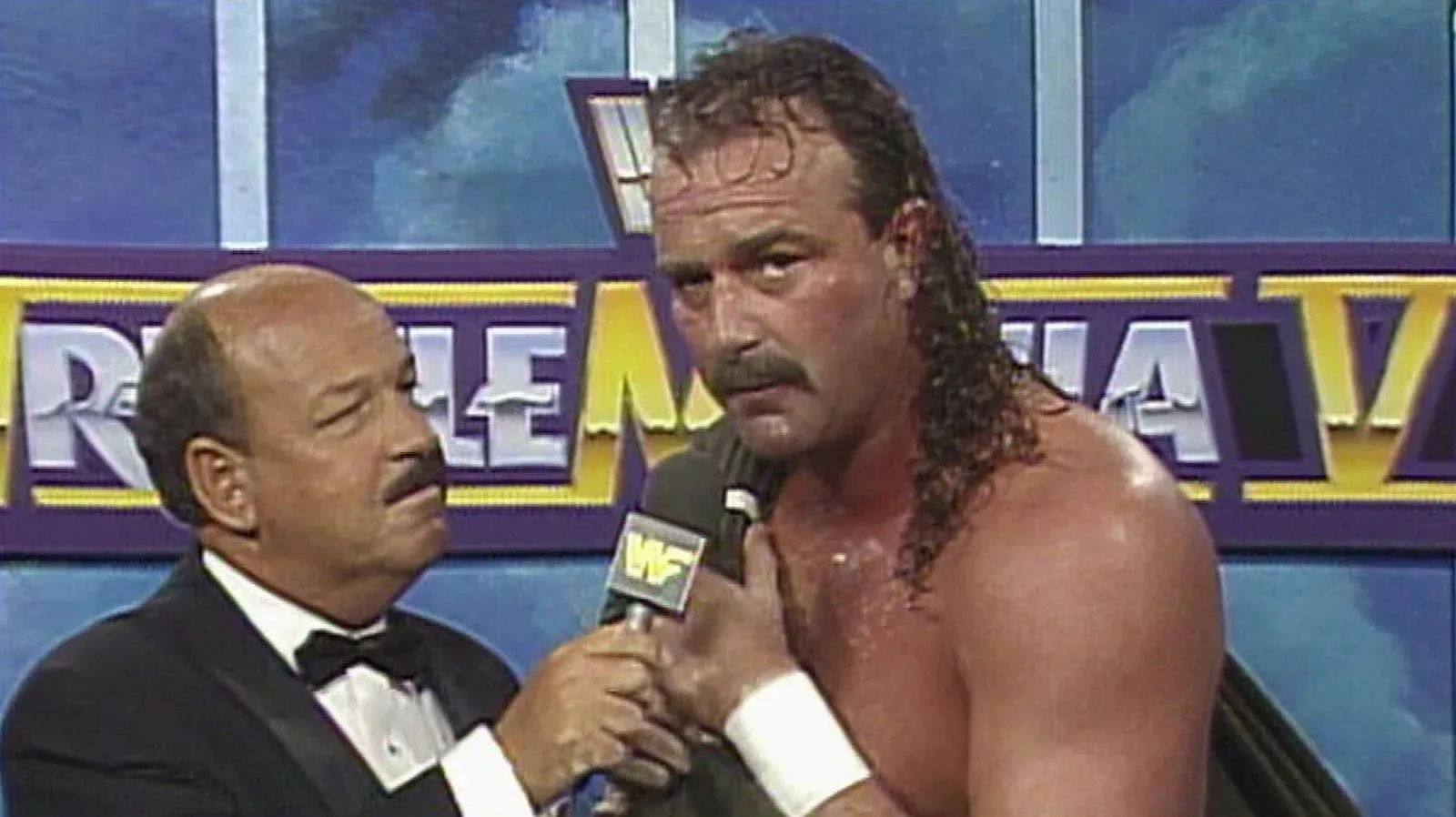
Jake “The Snake” Roberts has named Bray Wyatt and Randy Orton as the WWE stars who most remind him of himself, offering a concise but telling assessment of two wrestlers whose careers were built around menace, patience, and character-driven presentation rather than constant verbal volume.
During an interview with Nick Teodoro, Roberts was asked whether any wrestler he has watched in the modern era has brought his own work to mind. The WWE Hall of Famer did not offer a lengthy list.
“Bray Wyatt did,” Roberts said. “Randy Orton does. That’s about it. They’re different. Different. Randy’s got a lot [of similarities].”
Roberts’ answer puts Wyatt and Orton in rare company. While he acknowledged that neither performer is a copy of “The Snake,” he identified traits in both men that clearly connect to the approach that made Roberts one of the most memorable personalities in WWE history. His comments to Teodoro are especially notable because Roberts’ influence is frequently discussed whenever wrestling fans consider performers who used psychological tension, measured speech, and an unsettling presence to make audiences pay attention.
For more background on this topic, read Kacy Catanzaro Reflects on Earning NXT Women’s Tag Team Title Moment With Kayden Carter.
Why Roberts’ Comparison Carries Weight
Roberts never needed a WWE championship reign to establish his place in wrestling history. His legacy rests heavily on the distinctiveness of his character, the deliberate rhythm of his interviews, and his ability to make a few carefully chosen words feel more threatening than a louder or more animated promo. He was a wrestler who could create anticipation simply by slowing down and letting a moment breathe.
That style was central to the “Jake ‘The Snake’ Roberts” character. The snake was an unforgettable visual element, but it was not the entire act. Roberts’ real strength was his control of mood. His interviews often felt less like conventional wrestling promos and more like warnings. He did not have to explain every thought or promise every possible act of violence. The implication was often the point.
That is one reason the comparison to Wyatt makes sense. Throughout his WWE run, Wyatt became associated with unusual, layered character work and a promo style that was intentionally different from the direct, sports-centered language used by many of his peers. Whether he was delivering ominous sermons as the original Wyatt Family leader or presenting later evolutions of his persona, Wyatt placed atmosphere at the center of his presentation.
Roberts’ observation also underscores how uncommon that kind of commitment can be. Plenty of wrestlers have had dark characters, but a dark visual alone does not create the same effect. Roberts built his reputation by making audiences wonder what he meant, what he might do next, and whether his calmness was more dangerous than anger. Wyatt similarly made unpredictability and ambiguity important parts of his act.
Roberts Has Previously Discussed Wyatt’s WWE Presentation
This is not the first time Roberts has spoken about Wyatt. In a 2017 interview, the veteran expressed concern about the way WWE was presenting Wyatt at the time. Roberts questioned why a character positioned as a heel was being allowed to become so relatable and cheered by the audience.
That perspective reflects the wrestling philosophy of Roberts’ generation, particularly his belief in clear emotional roles and character consistency. In that view, a heel’s objective is not simply to entertain in the same way as a fan favorite. The heel is meant to provoke a reaction that creates a strong contrast with the hero of the story.
Modern wrestling audiences, however, have often responded differently. Fans regularly applaud standout performers regardless of alignment, especially when they admire a wrestler’s creativity, in-ring ability, or charisma. Wyatt’s popularity showed how a performer can connect with viewers even while playing a sinister role. Roberts’ criticism was not a dismissal of Wyatt’s talent; rather, it came from his concern that the audience response could alter the intended effect of the character.
The fact that Roberts has now named Wyatt as one of the only wrestlers who reminded him of himself adds further context to those earlier remarks. Roberts evidently saw substantial value in Wyatt’s presence and character instincts, even if he did not always agree with how WWE’s audience relationship with the character was being managed.
Randy Orton’s Similarities to “The Snake”
Roberts was even more direct about Orton, saying that the longtime WWE star has “a lot” of similarities to him. It is not difficult to see the traits Roberts may be referencing. Orton has spent much of his career portraying a calculated, cold, and highly controlled competitor. His most effective character work has often come when he has allowed silence, facial expressions, timing, and body language to do as much of the work as dialogue.
Orton’s presentation has rarely depended on frantic energy. Instead, his aura has frequently been built around the possibility that he could strike at any moment. The patience behind that approach is comparable to the emotional tension Roberts created during his own peak years. Both men have been able to make a pause feel intentional rather than empty.
There are clear differences as well. Orton’s career has been defined by his athleticism, major championship success, and longevity at the top level of WWE. Roberts came from a different era and constructed a persona with a more overtly psychological, eerie quality. Still, Roberts was careful to say that the wrestlers he named were “different,” while maintaining that Orton possessed many of the familiar elements.
In a previous 2017 discussion, Roberts also said he was interested in working with Orton. He believed there was an aspect of Orton’s character that could be further developed and expressed a desire to help him find it. Roberts stated at the time that he had contacted WWE on multiple occasions but did not receive a response, an experience that left him frustrated.
That history makes his current praise of Orton especially interesting. Roberts was not merely identifying surface-level similarities. His past comments indicated that he saw room for a creative collaboration and believed Orton had the foundation for something even more distinctive. While that collaboration did not materialize at the time, Roberts’ latest answer confirms that his view of Orton’s potential and his qualities as a performer has remained high.
Roberts’ Current WWE Connection
Roberts has since returned to WWE in a limited capacity. His involvement appears to be centered mainly on convention appearances, and he has clarified that he is not under contract with the company at this stage. Even without a full-time on-screen role, his association with WWE gives the company another connection to an influential period of its history and to a performer whose work still resonates in contemporary character discussions.
His comments about Wyatt and Orton also serve as a reminder that influence in wrestling is not always about reproducing a move set or using the same kind of catchphrase. Roberts’ impact is visible in performers who understand how to use restraint, how to establish a mood, and how to make audiences feel that a character has more beneath the surface than has been revealed.
Wyatt and Orton arrived at that kind of presentation through very different paths. Wyatt leaned into mystery, shifting identities, and theatrical storytelling. Orton developed the image of a disciplined and dangerous veteran whose calm exterior could disappear in an instant. Yet Roberts’ answer suggests both men shared a key quality: they made their characters feel like people with unsettling intentions, not simply wrestlers delivering lines before a match.
For Roberts, that distinction appears to matter. His body of work has long stood as an example of how a wrestler can create intensity without shouting, explain a threat without spelling it out, and make a persona endure without relying on championship gold. By naming Bray Wyatt and Randy Orton, Roberts pointed to two WWE performers who, in their own separate ways, carried forward some of those same principles.
Roberts’ quoted remarks were made in an interview with Nick Teodoro.
In pictures

Darryl Polo
Darryl Polo is a passionate wrestling fan covering WWE, AEW, TNA and beyond. He loves great rivalries, breakout stars and the moments that keep fans talking long after the bell. How we work.