
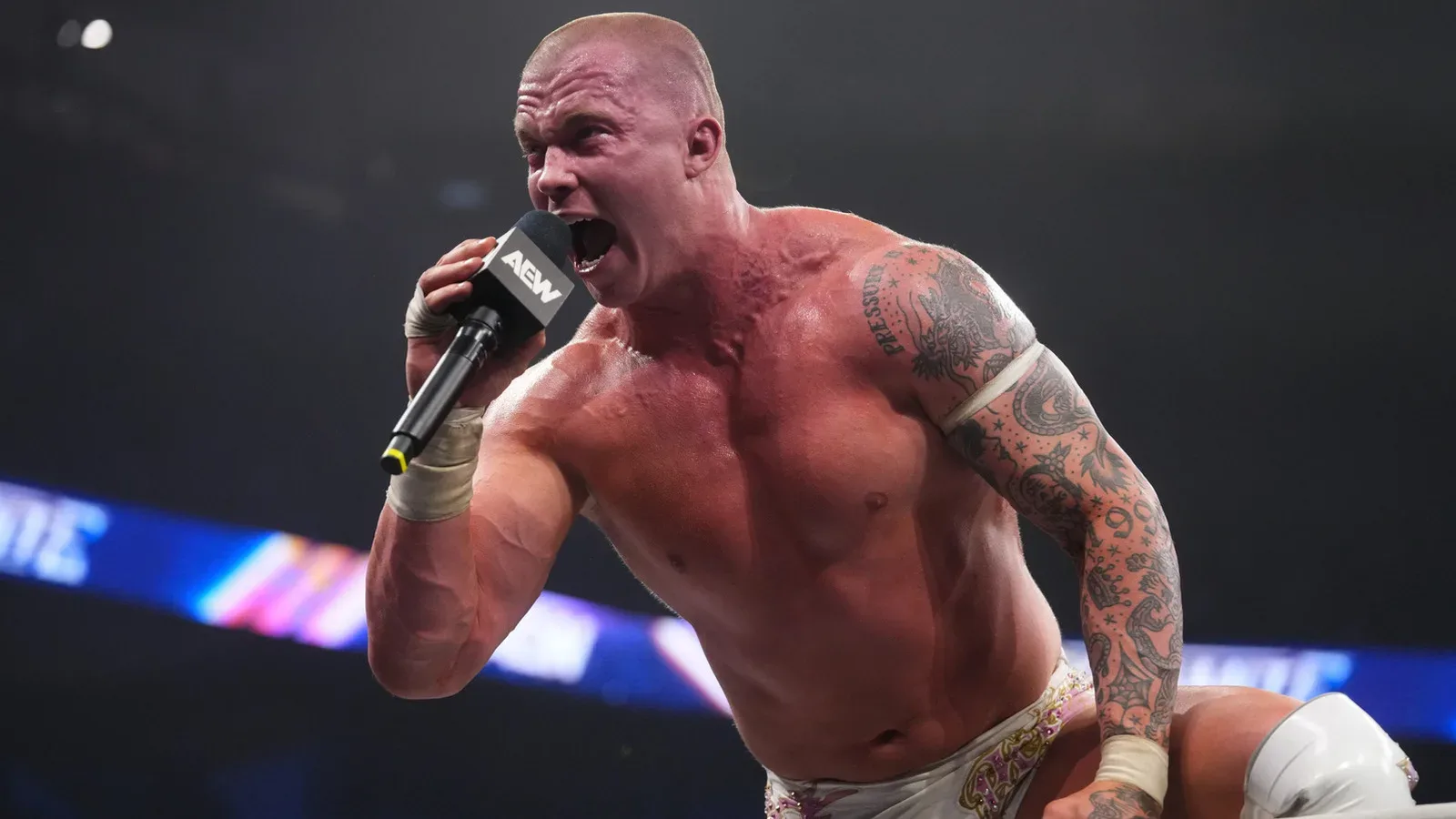
Kyle Fletcher has explained the deeply personal meaning behind one of his tattoos, revealing that a brief phrase on his wrist came from a significant conversation with fellow AEW wrestler Claudio Castagnoli.
Fletcher has a number of tattoos, but this one carries a different kind of importance. Positioned on his wrist and easy to miss beneath a watch, the tattoo is connected to advice Castagnoli gave him during the earlier portion of Fletcher's AEW career. The phrase is not simply a motivational slogan to Fletcher. It represents an answer to a difficult question he was asking himself at a pivotal point in his professional life: whether reaching a major goal would ever truly feel like enough.
For Fletcher, arriving in AEW was unquestionably a major accomplishment. Yet he admitted that success did not immediately bring the sense of fulfillment he expected. That disconnect led him to publicly share his thoughts online, wondering whether he would ever reach a point where his achievements felt sufficient.
“That was a bit of advice I got from Claudio Castagnoli,” Fletcher said of the wrist tattoo. “It was very... it was earlier on in my career at AEW, and I had put up something online that was something along the lines of ‘Will it ever be enough? Will it ever feel like it’s enough?’”
For more background on this topic, read Brian Cage Says AEW Pay-Per-Views ‘Smash’ WWE’s Every Time.
Fletcher described the thought process behind that message as a moment of uncertainty rather than a rejection of what he had accomplished. Getting to AEW was a huge step for him, but the internal feeling did not entirely match the importance of that milestone.
“Because at the time, I feel like I was going through a little bit of... a little bit of success? Obviously I had gotten to AEW. To me, obviously, that was huge. But I guess I didn’t feel fulfilled is the right word. And I posted that, because that’s how I was feeling. ‘Will it ever feel like it’s enough?’”
Castagnoli saw Fletcher's post and later approached him backstage at an AEW event. What followed was a longer conversation about the nature of ambition and the difficulty of feeling satisfied in a profession built around constant improvement, competition and the pursuit of a bigger opportunity.
Castagnoli's Answer Stayed With Fletcher
The advice that resonated with Fletcher was not based on the promise that a wrestler will eventually feel fully satisfied with their work. In fact, Castagnoli's message appears to have started with the opposite idea: complete satisfaction may never arrive. Instead of treating that reality as discouraging, Fletcher asked what allows someone to continue striving when there is always another goal ahead.
It was Fletcher's follow-up question that produced the response now memorialized on his wrist. He wanted to know what keeps a person working hard when the feeling of having done enough remains elusive.
“I was like, ‘So if that’s the case, you’re striving for something, like how do you keep going?’” Fletcher recalled. “‘Like what is the thing that keeps pushing you to work so hard?’ And he stood there for a second, and he thought about it, and he said the words ‘It’s who we are.’”
Those four words became the central message Fletcher took away from the conversation. Rather than defining hard work as a temporary response to an external target, Castagnoli's answer framed it as part of personal identity. For Fletcher, that perspective helped explain why success alone had not quieted his drive. The impulse to improve, compete and commit himself to wrestling was not just about reaching the next destination; it was tied to who he believes he is.
“And it stuck with me a lot, because this is who I am,” Fletcher said. “I work so hard cause this is who I am. If I didn’t work so hard, if I didn’t love this, if I didn’t have that passion, I wouldn’t feel like the same person. I wouldn’t be who I am, so that’s one of the things that keeps me going.”
A Reminder of the Difference Between Success and Fulfillment
Fletcher's explanation touches on a familiar tension for performers at every stage of their careers. A major signing, a prominent match or a breakthrough opportunity can be a dream realized, but reaching that point does not necessarily end the desire to accomplish more. In wrestling, where performers are evaluated in front of live crowds and where the next show quickly follows the last one, there is rarely much time to settle into an achievement before another challenge emerges.
That dynamic can make fulfillment complicated. A wrestler may understand that a major opportunity is meaningful while still feeling a need to prove more, develop further or reach a different personal standard. Fletcher was clear that AEW was a major accomplishment to him. His uncertainty was not about minimizing that milestone. It was about recognizing that achievement and contentment are not always the same thing.
Castagnoli's answer offered a framework that did not require Fletcher to force himself into feeling complete. If the work comes from identity and passion, then the lack of a final finish line does not have to be a problem. The desire to keep moving is part of the reason for doing it in the first place.
That is why the tattoo matters beyond its small placement. It serves as a physical reminder of a personal principle Fletcher can carry with him. The phrase reflects the idea that motivation does not need to depend entirely on awards, status or a single career-defining destination. It can come from the commitment to the craft itself.
The Value of Backstage Perspective
The story also highlights the value of conversations that happen away from the ring. Wrestling is a public profession, with matches, interviews and storylines presented to an audience, but performers also spend extensive time around colleagues who understand the pressures of the job. A veteran's response to a younger wrestler's uncertainty can have a lasting effect, especially when it addresses a question larger than any one match or event.
In this case, Castagnoli did not offer Fletcher a shortcut to certainty. His response instead acknowledged the enduring nature of ambition. Fletcher's reaction shows why the advice landed: it gave language to a feeling he was already experiencing. He did not need to stop wanting more in order to appreciate where he was. He could accept that the desire to work hard is inseparable from his connection to wrestling.
For Fletcher, that realization became permanent. The tattoo may be understated and often covered by his watch, but its meaning is direct. It is a reminder of a conversation that arrived at an important time in his AEW career, and of the mindset he says continues to push him forward.
“It’s who we are” is therefore more than a phrase Fletcher heard backstage. It is the answer he found to his own question about whether success will ever feel like enough. Rather than waiting for a final sense of arrival, Fletcher has embraced the work, the passion and the continued pursuit of growth as essential parts of who he is.
In pictures

Darryl Polo
Darryl Polo is a passionate wrestling fan covering WWE, AEW, TNA and beyond. He loves great rivalries, breakout stars and the moments that keep fans talking long after the bell. How we work.