
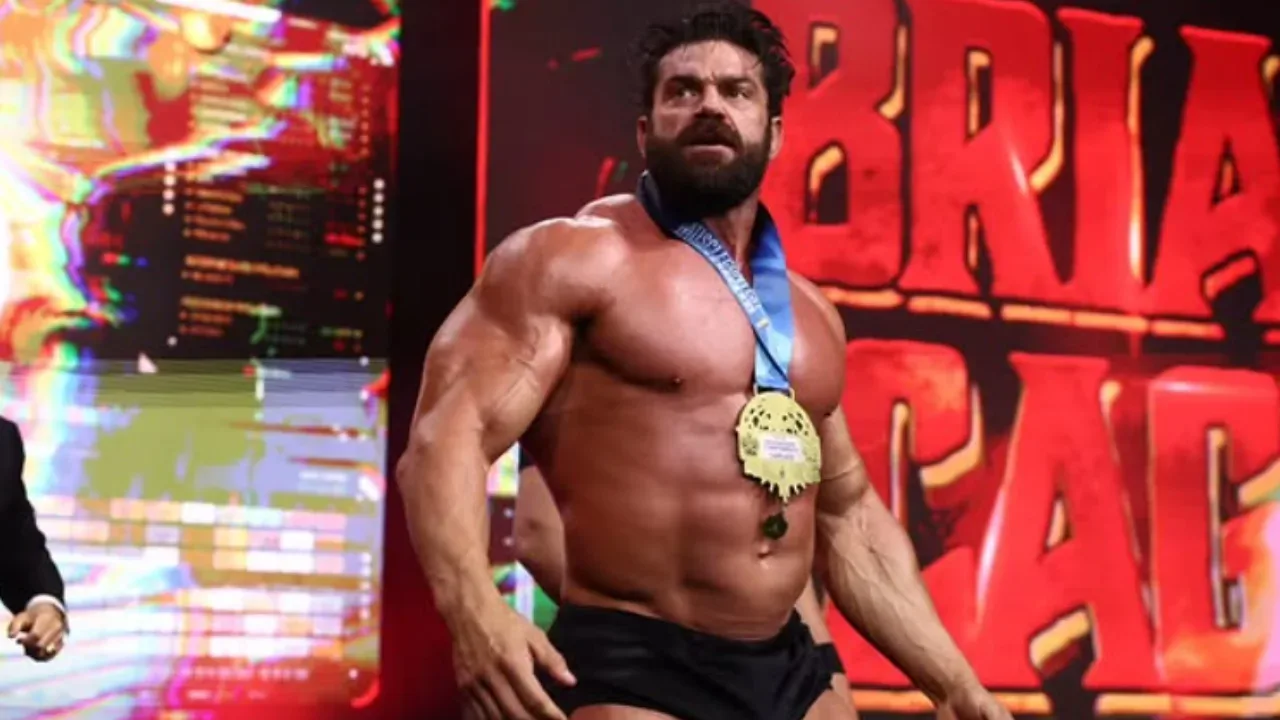
Brian Cage has offered an emphatic defense of All Elite Wrestling’s pay-per-view product, arguing that AEW’s major events consistently outperform WWE’s Premium Live Events when the two are compared directly.
Appearing on The @smoothvega Podcast, Cage discussed the contrast he sees between the two leading U.S. wrestling promotions. While making clear that he was not intending to disparage WWE, the veteran powerhouse left little room for doubt about which company he believes delivers the stronger pay-per-view experience.
“It’s second to none,” Cage said of AEW’s in-ring product. “You take any WWE pay-per-view — and not even trying to throw shade at WWE — any pay-per-view of theirs and throw any pay-per-view of ours against theirs and ours smashes theirs every time.”
Cage’s comments are a strong endorsement of the element AEW has most regularly presented as a central part of its identity: lengthy, athletic, high-impact wrestling matches on major cards. AEW has built much of its reputation around an in-ring-focused approach, and Cage believes that approach gives the company a clear advantage when it comes to its biggest events.
For more background on this topic, read Brian Cage Discusses PED Use, Steroid Stigma And Wrestling’s Health Conversations.
Cage Draws a Clear Pay-Per-View Comparison
The comparison between AEW and WWE is inevitable within the modern wrestling landscape. Both companies run major events designed to command attention beyond weekly television, and both have extensive rosters capable of producing high-level matches. Their overall presentation, however, has often been viewed through very different lenses by fans.
WWE’s Premium Live Events are positioned as major tentpole attractions within a broader entertainment-driven format. The company’s events can include marquee title bouts, celebrity involvement, large-scale production, and storylines that have developed over weeks or months of television. WWE’s reach and presentation give its biggest shows a distinct sense of scale.
AEW, meanwhile, has frequently emphasized match quality and the appeal of seeing wrestlers given substantial time to perform. That does not mean AEW events are without major stories or championship stakes, but Cage’s remarks reflect the view that AEW’s greatest competitive strength lies in its bell-to-bell action.
For Cage, that strength is decisive. His statement was not simply that AEW can compete with WWE on pay-per-view. He argued that AEW wins that comparison every time.
‘Second to None’ in the Ring
The phrase “second to none” is particularly significant because it speaks to how Cage sees AEW’s core product rather than a single match, a particular card, or one standout event. He framed the company’s in-ring work as the defining feature that separates it from its competition.
Cage is well suited to discuss that element of AEW. His own style has long been built around a combination of power, explosiveness, and athleticism. He is known for performing with the physical intensity of a powerhouse while also incorporating movement and offense more often associated with smaller wrestlers. That style fits naturally into a promotion where high-level athletic performances are regularly positioned as a major attraction.
His comments also arrive from the perspective of a wrestler who has spent years working within AEW’s environment. Cage joined the company in 2020 and has remained part of its roster since then. In 2024, he signed a long-term contract extension, further establishing his connection to AEW’s future.
That tenure means Cage has been present for a substantial portion of AEW’s history as a national promotion. He has seen the company’s presentation evolve, its roster expand, and its major-event schedule continue to develop. When Cage praises AEW’s pay-per-views, he is doing so as someone invested in the company and familiar with what it seeks to deliver in the ring.
A Subjective Debate With a Familiar Divide
Comparing AEW and WWE pay-per-views is ultimately subjective. Different viewers value different aspects of a wrestling show. Some prioritize match length, pace, athletic difficulty, and a card’s overall in-ring consistency. Others place greater importance on character development, presentation, mainstream visibility, or the payoff to long-term stories.
Cage’s assessment clearly comes from the former perspective. He focused on the wrestling itself and made the case that AEW’s output in that area is unmatched. It is a viewpoint shared by many fans who look to AEW’s major events for ambitious matches and a sustained emphasis on the action inside the ropes.
At the same time, Cage took care to preface his comparison by saying he was not trying to “throw shade” at WWE. That qualification matters because the AEW-WWE discussion can quickly become framed as an all-or-nothing argument. Cage did not dispute WWE’s position in the industry or dismiss its product wholesale. Instead, he made a specific claim about the quality of the companies’ respective pay-per-view cards.
Even with that caveat, it was still a bold claim. Saying AEW “smashes” WWE every time sets a very high standard and leaves no room for exceptions. It is the kind of statement likely to generate debate among fans of both promotions, particularly because WWE and AEW often aim at different priorities despite operating in the same marketplace.
AEW’s Major-Event Identity
AEW’s pay-per-views have become an important measuring stick for the promotion. Weekly programming carries the responsibility of advancing stories and spotlighting a large roster, but pay-per-view cards are where the company has traditionally looked to provide its most complete in-ring showcases.
That philosophy has helped create a clear expectation around AEW’s biggest nights. Fans often expect championship matches, high-stakes grudge contests, and bouts that are given the time needed to build into major performances. Cage’s comments align directly with the idea that those events are where AEW is at its best.
The company’s emphasis on a deep wrestling roster also feeds into that expectation. AEW has regularly featured performers with varied backgrounds, styles, and strengths, creating opportunities for matchups that can appeal to fans of power wrestling, technical wrestling, aerial offense, hard-hitting exchanges, and tag team action. Cage’s own blend of size and agility is one example of the range available within that environment.
Of course, presenting an acclaimed in-ring product is not the only challenge faced by a national wrestling company. Building feuds, structuring television, maintaining audience interest, and making individual matches feel essential are all part of the larger equation. Cage’s remarks did not attempt to settle every part of the AEW-versus-WWE discussion. They were centered squarely on the quality of the major-event wrestling.
Cage Remains Firmly Behind AEW
Since arriving in AEW in 2020, Cage has been a recognizable presence because of his distinctive physique and explosive style. His 2024 long-term extension confirmed that AEW sees continuing value in him, while also signaling that Cage intends to remain part of the promotion’s plans.
His strong public backing of AEW’s pay-per-view product is therefore unsurprising, but the directness of his wording stands out. Rather than offering a diplomatic answer about the companies serving different audiences, Cage made his own preference unmistakable. In his view, an AEW pay-per-view is superior when placed head-to-head with any WWE Premium Live Event.
That assessment will remain open to interpretation among viewers, as comparisons between the two promotions always are. WWE and AEW each bring different creative philosophies to their major events, and fans will continue to judge them based on the aspects of wrestling they value most.
For Cage, though, there is no close contest. He believes AEW’s in-ring product is “second to none,” and he sees the company’s pay-per-views as the clearest proof of that belief.
Darryl Polo
Darryl Polo is a passionate wrestling fan covering WWE, AEW, TNA and beyond. He loves great rivalries, breakout stars and the moments that keep fans talking long after the bell. How we work.