
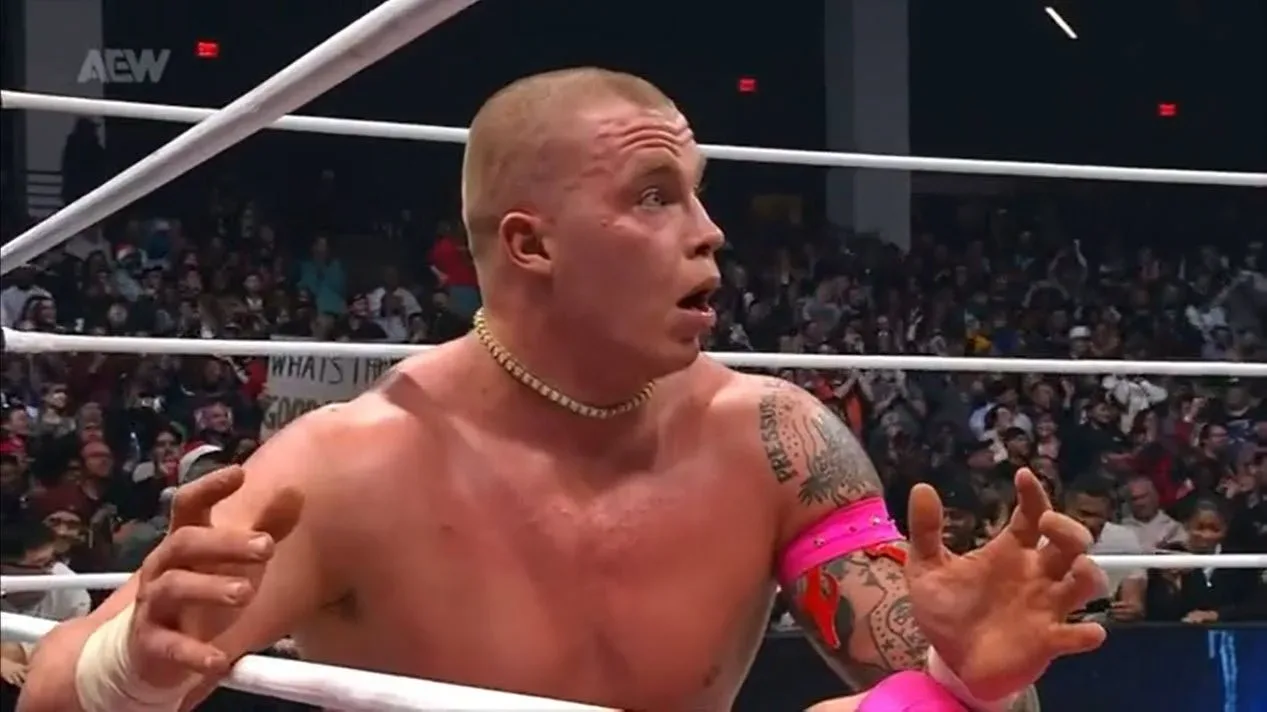
Kyle Fletcher has taken part in his share of high-risk moments in AEW, but one particular bump stands above the rest in his mind.
Speaking on Westwood One Sports Night, Fletcher was asked to name the nastiest bump he has absorbed during his professional wrestling career. The AEW wrestler immediately pointed to a suplex delivered by Mark Briscoe, a move that sent Fletcher from the top of the guardrail down to the floor.
The landing, Fletcher explained, drove him directly onto his tailbone and produced a sensation serious enough that he had to remain down and determine whether he was physically able to continue. While the match ultimately went on, Fletcher’s recollection offers a candid look at the split-second calculations wrestlers can face after a difficult impact.
A Guardrail Bump Fletcher Has Not Forgotten
Fletcher said the Briscoe suplex is the first moment he thinks of whenever he is asked about the roughest bump he has taken. He noted that footage of the spot makes clear how much the landing affected him, particularly through the immediate expression on his face.
For more background on this topic, read Billy Gunn Calls Triple H’s 2019 AEW Remark at WWE Hall of Fame a ‘Dick Move’.
“The one that comes to mind when I’ve been asked this question before is I took a suplex from the top of the guard rail to the floor from Mark Briscoe,” Fletcher said.
He described landing squarely on his tailbone rather than distributing the force in a more favorable way. Fletcher said it felt as though his “insides exploded,” using graphic language to convey the intensity and unusual nature of the pain he experienced in the aftermath.
“It felt like I was pissing blood and my insides fell out my butthole at the same time,” Fletcher said. “It was the weirdest feeling ever.”
Fletcher did not describe a diagnosed injury from the bump, nor did he provide a date for the match during the discussion. What he did make clear was that the pain was immediate enough to interrupt his normal rhythm and force him to pause before making a decision about the rest of the contest.
The Decision to Continue
Rather than instantly rising after the suplex, Fletcher said he asked for a moment. He remained on the ground for roughly 30 seconds, concentrating on whether his body was in a condition to keep performing.
“I literally just had to go, ‘Give me a minute,’ and I had to make sure that I was okay,” Fletcher said.
That brief period was not merely a dramatic beat in a match. In Fletcher’s telling, it was a genuine check-in following an impact that had left him uncertain about what he was feeling. He recalled asking himself a simple but consequential question: “Can I keep wrestling?”
After taking that time, Fletcher decided he could continue. “Then I went, ‘Yeah, I think I can keep wrestling,’ and then I got up and kept wrestling,” he said.
The story underlines the difficult line that performers walk in a sport built around physicality, timing and trust. A wrestler may know the planned direction of a match, but a hard landing can change the situation instantly. When that happens, the ability to communicate, evaluate the moment and adjust becomes as important as executing the next move.
Fletcher’s High-Risk Reputation
Fletcher has developed a reputation as a wrestler willing to endure punishment in major situations. His body of work has included dangerous-looking falls from elevated structures and hard landings outside the ring, the type of visuals that can draw a loud reaction while also placing enormous pressure on the performers involved.
That approach has made Fletcher’s matches feel urgent and physically charged. It has also meant that his answer to the question about his roughest bump comes from a substantial collection of painful moments rather than an isolated incident.
The guardrail suplex with Briscoe stood out because of the specific way Fletcher landed. A move from an elevated surface to the floor already presents obvious risks, but he emphasized that the tailbone-first impact changed the experience completely. The pain was not simply the familiar sting associated with a fall; it was disorienting enough that Fletcher struggled to immediately identify whether he was able to proceed.
His comments are also a reminder that the audience’s view of a major spot is only one part of the story. Fans can see the height, hear the collision and watch a performer react. They cannot always know how the wrestler is processing the impact in real time, or whether a performer is taking a moment to ensure that continuing is the right call.
Mark Briscoe’s Role in a Memorable Moment
Mark Briscoe has long been associated with a hard-hitting, emotionally intense style, and the suplex Fletcher recalled fits the kind of uncompromising action both men can bring to a wrestling match. Fletcher did not frame the spot as a complaint about Briscoe or suggest that anything improper occurred. Instead, he singled it out because of the result of the landing and the extraordinary sensation it caused.
That distinction matters. Professional wrestling relies on cooperation between opponents, even in its most violent-looking sequences. Wrestlers work together to create impact, protect one another where possible and adapt when a move does not land as intended. Fletcher’s account focuses on the aftermath of a particularly unforgiving collision, not on assigning blame.
For Briscoe, the mention adds another chapter to a career defined by intensity. For Fletcher, it appears to be a benchmark moment: the bump against which he measures other painful experiences when discussing the physical demands of his profession.
The Reality Behind the Spectacle
There is an unavoidable contrast at the heart of Fletcher’s story. The spot was part of a professional wrestling match, designed to heighten the stakes and contribute to the audience’s experience. Yet for Fletcher, the immediate aftermath became an intensely personal physical test.
His account makes the reality of that test plain. He did not simply sell the pain and move to the next sequence. He stopped, evaluated himself and only then made the choice to get back up. The fact that he was able to resume does not lessen the seriousness of the moment as he remembers it; if anything, it explains why the suplex has remained so vivid.
Fletcher’s willingness to speak frankly about the bump also gives fans a clearer sense of the resilience required from performers. The visible result was a wrestler eventually continuing the match. The unseen part was the half-minute of uncertainty, the internal assessment and the need to trust his own judgment before returning to action.
Looking Back at a Career-Defining Bump
Fletcher has not been reluctant to take spectacular risks, and that willingness has been an important part of his presentation in AEW. But when asked to identify the one bump that affected him most severely, he did not point to a cage fall or a broadly remembered stunt. He chose a single suplex from Mark Briscoe, from the top of a guardrail to the floor, and the tailbone-first landing that followed.
It is a stark answer, delivered with Fletcher’s unmistakably blunt sense of humor and honesty. More importantly, it captures the reality behind the highlights: even experienced wrestlers can find themselves on the mat, taking stock of their bodies and wondering whether the match can continue.
On this occasion, Fletcher decided that it could. He got up, carried on and added another example of the toughness that has become central to his reputation. Still, the Briscoe suplex remains the bump he cannot forget.

Darryl Polo
Darryl Polo is a passionate wrestling fan covering WWE, AEW, TNA and beyond. He loves great rivalries, breakout stars and the moments that keep fans talking long after the bell. How we work.